Introduction
A new provider joins your network. The credentialing packet is complete, references are verified, and then one form stalls everything: the training attestation. Without a signed attestation confirming completion of required training, the provider can't move to active status.
This isn't a one-time hurdle. Attestation forms resurface at every recredentialing cycle and each time a payer or accrediting body updates its requirements.
Medicare, state Medicaid managed care plans, and accreditation organizations all treat this documentation as ongoing proof of compliance, reviewed continuously rather than filed once and forgotten.
Get it wrong, and you're looking at delayed activation, audit findings, or worse.
This guide breaks down everything you need to know about provider training attestation forms:
- What the form actually is and why it exists
- Why regulators and payers require it
- What information it must contain
- Who needs to sign it
- How to replace scattered spreadsheets and email chains with a reliable process
Key Takeaways
- Training attestations require a personally signed declaration from the provider, not staff
- Attestation and certification are related but legally distinct credentialing concepts
- CMS, state Medicaid plans, and accreditors all link attestation to credentialing cycles
- Manual spreadsheet tracking creates audit risk that automated platforms close
What Is a Provider Training Attestation Form?
A provider training attestation form is a signed document in which a provider personally confirms they've completed required training, such as HIPAA privacy and security, compliance program basics, fraud/waste/abuse (FWA), or cultural competency modules.
The word "attestation" carries legal weight. It's a formal declaration that a stated fact is true, and depending on the program, it may carry contractual or regulatory consequence if that declaration turns out to be false. This is different from simply checking a box on an internal training log.
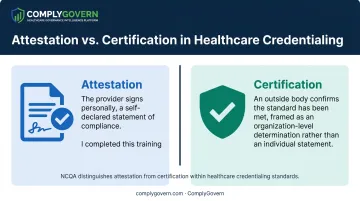
Attestation vs. Certification: What's the Difference?
These two terms get used interchangeably, but they aren't the same thing:
- Attestation is self-declared. The provider states, "I completed this training," and signs their name to it.
- Certification typically involves third-party verification, with an outside body confirming that a person or organization meets a defined standard.
NCQA's credentialing framework illustrates this distinction well. A practitioner's signed attestation is a personal representation about their application. NCQA Certification, on the other hand, evaluates whether a credentialing organization's verification processes meet NCQA's own standards, an entirely different, organization-level determination.
Why the Provider Must Sign Personally
Most payer and accreditation requirements build in personal accountability. A compliance officer or credentialing coordinator can't sign on the provider's behalf. The whole point of the form is that the individual provider, not their staff, is vouching for their own training completion.
A typical attestation statement follows a simple pattern:
"I, [Provider Name], attest that I have completed the required training on [date] covering [topics] and understand my obligations under [program/policy name]."
That single signature carries real consequences. A false attestation can expose both the provider and the organization to contractual penalties, regulatory scrutiny, or fraud liability, depending on the payer contract or accreditation standard involved.
Why Provider Training Attestation Forms Matter for Healthcare Compliance
Training documentation isn't optional under federal rules. CMS Conditions of Participation require hospitals to document that staff completed required training and demonstrated competency, and the regulation requires this documentation to live in personnel records, not simply as verbal confirmation (42 CFR 482.13).
Accrediting bodies extend this further. Organizations like Joint Commission, DNV, and CIHQ expect documented proof of training and competency during credentialing and recredentialing reviews.
State Medicaid managed care plans formalize similar requirements through provider notices. Some plans, for example, require newly contracting Medi-Cal providers to complete specific training and submit a signed attestation before their contract activates.
What Happens When Attestation Is Missing
Skipping or delaying an attestation form isn't a small administrative miss. It can trigger:
- Delayed contracting or credentialing — providers can't see patients under the network until the file is complete
- Network termination risk — some state Medicaid programs terminate enrollment entirely if recredentialing isn't completed by the deadline
- Survey citations — missing documentation shows up as a deficiency during CMS or accreditor site visits
- Fragmented visibility — when compliance, credentialing, and quality teams each track attestation separately, nobody has a full picture
Beyond the compliance mechanics, this documentation connects directly to patient safety. Training on fraud, HIPAA, and quality standards isn't busywork: it reduces the likelihood of downstream incidents that create real liability exposure for the organization.
This fragmented visibility is exactly why platforms like ComplyGovern centralize attestation tracking, credentialing files, and quality data in one system, replacing scattered spreadsheets with a single source of truth.
Key Components of a Provider Training Attestation Form
A well-built attestation form isn't complicated, but it needs specific elements to hold up under audit scrutiny.
Identification and Training Content
Every form should capture:
- Provider identification: name, NPI, specialty, facility or department affiliation
- Training topics covered: HIPAA privacy/security, compliance program overview, FWA, cultural competency, infection control, or Model of Care training for special needs plans
- The attestation statement itself, including any regulatory citation it references
Signature, Supporting Evidence, and Retention
The form also needs clear rules around execution and proof:
| Component | What It Should Specify |
|---|---|
| Signature requirement | Whether electronic signatures are accepted or a wet signature is mandated |
| Supporting documentation | Certificates of completion, training logs, or LMS records to retain alongside the form |
| Retention period | How long the payer, state, or accreditor requires the file to be kept |
| Audit trail | Who accessed or modified the record, and when |
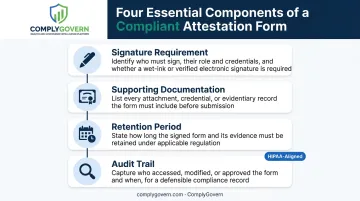
On the signature question, federal law under the ESIGN Act establishes that electronic signatures can't be denied legal effect simply because they're electronic. Individual payers and accreditors still set their own acceptance rules, so confirm expectations before assuming e-signatures work across the board.
Retention periods vary by program. Rather than guessing, match your retention schedule to the specific payer contract, state Medicaid requirement, or accreditation standard governing that provider relationship.
Who Must Complete It & When
New provider contracts are the most common trigger. Note the distinction: a provider signing a brand-new contract needs a fresh attestation, but a provider simply updating demographic information or changing office locations typically doesn't need to redo the whole process.
Beyond initial contracting, attestation requirements recur at predictable points:
- Recredentialing cycles: according to NCQA's credentialing standards, practitioner recredentialing occurs at least every three years, and attestation renewal typically aligns with that same timeline
- Policy or regulatory updates: if a payer changes its training requirements mid-cycle, providers may need to re-attest before the next scheduled recredentialing date
- Network affiliation changes: moving between delegated entities, such as joining a new IPA or medical group, can reset attestation obligations
The Role of Delegated Credentialing Entities
When a health plan delegates credentialing authority to an IPA or medical group, that entity typically becomes responsible for collecting and submitting attestation forms on behalf of its affiliated providers. This delegation doesn't remove the payer's oversight responsibility — it just shifts who's doing the day-to-day collection work.
Best Practices for Managing Provider Training Attestation at Scale
If your organization is still tracking attestation status in spreadsheets, shared drives, and email threads, you already know the problem: nobody has a reliable, real-time answer to "which providers still need to attest?"
That gap gets worse as networks grow. A credentialing coordinator might know the status for providers they're personally tracking, but compliance officers and boards often can't see the full picture until an audit forces the issue.
What Actually Fixes This
A few structural changes make the biggest difference:
- Centralize everything: attestation status, training records, and credentialing files should live in one system, not three
- Automate deadline reminders: recredentialing cycles shouldn't rely on someone remembering to check a calendar
- Build in escalation workflows: if an attestation isn't submitted within a set window, the right person should be notified automatically, not after the deadline passes
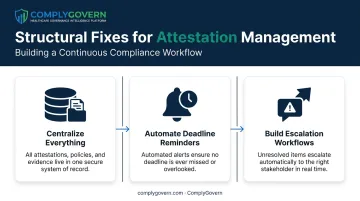
This is the gap ComplyGovern's platform is built to close. Its Governance Intelligence Engine connects training, policy, and credentialing activity within the Medical Staff Governance and Policy & Document Governance modules.
Attestation records don't sit in isolation: they're linked to the broader compliance evidence chain that compliance officers and boards rely on during audits and site visits.
The payoff extends beyond less manual tracking: continuous survey readiness. Your organization won't scramble to reconstruct attestation records the week before a site visit, because the evidence has stayed current all along.
Frequently Asked Questions
Is attestation the same as certification?
No. Attestation is a self-declared statement of fact, such as "I completed this training." Certification involves a third party verifying that a person or process meets a defined standard.
What does attestation mean?
Attestation is a formal, signed declaration confirming that a stated fact is true. In healthcare credentialing, it often carries legal or contractual accountability if the declaration proves false.
What is an example of an attestation statement for training?
A typical statement reads: "I, [Provider Name], attest that I completed the required training on [date/topics] and understand my obligations under [program/policy]." Exact wording varies by payer or accreditor.
How often must providers complete training attestation?
Frequency depends on the specific payer or accreditor, but it commonly aligns with initial credentialing and recurring recredentialing cycles — often every three years under NCQA standards.
What happens if a provider doesn't submit the attestation form?
Consequences include delayed or denied contracting, network inactivation, or compliance findings during a payer or accreditor audit. Some state Medicaid programs terminate enrollment entirely if the deadline passes.
Are electronic signatures accepted on attestation forms?
Many payers and platforms accept electronic signatures under the ESIGN Act's legal framework, but requirements vary. Always confirm acceptance rules with the specific contracting payer or accrediting body.