Meanwhile, most compliance teams manage this complexity across spreadsheets, shared drives, and departmental apps that don't talk to each other. Policies get updated in one place but not another. Version control breaks down. Nobody's quite sure which document is current when a surveyor walks in.
This guide covers the pillars every compliance program needs, the policy categories that show up in nearly every survey, and how to write and maintain policies that actually hold up under scrutiny.
Key Takeaways
- OIG's seven core program elements form the blueprint for every compliance policy framework
- Infection control, HIPAA, credentialing, and patient rights policies are near-universal CMS requirements
- Strong policies are standardized, actively trained on, and reviewed on a fixed cycle, not written once and shelved
- Centralizing policy management in one system closes version-control gaps and strengthens survey readiness
What Is Healthcare Compliance and Why Policies Matter
Defining Healthcare Compliance
Healthcare compliance means adherence to applicable federal and state laws, plus the ethical standards and codes of conduct an organization sets for itself.
The Department of Health and Human Services' Office of Inspector General frames this clearly in its General Compliance Program Guidance. A code of conduct should communicate the organization's mission, ethical requirements, and its commitment to following federal and state law.
Written policies are what turn that commitment into something staff can actually use. A statute doesn't tell a nurse how to document a medication error. A policy does. Policies and procedures are the translation layer between "the law says X" and "here's what you do on Tuesday at 2 p.m."
Why Strong Policies Are Non-Negotiable
OIG's guidance identifies specific risk areas every compliance program should address through policy, including:
- Billing and coding accuracy
- Sales and marketing practices
- Quality of care standards
- Patient incentive arrangements
- Relationships with physicians, vendors, and referral sources
The stakes for getting this wrong are real. CMS warns that violations of federal fraud-and-abuse laws can trigger claim denials, civil monetary penalties, program exclusion, and in serious cases, criminal fines or imprisonment. The civil False Claims Act alone permits treble damages plus a per-claim penalty adjusted annually for inflation.
None of this means a weak policy automatically causes a violation. But a policy that's unclear, outdated, or unenforceable gives staff no roadmap—and no roadmap means no defense when something goes wrong.
The Core Pillars of an Effective Healthcare Compliance Program
OIG's General Compliance Program Guidance lays out seven foundational elements every compliance program should have in place. Think of these as the infrastructure that written policies sit on top of.
- Written Policies, Procedures & Standards of Conduct — the documented backbone defining expectations for billing, referrals, PHI handling, and other high-risk areas
- Compliance Leadership & Oversight — a designated compliance officer, an active compliance committee, and board-level visibility into program performance
- Effective Training & Education — role-specific instruction so staff understand not just what a policy says, but how to apply it in their actual job
- Open Communication & Non-Retaliation Reporting — hotlines and reporting channels that surface problems before they become citations
- Auditing, Monitoring & Enforcement — ongoing internal reviews, consistent discipline, and prompt corrective action when gaps surface
- Risk Assessment — identifying and prioritizing the areas most likely to draw regulatory scrutiny
- Responding to Detected Offenses — a defined process for investigating, correcting, and reporting issues when required
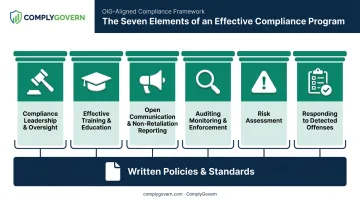
Written policies come first on that list for a reason: everything else depends on having clear, current documentation to audit against, train on, and enforce. ComplyGovern's policy lifecycle management tools help keep that documentation current without manual review cycles.
Skip the policy foundation, and the other six pillars have nothing solid to stand on.
Essential Healthcare Compliance Policies Every Organization Needs
The exact policy list varies by facility type. A skilled nursing facility and an ambulatory surgical center face different Conditions of Participation. But most required policies fall into five broad categories.
| Category | What It Covers | Example Requirement |
|---|---|---|
| Regulatory & Fraud Prevention | Anti-Kickback Statute, Stark Law, False Claims Act, Code of Conduct | Policies addressing referral and vendor arrangements |
| Patient Safety & Care Quality | Infection control, medication management, QAPI | 42 CFR 482.42 requires a hospital-wide infection surveillance program |
| Patient Rights & Privacy | Informed consent, grievances, HIPAA/PHI safeguards | 45 CFR 164.530 requires written privacy policies and a designated privacy official |
| Workforce & Credentialing | Provider privileging, cultural competency, patient education | 42 CFR 482.22 requires medical staff to verify credentials before recommending appointments |
| Operational & Financial | Billing/coding standards, contract management, telehealth delivery | Financial policies aligned to organizational risk areas |
A few of these carry hard federal teeth. HIPAA's Security Rule, for instance, requires covered entities to retain security policy documentation for six years and update it whenever organizational changes affect electronic protected health information.
Patient rights and infection control requirements are built directly into hospital Conditions of Participation. They function as survivability requirements for continued Medicare participation, not optional add-ons.
Best Practices for Writing, Implementing, and Maintaining Compliance Policies
Writing a compliant policy is one thing. Keeping it alive and followed is another. Here's what separates policies that hold up under survey scrutiny from ones that don't.
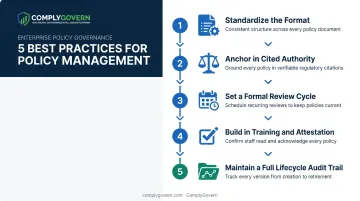
Five practices separate policies that survive an audit from ones that don't:
- Standardize the format. Use one structure for every policy (purpose, scope, procedure, references, review date), and write short, active-voice statements, such as "Staff must verify patient identity using two identifiers."
- Anchor policies in cited authority. Reference the specific statute, regulation, or accreditation standard each policy satisfies, and cross-reference related policies to prevent contradictions between departments.
- Set a formal review cycle. OIG recommends reviewing policies at least annually, with updates sooner when regulations change. Assign clear ownership so review responsibility is never in question.
- Build in training and attestation. Distribution isn't adoption. Require staff to acknowledge they've read and understood each policy, not just receive an email about it.
- Maintain a full lifecycle audit trail. Track drafting, approval, sign-off, distribution, and attestation in one traceable record, so evidence is ready whenever a surveyor asks. Lifecycle management tools can capture this trail automatically as each step happens.
From Fragmented Risk to Continuous Compliance
Common Pitfalls That Undermine Compliance Programs
Most compliance teams don't fail because they lack policies. They fail because those policies live in too many disconnected places.
- Fragmented systems: Policies scattered across spreadsheets, shared drives, and departmental apps make it nearly impossible to confirm which version is current
- Reactive culture: Scrambling to assemble evidence in the days before a survey increases citation risk compared to organizations that stay continuously prepared
- Adherence gaps: The Joint Commission's 2025 survey analysis flagged policy implementation as a recurring problem, with staff frequently missing protocols for medication administration, hand hygiene, and patient monitoring
Having a policy on paper solves nothing if nobody consistently follows it, and no amount of documentation fixes that on its own.
How a Unified Governance Platform Solves These Gaps
The fix requires connecting policy management directly to the regulations, evidence, and corrective actions it governs, without adding more spreadsheets or stricter memos.
This is the model behind ComplyGovern's Governance Intelligence Engine, which links policies across nine connected governance disciplines into one system of record. These disciplines include regulatory compliance, accreditation readiness, policy governance, quality management, risk management, incident and corrective action, medical staff governance, AI governance, and board reporting. A single policy update flows through that entire chain automatically, rather than requiring someone to manually update six different tracking sheets.
Practically, this looks like:
- Policies mapped to regulatory and accreditation standards with full audit history
- Automated evidence collection that replaces last-minute survey scrambling
- Native Microsoft 365 and SharePoint integration, so teams work inside tools they already know
- HIPAA-aligned security with role-based access, encryption, and audit logging
- Role-specific dashboards giving executives and boards real-time visibility from the boardroom down to bedside care
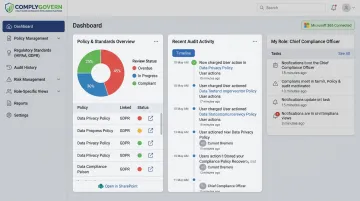
Replacing reactive scrambling with continuous readiness closes the exact adherence and version-control gaps that show up as citations during accreditation surveys, while easing audit stress across the organization.
Frequently Asked Questions
What is an example of a healthcare compliance policy?
An Anti-Kickback and Stark Law compliance policy governs financial relationships with referral sources to prevent fraud risk. A HIPAA privacy policy governs how staff access, use, and disclose protected health information.
What are the key pillars of a healthcare compliance program?
OIG's framework centers on written policies, compliance leadership and oversight, staff training, open communication channels, and ongoing auditing with enforcement. These elements function as one connected system, and a weakness in any single pillar puts the whole program at risk.
What are the main types of compliance?
Healthcare organizations manage regulatory/legal compliance (laws like HIPAA and Stark), accreditation/quality compliance (Joint Commission or DNV standards), and internal ethics/operational compliance (organizational codes of conduct).
How often should healthcare compliance policies be reviewed?
OIG recommends reviewing policies at least annually. Organizations should also update policies immediately whenever regulations, accreditation standards, or internal risk factors change.
Who is responsible for maintaining compliance policies?
Responsibility is shared: the compliance officer and committee drive day-to-day maintenance, department leaders ensure operational accuracy, and executive leadership and the board provide oversight and accountability.
What happens if a healthcare organization fails to comply?
Consequences range from civil monetary penalties and False Claims Act liability to exclusion from federal healthcare programs. Organizations may also face mandatory corrective action plans and lasting reputational damage.