Introduction
Few processes in healthcare get scrutinized as heavily as radiology peer review, yet get reduced to a compliance checkbox as often. Regulators demand it. Accreditors audit it. Medical staff offices chase it every quarter.
And still, decades of published research show that traditional scoring systems like RADPEER produce inconsistent, biased results that rarely change how radiologists practice.
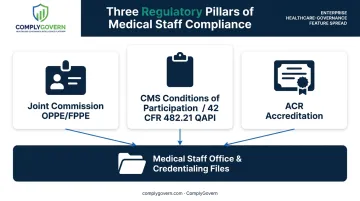
That's the tension at the center of this guide. Radiologists and Medical Staff Offices need peer review to satisfy Joint Commission OPPE/FPPE requirements, CMS Conditions of Participation, and ACR accreditation standards. But the tools built to meet those requirements often fail the people using them.
This article breaks down what matters most for building a peer review program that satisfies regulators and improves quality:
- Why legacy peer review processes fall short in practice
- What regulations actually require, versus what practices assume they require
- What to look for in modern QA software
- How connecting peer review data to broader governance infrastructure closes the compliance-to-quality gap
Key Takeaways
- Peer review supports Joint Commission OPPE/FPPE, CMS, and ACR compliance, but score-based systems risk bias and underreporting
- Radiology is shifting from punitive scoring toward Just Culture peer learning, improving engagement and patient safety
- Effective software must work inside PACS/RIS workflow while feeding compliance, credentialing, and accreditation systems
- A unified governance platform connects peer review findings to OPPE/FPPE files and dashboards for continuous survey readiness
What Is Radiology Peer Review and Quality Assurance?
Radiology QA relies on several distinct mechanisms, and mixing them up causes confusion at the program level.
- Peer review: one radiologist assesses the accuracy of a report issued by a colleague
- Peer feedback: findings from that review get communicated back to the original report author
- Double reporting: two radiologists independently interpret the same exam and issue separate reports
- Joint reporting: two or more radiologists interpret together and issue one shared report
Source: Strickland, Clinical Radiology (2015)
Despite these distinct definitions, most formal programs still lean on accuracy or discrepancy scoring as a stand-in for competency. The ACR's RADPEER tool uses a four-point scale: score 1 means the reviewer concurs, while scores 2 through 4 flag discrepancies of increasing clinical significance. Groups submit this data to generate physician- and group-level statistics by modality.
Why It Matters for Compliance
Peer review isn't just an internal quality exercise. It's built to support:
- Ongoing Professional Practice Evaluation (OPPE) for credentialed radiologists
- Maintenance of Certification Part 4, which the American Board of Radiology has accepted RADPEER toward since 2009
- Departmental quality assurance programs required for accreditation
The problem is that the scoring mechanism designed to serve all three purposes has real, well-documented flaws.
Why Traditional Peer Review Systems Fall Short
Bias, Selection, and Underreporting Problems
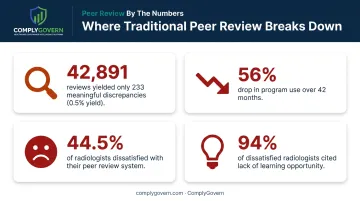
Self-selected case review, where radiologists pick which prior reports to examine rather than receiving random assignments, skews results. A tertiary-hospital random-review program that completed 42,891 reviews found only 233 potentially meaningful discrepancies, a yield of 0.5%. Program use dropped 56% over 42 months, and identifying a single meaningful discrepancy consumed more than six radiologist-hours (Trinh et al., AJR, 2018).
That low yield pushes many programs back toward self-selected or incidental case review, which reintroduces bias.
Hindsight bias compounds the problem. Once a reviewer knows the clinical outcome, it's easy to underestimate how difficult the original read actually was.
Reviewers also aren't always anonymous to the radiologist being reviewed, which skews scoring in predictable directions. A reviewer who receives a minor "ding" may become more likely to flag someone else's case during the same period.
Underreporting is the bigger issue. In a national survey of board-certified radiologists, 44.5% reported dissatisfaction with their peer review system, and among the dissatisfied group, 94.0% cited insufficient learning opportunity as the core complaint (Abujudeh et al., AJR, 2020). Fear of repercussions, not just workflow friction, keeps significant discrepancies out of the record.
Compliance, Workflow, and Feedback Gaps
Legacy peer review programs that aren't embedded in daily workflow see wildly inconsistent participation. Compliance in some published programs starts as low as 50% and climbs only with sustained process changes, not because radiologists don't care, but because standalone scoring tools compete with an already packed reading list.
Two more structural problems make things worse:
- No feedback loop. Most legacy systems log a discrepancy and stop. The original report author never sees it, so nothing gets learned.
- Fixed numeric targets backfire. A hard rule like "keep discrepancies under 5-10%" creates pressure to under-report rather than improve. Published discrepancy rates vary so widely by methodology and case mix that a single universal target isn't defensible in the first place.
Regulatory and Accreditation Requirements Driving Radiology Peer Review
Joint Commission OPPE/FPPE and Medical Staff Credentialing
The Joint Commission requires hospitals to define a process for evaluating every privileged practitioner's professional practice, run that evaluation continuously, and use the results when deciding whether to continue, limit, or revoke privileges (Baker and Kruskal, JACR, 2024). This applies fully to radiologists.
- OPPE covers ongoing evaluation for continuing privileges
- FPPE applies to new privilege requests or when a specific performance concern arises
Peer review data feeds directly into these files. Reappointment and privileging decisions made by medical staff offices and credentialing committees rely on it, which is exactly why gaps in the underlying data create downstream risk.
CMS Conditions of Participation and ACR Accreditation
Beyond Joint Commission requirements, CMS imposes its own layer of oversight through 42 CFR 482.21, which requires hospitals to maintain an effective, ongoing, hospital-wide QAPI program. Radiology reporting quality falls under that umbrella, even though the regulation itself doesn't name a specific peer review tool.
ACR accreditation adds another layer. Sites in CT, MRI, nuclear medicine/PET, and ultrasound programs must actively participate in physician QA, but ACR now permits either score-based peer review or a documented peer-learning program. RADPEER is one accepted method, not a mandated product.
The Administrative Burden on Medical Staff Offices
Here's where things get messy operationally. Peer review data, credentialing files, and accreditation evidence often live in separate systems:
- Peer review scores in a radiology-specific tool
- Credentialing files in a medical staff database
- Accreditation evidence in spreadsheets or shared drives
That fragmentation forces duplicate data entry and leaves gaps right when a surveyor asks for documentation. Platforms like ComplyGovern connect peer review findings directly to credentialing files and accreditation frameworks within a single system, removing that duplication and supporting continuous survey readiness instead of a scramble every three years.
Key Features to Look for in Radiology Peer Review & QA Software
Clinical Workflow Capabilities
The case-review layer of any QA program should live inside the radiologist's existing workflow, not add a second login. Look for:
- Native PACS/RIS integration so radiologists review prior reports without leaving their reading environment
- Anonymized case assignment that separates reviewer identity from the radiologist being reviewed
- Configurable case selection that blends random assignment with targeted, higher-risk cases
- Free-text comment fields alongside, or instead of, rigid numeric scoring
Programs that pair immediate, comment-enriched feedback with case review tend to see stronger radiologist engagement than those relying on delayed, centrally batched reporting. Speed matters here. A discrepancy flagged weeks later teaches nothing.
Governance, Compliance, and Reporting Capabilities
Clinical workflow is only half the picture. Once a discrepancy is documented, it needs to go somewhere useful. This is the layer where most legacy tools stop short, and where the compliance risk actually lives.
Software at this level should:
- Automatically link discrepancy findings to OPPE/FPPE records rather than storing them in an isolated database
- Route findings into corrective action workflows so nothing gets logged and forgotten
- Feed medical staff credentialing files so reappointment decisions are based on complete records
- Provide role-specific dashboards for department chairs, quality leaders, and boards, not just radiology
ComplyGovern's Governance Intelligence Engine addresses this gap directly. Rather than treating peer review as a standalone dataset, the platform connects peer review evidence, corrective actions, policies, and credentialing data within one system of record.
That connection gives Medical Staff Offices and quality leaders continuous accreditation readiness instead of last-minute survey prep. The documentation trail already exists when a surveyor asks for it.
Peer review data also carries unique medicolegal discoverability concerns. Software handling it needs HIPAA-aligned security, role-based access control, and audit logging as baseline requirements, not add-ons.
From Peer Review to Peer Learning: Best Practices for Sustainable QA Programs
The field is moving away from blame-oriented discrepancy scoring. Nearly half of radiologists surveyed by the ARRS Performance Improvement Subcommittee reported dissatisfaction with their current peer review process, and the overwhelming majority pointed to a lack of educational value as the reason. That data point alone explains why peer learning conferences, built on Just Culture principles, are gaining ground.
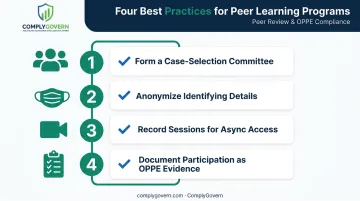
A few practices separate programs that stick from ones that fizzle out:
- Form a small case-selection committee to pull cases for group discussion rather than relying on one reviewer's judgment
- Anonymize identifying details before any case reaches a conference setting
- Record sessions so radiologists across shifts and sites can participate asynchronously
- Document conference participation and case-based improvement initiatives as valid OPPE evidence, rather than leaning solely on discrepancy rates
Dedicated medical staff governance software—like ComplyGovern's peer review and OPPE tools—can enforce this separation automatically, without manual tracking.
ACR's current QA pathway requires peer-learning content to be sequestered from individual performance evaluation, with annual participation documented separately.
That distinction matters. Mixing education with judgment is exactly what discourages radiologists from engaging honestly in the first place.
Frequently Asked Questions
What is RADPEER and is it required for radiology accreditation?
RADPEER is the ACR's web-based peer review tool using a four-point discrepancy scale. It's one accepted way to satisfy ACR physician QA requirements, but ACR also permits documented peer-learning programs as an alternative.
What is the difference between peer review and peer learning in radiology?
Peer review is a judgment-based scoring process focused on individual discrepancy rates. Peer learning emphasizes group discussion, education, and Just Culture principles, and keeps that content separate from performance evaluation.
How does radiology peer review relate to OPPE and FPPE requirements?
Peer review data serves as documented evidence supporting Ongoing and Focused Professional Practice Evaluation, which credentialing committees use for reappointment and privileging decisions.
What discrepancy rate is considered normal in radiology peer review?
There isn't one. Published rates vary widely depending on methodology, case mix, reviewer expertise, and how "discrepancy" is defined, so cross-practice comparisons should be made cautiously.
Can peer review software integrate with PACS and RIS systems?
Yes. Leading clinical peer review tools integrate directly into PACS/RIS workflow, letting radiologists score prior reports without leaving their normal reading process. ComplyGovern then connects those findings to credentialing and accreditation records downstream.
How can healthcare organizations reduce bias in radiology peer review?
Anonymize both reviewer and reviewed radiologist identities, use randomized rather than self-selected case assignment, and keep educational peer learning sessions separate from performance-based scoring.