For healthcare organizations, the stakes are higher than almost anywhere else. When policies live across spreadsheets, shared drives, and departmental apps, the result isn't just inefficiency — it's risk to patient safety, accreditation status, and CMS survey outcomes.
This guide compares the best policy management software options in 2026, with a focus on what actually matters for regulated healthcare environments.
Key Takeaways
- Policy management software unifies drafting, approval, distribution, and attestation while auto-building audit trails
- Healthcare buyers need tools tied to accreditation standards, CMS regulations, and clinical systems — not generic workflows
- ComplyGovern, SmartSuite, VComply, PowerDMS, NAVEX PolicyTech, LogicGate, and ConvergePoint lead the field for different organizational needs
- Continuous survey readiness, not last-minute scrambling, is becoming the real differentiator for regulated organizations
Overview of Policy Management Software in Healthcare Compliance
Policy management software governs the full lifecycle of an organization's policies and procedures, from authoring through retirement, with a verifiable trail at every step.
In healthcare, that trail matters more than in most industries. Multiple regulatory bodies are watching at once: CMS, state survey agencies, and accrediting organizations like Joint Commission or DNV.
The gap between "having policies" and "proving compliance with them" is exactly where organizations get cited.
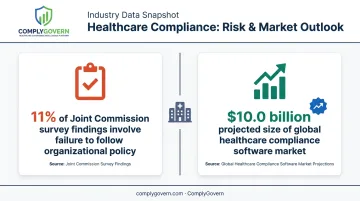
Joint Commission survey data shows the scale: across 611 Hospital Accreditation Program surveys, 66 findings (11%) involved failure to follow organizational policy on pre-sedation and pre-anesthesia assessments alone, according to Joint Commission survey analysis.
Separate 2025 findings flagged noncompliance with nursing documentation policies, defibrillator equipment checks, and PPE protocols as top clinical improvement opportunities.
This isn't a small market problem, either. The global healthcare compliance software market is projected to reach $10.0 billion, according to Grand View Research's market analysis, as organizations move away from spreadsheets toward platforms built specifically for regulatory evidence.
The following section ranks the top policy management platforms for 2026, evaluated on:
- Lifecycle coverage from policy creation to retirement
- Compliance evidence and audit trail strength
- Usability for compliance teams and clinical staff
- Healthcare-specific regulatory and accreditation fit
Best Policy Management Software Solutions in 2026
We evaluated each platform on four criteria: full lifecycle coverage (not just storage), auditability, integration depth, and relevance to regulated industries like healthcare.
ComplyGovern
ComplyGovern is a healthcare compliance and governance platform that unifies policy management with accreditation, quality, risk, and AI governance into a single system of record. Instead of managing policies in one tool and evidence in another, everything runs through what the platform calls its Governance Intelligence Engine.
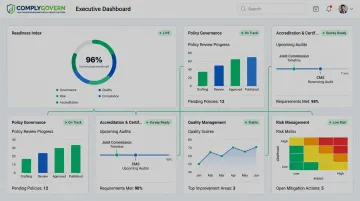
That engine connects regulations to accreditation standards, standards to policies, policies to controls, and controls to the evidence needed to prove compliance. A second chain links quality measures to risks, audits, findings, and corrective actions. Both surface in real time on role-specific executive dashboards built for the CEO, CMO, CCO, board members, and committee chairs.
What sets it apart for healthcare specifically:
- Continuous survey readiness rather than reactive, last-minute prep
- Native integration with Microsoft 365 and SharePoint
- Interoperability with Epic, Oracle Health (Cerner), MEDITECH, and athenahealth
- Coverage across all CMS-recognized facility types, including hospitals, ASCs, SNFs, home health, hospice, and FQHCs
- HIPAA-aligned security built into the architecture from the ground up
| Category | Details |
|---|---|
| Best For | Hospitals, health systems, and CMS-recognized facilities needing unified governance, compliance, and continuous accreditation readiness |
| Key Features | Nine connected governance disciplines, Microsoft 365/SharePoint native integration, AI Governance module, role-specific executive dashboards |
| Differentiator | Single source of truth from boardroom to bedside, eliminating duplicate effort across compliance, quality, and risk teams |
SmartSuite
SmartSuite takes a no-code, all-in-one approach to project and GRC management. It ships with 15 out-of-the-box GRC templates, including one built specifically for policy management, plus a drag-and-drop automation builder for approvals and reminders.
It's a solid generalist option: flexible, affordable, and not limited to healthcare use cases. That flexibility is also its ceiling: it's built for broad enterprise workflows rather than deep clinical or accreditation mapping.
| Category | Details |
|---|---|
| Best For | Banks, credit unions, and general enterprises wanting flexible no-code policy workflows |
| Key Features | Drag-and-drop automation, version history, dashboards, SAML-based SSO and SCIM provisioning |
| Pricing | Team plan from $15/seat/month (annual); Professional plan from $32/seat/month (annual); Enterprise by quote; 14-day free trial |
VComply
VComply's PolicyOps module handles creation, approval, and distribution within one centralized system, with AI-assisted drafting to speed up authoring. It maps policies against frameworks including ISO, SOX, NIST, and HIPAA, and tracks employee acknowledgment automatically.
Reviewers rate it well, earning a 4.6 out of 5 on G2 across 51 reviews, for mid-size to enterprise organizations spanning multiple regulated industries, not healthcare exclusively.
| Category | Details |
|---|---|
| Best For | Mid-size to enterprise organizations across multiple regulated industries |
| Key Features | AI policy drafting, audit trail, compliance dashboards, mobile access |
| Pricing | Pro GRC Suite starts at $1,000/month; trial requires a 10-minute activation call |
PowerDMS
PowerDMS connects policy, training, and accreditation for regulated and public-safety-adjacent organizations. It's marketed directly at healthcare facilities, with claims of reducing survey prep time by 60% for TJC and NCQA standards, according to PowerDMS's healthcare page.
Strengths include acknowledgment tracking and side-by-side document comparison. But reviewers have flagged friction points worth knowing before you buy.
- Workflow complexity: Setting up multiple departments with different directors is harder than expected, per reviewer feedback
- Approval visibility: The system doesn't always notify users when someone fails to approve a workflow
- Mobile limitations: Push notifications for the mobile app aren't very customizable
| Category | Details |
|---|---|
| Best For | Healthcare, public safety, and accreditation-driven organizations |
| Key Features | Version control, e-signatures, training integration, real-time notifications |
| Limitation | Workflow setup complexity for multi-department structures; limited mobile customization |
NAVEX PolicyTech
Now part of the broader NAVEX One platform, PolicyTech automates document creation, distribution, and employee attestations, then links policies directly to ethics and compliance training modules. It's built for large enterprises already invested in the NAVEX GRC ecosystem.
User feedback is mixed on usability. One reviewer described the NAVEX One layout as "confusing and not as easy to navigate as other platforms," while another cited expensive licensing and limited flexibility for customization.
| Category | Details |
|---|---|
| Best For | Large enterprises already invested in the NAVEX GRC ecosystem |
| Key Features | Centralized repository, workflow automation, violations reporting |
| Limitation | Navigation and customization limitations, plus higher licensing costs, per user reviews |
LogicGate
LogicGate's Risk Cloud takes a no-code, graph-database approach that connects policy management directly to risk registers rather than treating policy as a standalone function. Its Spark AI assistant helps generate response strategies when anticipating disruptions.
The tradeoff is setup time. Multiple reviewers describe a steep learning curve, and one noted the difficulty of managing changes without a sandbox environment or an undo button, a real concern for teams iterating on workflows.
| Category | Details |
|---|---|
| Best For | Risk and compliance teams wanting custom, risk-linked policy workflows |
| Key Features | Drag-and-drop workflow builder, centralized risk repository, prebuilt reporting templates |
| Limitation | Steep initial setup complexity; challenging to configure without prior GRC experience |
ConvergePoint
ConvergePoint installs directly inside Microsoft 365 SharePoint, using Word Online for drafting. It's organized into three modules (Policy Creation, Policy Library, and Policy Attestation), each handling a distinct piece of the lifecycle, down to quiz-based comprehension checks.
For organizations already standardized on Microsoft 365, that's a genuine advantage. For anyone outside the Microsoft ecosystem, it's a hard dependency.
| Category | Details |
|---|---|
| Best For | Mid-to-large organizations already standardized on Microsoft 365/SharePoint |
| Key Features | Custom workflows, expiration notifications, real-time dashboards |
| Limitation | Dependency on SharePoint infrastructure limits fit for non-Microsoft organizations |
Key Factors to Consider When Choosing Policy Management Software
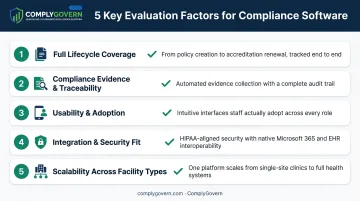
The biggest buying mistake we see: selecting a tool for document storage alone, rather than full lifecycle governance. Authoring, review, approval, versioning, and retirement need to function as one connected process rather than five disconnected steps.
Once that process is unified, compliance evidence and traceability should sit near the top of your checklist. Your platform should:
- Map policies directly to regulations and accreditation standards
- Auto-generate audit trails without manual reconstruction
- Track acknowledgment logs by user, role, and date
- Export evidence packages on demand, not just on request
Usability and adoption matter just as much as features. A policy no one reads doesn't reduce risk. Look for a searchable interface, mobile access, and role-based views so staff see what's relevant to their job, without wading through a 400-page policy manual.
Integration and security fit is where healthcare buyers need to be strictest. At minimum, confirm:
- SSO/SCIM support for identity management
- APIs connecting to HR, LMS, and EHR systems
- Encryption, role-based access control, and clear data residency terms
- HIPAA-aligned security and integration with clinical systems like Epic, Oracle Health, MEDITECH, or athenahealth
Finally, think about scalability across facility types and jurisdictions. A single hospital's needs look different from a multi-site health system running SNFs, ASCs, and home health agencies under one governance umbrella.
The real differentiator is whether the platform supports continuous, always-on survey readiness instead of a manual scramble every 18 to 36 months.
How We Evaluated These Platforms
Our evaluation combined four inputs: lifecycle coverage (authoring through retirement), verified user feedback from G2 and Capterra, integration depth with clinical and enterprise systems, and relevance to healthcare and other regulated industries.
Common buyer mistakes we avoided in this list:
- Prioritizing sticker price over auditability — a cheaper tool that can't produce evidence during a survey costs more in the long run
- Choosing generic document management software and assuming it covers compliance needs
- Overlooking mobile and role-based usability, which directly affects whether staff actually engage with policies
Conclusion
The best policy management software matches your regulatory scope, integration needs, and operational reality, not the one with the longest feature list or the most recognizable name.
Before committing, evaluate integration depth and how well the platform scales across facility types — not just what a demo shows on day one.
Healthcare organizations looking for continuous compliance and unified governance across policy, accreditation, quality, and risk can explore ComplyGovern to see how a connected approach compares to the fragmented status quo.
Frequently Asked Questions
How much does policy management software cost?
Pricing varies widely by vendor and model — per-seat, tiered, or enterprise quote-based. Healthcare buyers should request a 3-year total cost of ownership rather than relying on year-one pricing alone.
Which tool is used to manage group policies?
IT teams use Microsoft's Group Policy Management Console to control Windows network and device settings, a separate category altogether. Enterprise policy governance software like ComplyGovern, VComply, or PowerDMS manages organizational compliance policies instead of IT infrastructure settings.
What is the difference between policy management software and document management software?
Document management tools focus on storage and version control. Policy management software governs the full lifecycle, including ownership, approval, distribution, acknowledgment, and audit evidence, well beyond just holding files.
What features should healthcare organizations prioritize in policy management software?
Prioritize regulatory framework mapping, acknowledgment tracking, HIPAA-aligned security, and integration with clinical or EHR systems. Without these, you're managing documents, not compliance.
How does policy management software support accreditation and survey readiness?
Automated evidence collection, scheduled review cycles, and real-time dashboards replace manual, last-minute survey prep with continuous readiness. That shift alone can save weeks of staff time before a survey window opens.
Can policy management software integrate with EHR or clinical platforms?
Leading healthcare-focused platforms integrate with systems like Epic, Oracle Health (Cerner), MEDITECH, and athenahealth. This keeps policies aligned with live clinical workflows instead of existing as a separate compliance silo.