The right enterprise risk register software fixes that. It turns scattered risk data into a single, real-time view that feeds directly into compliance reporting, board decisions, and survey readiness.
This guide ranks the top enterprise risk register platforms for 2026, with particular attention to tools built for regulated industries like healthcare.
Key Takeaways
- Spreadsheets still dominate risk tracking, but they break down at enterprise scale
- Leading platforms link risk data to compliance, audit, and executive reporting
- Integration depth, automation, and framework coverage set leaders apart
- ComplyGovern, MetricStream, Vanta, Resolver, and Riskonnect each suit different organizational needs
Overview of Enterprise Risk Register Software in 2026
An enterprise risk register is a centralized system that identifies risks, scores them by likelihood and impact, assigns ownership, and tracks mitigation status across an entire organization. That's the definition on paper. In practice, the best platforms go further, linking every risk to the controls, evidence, and corrective actions that address it.
A basic spreadsheet can't do any of that automatically. Someone has to update it, cross-reference it, and email it to whoever needs it next.
The gap between spreadsheets and software is still enormous:
- A 2025 Baker Tilly and Internal Audit Foundation survey found that 59% of organizations still use basic tools like word processors and spreadsheets for enterprise risk management, while only 21% rely on integrated GRC platforms.
- Grand View Research pegs the total enterprise governance, risk, and compliance market at $72.4 billion in 2025, with software making up 65.3% of that spend.
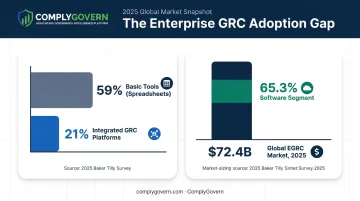
That gap represents real exposure, and the GRC software market is scaling fast to close it.
The platforms below were ranked on automation depth, integration capability, scalability, and how well they serve regulated sectors like healthcare.
Top Enterprise Risk Register Software for 2026
Selection criteria for this list included automation and AI capability, integration depth with existing systems, regulatory alignment, and the quality of executive and board reporting.
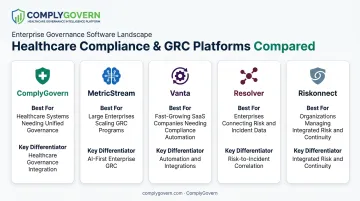
ComplyGovern
ComplyGovern is a healthcare compliance and governance platform that treats the risk register as one connected piece of a larger governance system. Its Governance Intelligence Engine automatically links risks to the regulations that created them, the controls designed to mitigate them, the evidence proving compliance, and the corrective actions closing any gaps.
That connectivity matters most during survey prep. Instead of scrambling for documentation, teams work from a live Readiness Index that reflects governance, quality, and risk status continuously.
The platform is built natively on Microsoft 365 and SharePoint, extending into the clinical systems teams already rely on daily. Security is HIPAA-aligned, with encryption at rest and in transit, MFA/SSO through Entra ID, role-based access control, and full audit logging.
| Best For | Hospitals, health systems, and CMS-recognized facilities needing risk registers connected to compliance and accreditation workflows |
| Key Features | Governance Intelligence Engine, automated evidence collection, continuous survey readiness, integrations with Epic, Oracle Health, MEDITECH, athenahealth |
| Differentiator | Connects risk to nine governance disciplines within a single system of record spanning compliance, quality, and accreditation |
MetricStream
MetricStream has served large enterprises for years and positions itself as an AI-first GRC platform spanning risk, audit, compliance, and resilience. Its ERM module identifies business objectives, processes, and controls, then runs qualitative and quantitative assessments, including Monte Carlo risk quantification for organizations that need that level of rigor.
AppStudio, MetricStream's configuration framework, lets administrators modify fields, workflows, dashboards, and business rules without writing code. This level of configurability appeals to complex, multi-department organizations.
| Best For | Large enterprises with mature, multi-department GRC programs |
| Key Features | Risk identification, analysis, mitigation planning, AppStudio configurability, analytics dashboards |
| Differentiator | Deep GRC ecosystem spanning compliance, audit, and third-party risk, not just registers |
Vanta
Vanta built its reputation on compliance automation, and its risk management module extends that same philosophy to risk registers. Users can import an existing register or start from a prebuilt library containing over 100 common risk scenarios already mapped to controls.
A parent-child hierarchy lets teams roll individual risks up into broader categories for cleaner reporting, which scales well as organizations add business units. Vanta's integration directory lists 400+ connections, reducing the manual data entry that plagues fast-growing companies.
| Best For | Technology and fast-scaling companies needing automated, integration-driven risk tracking |
| Key Features | Multiple risk registers, role-based access, parent-child risk roll-ups, automated evidence and control testing |
| Differentiator | Strong automation and integration ecosystem for continuous, low-manual-effort risk management |
Resolver
Resolver's angle is context. Its Risk Intelligence platform correlates risks with incidents and security events, surfacing relationships that spreadsheets would never reveal. Embedded AI identifies connections across risks, controls, and remediation actions.
Security and operational risk teams find this especially useful for tracking how a single incident might expose multiple downstream risks. Interactive dashboards, custom reports, and KRI views round out the reporting side.
| Best For | Organizations wanting risk registers tied closely to incident and security event management |
| Key Features | Risk-to-incident correlation, configurable assessments, executive reporting dashboards |
| Differentiator | Bridges the gap between day-to-day operational incidents and enterprise-level risk visibility |
Riskonnect
Riskonnect takes an integrated risk management approach, folding the risk register into a broader suite that includes business continuity, claims, and insurance policy management. Its platform centralizes continuity plans and runs scenario-based simulations using threat-intelligence data.
Heat maps and calibrated exposure scoring feed directly into reporting built for boards and risk committees, which makes it a natural fit for organizations already juggling insurance and continuity obligations alongside standard enterprise risk.
| Best For | Enterprises needing ERM frameworks combined with business continuity and insurance risk tracking |
| Key Features | Configurable risk taxonomies, scenario and heat-map modeling, board-level reporting |
| Differentiator | Combines traditional ERM rigor with broader integrated risk modules like claims and continuity |
How We Chose the Best Enterprise Risk Register Software
Most organizations get this evaluation wrong in a predictable way. Gartner has found that GRC vendor selection often takes more than six months, followed by another nine months before full functionality is reached, often because ERM requirements get diluted by unrelated stakeholder demands.
A second common misstep: assuming a bigger, all-in-one suite automatically beats a leaner tool that integrates well with existing systems. It doesn't. Poor integration is a bigger problem than most buyers expect. In PwC's survey of nearly 4,000 risk leaders, 41% said legacy technology architecture hurt their risk management through bad data integration.
We weighed five factors when ranking the platforms above:
- Automation and AI capability: how much manual work the platform eliminates versus adds
- Integration depth: native connections to EHRs, GRC tools, and document systems like SharePoint
- Scalability: whether the platform holds up across multiple departments or facilities
- Regulatory alignment: support for industry-specific frameworks, particularly in healthcare
- Executive and board reporting quality: real-time dashboards versus static, manually compiled reports
Conclusion
The right enterprise risk register software should match your organization's regulatory complexity, not just its brand recognition. A tool that works beautifully for a fast-scaling tech company may fall short for a multi-facility health system with CMS survey obligations.
Before signing anything, evaluate the integration roadmap, scalability beyond your current facility count, and total cost of ownership, rather than judging the deal on sticker price alone.
Healthcare organizations weighing their options can explore ComplyGovern's unified governance and risk platform to see how continuous compliance and enterprise risk management work together in one system.
Frequently Asked Questions
What is an enterprise risk register?
It's a centralized system that aggregates and normalizes risk data from across an organization's departmental or subordinate registers, giving leadership one consolidated view of enterprise-wide risk exposure.
What should be included in an enterprise risk register?
Core fields include:
- Risk ID and description
- Category
- Likelihood and impact scoring
- Assigned owner and mitigation plan
- Current status
- Scheduled review date
How do you perform an enterprise risk assessment?
Identify risks cross-functionally, score each by likelihood and impact, prioritize based on severity, and document mitigation plans with clear ownership and timelines.
Is a spreadsheet enough for enterprise-level risk management?
Spreadsheets can work for small, low-complexity environments. They typically fail once an organization spans multiple departments or facilities and needs audit-ready, real-time reporting.
How much does enterprise risk register software typically cost?
Pricing varies widely based on user count, modules, and integration needs. Most vendors, including ComplyGovern, require a custom quote based on facility size and complexity.
Can risk register software integrate with existing compliance or clinical systems?
Yes. Leading platforms integrate with EHRs like Epic and MEDITECH, document systems like SharePoint, and other GRC tools to eliminate duplicate data entry across departments.