Introduction
A single missed CMS deadline, an unpatched vendor system, or an overlooked incident report can trigger a survey finding, a HIPAA penalty, or worse, patient harm.
Healthcare organizations in 2026 are managing risk across hundreds of overlapping CMS, HIPAA, and accreditation requirements, often with tools that were never built to talk to each other.
Enterprise risk assessment tools change that equation. Instead of chasing spreadsheets across departments, executives and compliance teams get continuous, organization-wide visibility into clinical, operational, cybersecurity, and regulatory exposure.
CMS-approved accrediting organizations alone survey more than 9,000 healthcare providers annually to confirm they meet baseline health and safety standards. This guide breaks down the enterprise risk assessment platforms best equipped to handle that scale in 2026.
TL;DR
- Enterprise risk assessment tools unify clinical, operational, cybersecurity, and regulatory data into one system
- Spreadsheets and departmental tools create blind spots that increase compliance violations and patient-safety incidents
- Prioritize platforms with strong regulatory coverage, EHR integrations, automation, and executive dashboards
- ComplyGovern, RLDatix, Origami Risk, Riskonnect, and LogicManager lead the market for different needs
Overview of Enterprise Risk Assessment Tools in the Healthcare Industry
Enterprise risk assessment tools are software platforms that identify, quantify, and monitor risk across an entire organization rather than one department at a time. That means clinical risk, financial risk, cybersecurity exposure, and regulatory compliance all live in one connected system instead of four disconnected ones.
The regulatory backdrop is heavy. Providers must simultaneously satisfy:
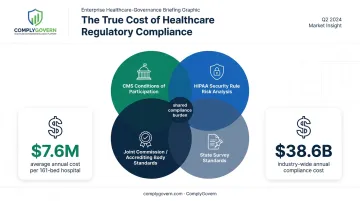
- CMS Conditions of Participation (CoPs) and Conditions for Coverage
- HIPAA Security Rule risk analysis requirements, mandated under 45 CFR 164.308(a)(1)(ii)(A)
- Joint Commission and other CMS-approved accrediting bodies
- State survey standards, which vary by facility type
An average 161-bed community hospital spends roughly $7.6 million per year on regulatory administrative activities. Industry-wide, that adds up to about $38.6 billion annually in compliance costs, according to the American Hospital Association.
The tools reviewed below were evaluated specifically for enterprise scalability — meaning their ability to serve hospitals, health systems, ambulatory facilities, and other CMS-recognized facility types without requiring a patchwork of add-ons.
Top Enterprise Risk Assessment Tools in Healthcare (2026)
Each platform below was assessed against four criteria: regulatory framework coverage, integration capability with clinical and enterprise systems, depth of automation, and scalability across facility types.
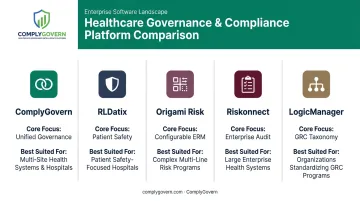
ComplyGovern
ComplyGovern is a unified healthcare compliance and governance platform built to replace fragmented spreadsheets, shared drives, and siloed departmental risk tools. Instead of managing risk as a standalone function, it connects risk management to eight other governance disciplines, including compliance, accreditation readiness, quality, policy management, and AI governance, within one system of record.
At the center of the platform sits the Governance Intelligence Engine, which automatically links regulations, accreditation standards, policies, controls, evidence, audits, findings, and corrective actions. A single risk update flows through the entire chain instead of requiring staff to manually update compliance, quality, and audit records separately.
Key platform elements include:
- Native Microsoft 365 and SharePoint integration
- HIPAA-aligned security, including encryption at rest and in transit, role-based access control, and MFA/SSO
- Interoperability with Epic, Oracle Health, MEDITECH, and athenahealth via HL7, FHIR, and DICOM
- A live Readiness Index dashboard that continuously scores governance, quality, risk, and compliance posture
| Category | Details |
|---|---|
| Facility Coverage | Supports all CMS-recognized facility types, from health systems and acute care hospitals to single-site DMEPOS suppliers |
| Regulatory Scope | U.S. federal healthcare laws, CMS-approved accrediting organizations, plus UK, Australia, and New Zealand standards |
| Standout Capability | Real-time executive and board dashboards with continuous survey readiness instead of reactive audit prep |
What sets ComplyGovern apart from single-purpose risk registers is that risk data doesn't sit in isolation. A clinical incident, for example, automatically feeds into the risk register, triggers a corrective action workflow, and updates the executive dashboard, all without anyone re-entering the same information three times.
RLDatix
RLDatix has been a fixture in hospital patient safety and risk management for years, and it remains one of the most widely deployed platforms in large health systems. Its RLD360 platform unifies credentialing, privileging, incident reporting, and root cause analysis into a connected clinical safety workflow.
The platform's core strength is incident reporting tied directly to clinical quality processes. Policy documents can be linked to standards from The Joint Commission, DNV, and CMS, and the vendor reports strong customer satisfaction rankings in recent KLAS surveys.
| Category | Details |
|---|---|
| Core Focus | Patient safety and clinical risk/incident management |
| Best Suited For | Large hospitals prioritizing clinical event and safety-event tracking |
| Limitation | Broader enterprise compliance and governance functions may require additional modules beyond the core patient safety suite |
Origami Risk
Origami Risk is a cloud-native, configurable ERM platform serving healthcare alongside other regulated industries like insurance and public entities. Its healthcare suite bundles Patient Safety, Quality, Claims & Insurance, and GRC tools, with HFMEA (Healthcare Failure Mode and Effects Analysis) capabilities modeled on VA and IHI frameworks.
Because the platform is built around configurable workflows and a REST API, organizations can shape risk registers and analytics to their specific structure rather than working within a fixed template.
| Category | Details |
|---|---|
| Core Focus | Configurable ERM and claims/risk analytics |
| Best Suited For | Health systems needing flexible, build-your-own risk workflows |
| Limitation | Flexibility comes at a cost: healthcare-specific regulatory content often requires significant configuration before it maps cleanly to CMS and accreditation standards |
Riskonnect
Riskonnect serves a broad customer base, including 140+ healthcare organizations and roughly 38% of Fortune 500 healthcare companies, built on its proprietary Force platform. It's less a healthcare-native tool and more a multi-industry risk platform with strong healthcare modules layered in.
Its Patient Safety module captures event data at the source, while its Business Continuity software aligns out of the box with ISO 22301. Internal Audit tools add continuous controls testing using robotic process automation.
| Category | Details |
|---|---|
| Core Focus | Broad enterprise risk, audit, and business continuity management |
| Best Suited For | Multi-facility health systems with dedicated enterprise risk teams |
| Limitation | Healthcare-specific accreditation frameworks generally require add-on configuration rather than arriving pre-mapped |
LogicManager
LogicManager takes a GRC-first approach, built around a pre-defined risk taxonomy that maps relationships between risks, resources, and business processes. Its "Risk Ripple Analytics" feature is designed to surface hidden risks and predict how one issue cascades into others across the organization.
Beyond its risk-mapping capabilities, LogicManager's pricing model stands out too: a fixed-fee, no-code licensing structure that doesn't charge per user seat, a notable departure from typical enterprise software pricing. One customer, Winona Health, reportedly integrated its ERM and incident management programs in 45 days.
| Category | Details |
|---|---|
| Core Focus | GRC with pre-built risk taxonomy library |
| Best Suited For | Mid-size healthcare organizations formalizing enterprise risk programs for the first time |
| Limitation | Native clinical and EHR system integrations appear less developed than platforms built specifically for healthcare environments |
How We Chose the Best Enterprise Risk Assessment Tools
Many organizations pick a risk platform based on brand recognition alone, or they buy a tool that looks great in a demo but doesn't connect to their existing EHR or compliance systems. Both mistakes create expensive rework down the line.
We weighted four factors when building this list, each tied to a measurable business outcome:
- Regulatory and accreditation framework coverage — Does the platform map to CMS CoPs, HIPAA, and the accrediting body your facility actually uses? Weak coverage means manual gap-filling and audit surprises.
- Clinical and enterprise system interoperability: Integration with Epic, Oracle Health, MEDITECH, or athenahealth reduces duplicate data entry and keeps evidence current without manual pulls.
- Automation and AI capability matters just as much. Automated evidence collection, policy review triggers, and workflow routing directly cut the administrative burden compliance teams carry.
- Scalability across facility types: A platform that works for a 500-bed academic medical center should also flex for a rural critical access hospital or single-site supplier without a full re-implementation.
The organizations that get the most value treat these factors as a pre-signing checklist rather than an onboarding afterthought.
Conclusion
There's no single "best" enterprise risk assessment tool, only the one that fits your facility type, your regulatory obligations, and the systems you already run. A large academic health system with dedicated risk teams may lean toward Origami Risk's configurability or Riskonnect's audit depth. A hospital focused primarily on clinical event tracking may find RLDatix a natural fit.
Before finalizing a decision, weigh three factors:
- How the platform scales as your organization grows
- Its total cost of ownership beyond the initial license
- How deeply it integrates with your existing tech stack
Once you've weighed these factors, consider whether risk management should stand alone or connect to your broader governance strategy. Organizations that want risk tied to compliance, quality, accreditation, and policy governance in one place, rather than stitched together after the fact, may find ComplyGovern's unified platform a better fit.
Built around continuous compliance, it gives boards and executives one source of truth from boardroom to bedside, with real-time visibility instead of after-the-fact reporting.
Frequently Asked Questions
What are some common risk assessment tools used in healthcare?
Common categories include HIPAA security risk analysis tools, clinical and patient safety scoring systems, and enterprise GRC platforms. Many organizations now consolidate these into unified governance platforms rather than managing them separately.
What is the best healthcare risk assessment tool?
The best tool depends on your facility type and regulatory scope. Organizations needing unified governance across compliance, risk, and accreditation often turn to platforms like ComplyGovern, while others prioritize clinical-incident-focused tools like RLDatix.
What is enterprise risk management (ERM) in healthcare?
ERM is an organization-wide approach to identifying and managing clinical, operational, financial, and compliance risks together rather than in departmental silos. It gives leadership one consolidated view of exposure instead of fragmented reports.
How much do healthcare risk assessment tools cost?
Pricing varies by facility size, modules needed, and deployment model — most vendors use custom enterprise contracts rather than published rates. Requesting direct vendor quotes is the most reliable way to get an accurate figure.
Are risk assessment tools required for HIPAA compliance?
The HIPAA Security Rule requires covered entities to conduct an accurate risk analysis of risks to ePHI. Tools don't replace this legal obligation, but they help automate and document the ongoing process.
How often should healthcare organizations conduct risk assessments?
Risk analysis should be continuous rather than a once-a-year checkbox exercise. Updates should be triggered by new technology, security incidents, staffing changes, or regulatory updates as they occur.