Yet many healthcare organizations still manage their policies through scattered spreadsheets, shared drives, and departmental binders. That patchwork approach creates compliance gaps that surface at the worst possible moment: during an audit, a breach investigation, or an accreditation survey.
This guide breaks down the specific policies required under HIPAA's three major rules, walks through a step-by-step framework for building them, covers documentation and retention obligations, and outlines best practices for staying continuously survey-ready.
Key Takeaways
- Written HIPAA policies are a standalone legal requirement under 45 CFR 164.530, not simply a breach-prevention measure
- Three rules govern required policies: Privacy, Security, and Breach Notification
- Policy documentation must be retained for six years from creation or last effective date, whichever is later
- Missing or unenforced policies can trigger OCR penalties even without an actual data breach
- Continuous monitoring beats reactive, audit-driven policy updates
What Are HIPAA Policies and Procedures?
HIPAA policies and procedures are the documented "work rules" that tell your workforce exactly how to protect the confidentiality, integrity, and availability of PHI. They're not suggestions. Under 45 CFR 164.530, covered entities and business associates must:
- Implement policies reasonably designed to comply with the Privacy and Breach Notification standards
- Document those policies in writing or electronically
- Make them accessible to workforce members who need them
That said, there's no universal template. Policy scope depends on organizational complexity:
| Organization Type | Policy Scope |
|---|---|
| Large health systems | Multiple departments, dozens of PHI touchpoints, and complex data-sharing agreements |
| Single-site suppliers or rural clinics | A leaner set focused on actual risk profile and services |
Regardless of organization size, one requirement doesn't change: failing to develop, implement, and enforce these policies is a HIPAA violation on its own, independent of whether any PHI was ever actually exposed.
OCR has issued financial penalties specifically for this failure. In 2017, OCR settled with Cornell Prescription Pharmacy for $125,000 after investigators found the pharmacy had no written Privacy Rule policies and hadn't trained its workforce — findings made separately from the underlying improper disposal incident that triggered the investigation.
The Three Required Categories of HIPAA Policies and Procedures
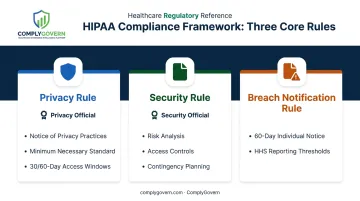
HIPAA doesn't leave "what policies do I need" open to interpretation. The requirements are organized under three major rules, each with a distinct scope and a designated official responsible for compliance.
Privacy Rule Policies and Procedures
Every covered entity must designate a Privacy Official responsible for developing, implementing, and training staff on Privacy Rule policies under §164.530. This person also serves as the contact for complaints.
Core policy areas required:
- Notice of Privacy Practices: must be provided no later than the first service delivery for direct-treatment providers
- Minimum necessary standard procedures: limiting PHI use, disclosure, and requests to what's actually needed under §164.502(b)
- Patient access, amendment, and accounting procedures: access requests require action within 30 days; amendment and accounting requests within 60 days
- Authorization form protocols under §164.508, covering required elements like purpose, expiration, and revocation rights
Security Rule Policies and Procedures
A Security Official, designated under §164.308, owns the administrative, physical, and technical safeguard policies protecting ePHI. Nothing prohibits this being the same person as the Privacy Official, though larger organizations typically split the roles.
Required policy areas include:
- Risk analysis and ongoing risk management
- Workforce security, access controls, and termination procedures
- Security incident response and reporting
- Contingency planning: data backup, disaster recovery, emergency-mode operations
- Device and media controls, including required disposal and reuse procedures
Breach Notification Rule Policies and Procedures
Policies must define what actually constitutes a notifiable breach. Under §164.402, an impermissible acquisition, access, use, or disclosure is presumed a breach unless one of three exclusions applies or the organization demonstrates low probability of compromise.
Required components include:
- Workforce reporting procedures for suspected incidents
- Individual notification within 60 days of discovery
- HHS notification immediately for breaches affecting 500+ individuals, or annually for smaller breaches
- Media notice when a breach affects more than 500 residents of one state
- Documentation proving the burden-of-proof standard under §164.414 was met
Given the differing deadlines and evidence requirements across these three rule categories, ComplyGovern's policy lifecycle module maps each policy to its regulatory citation and tracks review dates automatically.
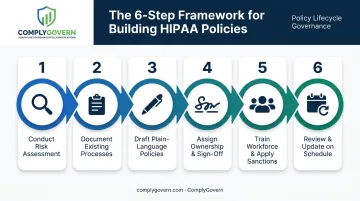
How to Develop HIPAA-Compliant Policies and Procedures: A Step-by-Step Framework
Building compliant policies from scratch, or fixing a fragmented set, doesn't require a legal team. It requires a repeatable process.
Step 1: Conduct a Risk Assessment to Identify Your Needs
Policies must be grounded in a documented risk analysis identifying where PHI and ePHI vulnerabilities actually exist. HHS provides a Security Risk Assessment Tool, but it's limited: it covers Security Rule gaps only and doesn't touch Privacy Rule or Breach Notification exposure. You'll need a separate approach for those.
Step 2: Document Existing Processes Before Writing New Ones
Don't start with a blank page. Inventory the informal practices already happening, such as how staff currently handle access requests, disclosures, or incident reporting, and evaluate whether they meet compliance needs before formalizing anything into written policy.
Step 3: Draft Policies in Plain, Role-Specific Language
Skip the regulatory jargon. A front-desk employee handling a patient's records request needs to understand a policy in plain terms, not decode legal citations. Write for the person doing the task, not for a compliance auditor.
Step 4: Assign Ownership, Distribute, and Obtain Sign-Off
Every policy needs an owner and a documented distribution plan. Employee attestation (proof that staff received and understood a policy) isn't optional. It's what supports your organization during an audit when a surveyor asks, "Can you prove your team knew this rule existed?"
Step 5: Train the Workforce and Apply Sanctions for Non-Compliance
Generic HIPAA training isn't enough. Training must tie directly to your specific written policies. Pair this with a documented sanctions policy: without one, non-compliance becomes a culture rather than an exception.
Step 6: Review and Update on a Recurring Schedule
Policies need periodic review, plus updates triggered by organizational changes, new federal regulations, or state law developments. Texas's Medical Records Privacy Act, for example, requires electronic record access within 15 business days — stricter than HIPAA's 30-day window. Organizations operating across states can't assume federal minimums cover them everywhere.
Platforms with continuous regulatory monitoring, like ComplyGovern's Governance Intelligence Engine, can flag these state-specific triggers automatically, reducing the manual tracking burden.
Documentation, Record-Keeping & Retention Requirements
HIPAA policies, training records, authorizations, notices, and complaint dispositions must be retained for six years from creation or the last effective date, whichever is later. Quick retrieval matters — you have a 30-day window to respond to a patient access request, and you can't meet that deadline digging through a filing cabinet.
Core documentation categories to maintain:
- Privacy and Security Official designations
- Training attestations tied to specific policy versions
- Business Associate Agreements
- Risk analyses and their remediation follow-through
- Breach incident logs and risk assessments
Material policy changes trigger additional documentation requirements. When you update a policy significantly, document:
- Re-training of all affected staff members
- Reissued Notices of Privacy Practices, if required
- Updated Business Associate Agreements, if warranted
- The change date and who completed retraining
Consequences of Non-Compliance: Violations & Penalties
A data breach and a HIPAA violation aren't the same thing. A breach becomes a violation when it stems from missing, outdated, or unenforced policies — which is exactly what turned the Cornell Prescription Pharmacy incident into a $125,000 settlement rather than a routine cleanup.
Current OCR civil monetary penalty tiers, adjusted for inflation as of January 2026:
| Culpability Tier | Min per Violation | Max per Violation | Calendar-Year Cap |
|---|---|---|---|
| No knowledge, reasonable diligence | $145 | $73,011 | $2,190,294 |
| Reasonable cause, not willful neglect | $1,461 | $73,011 | $2,190,294 |
| Willful neglect, timely corrected | $14,602 | $73,011 | $2,190,294 |
| Willful neglect, not corrected | $73,011 | $2,190,294 | $2,190,294 |
OCR has separately signaled it applies lower, tier-specific discretionary caps in some cases, but the statutory ceiling above is what regulated entities should plan around.
Cornell's case illustrates two enforcement realities:
- OCR doesn't need proof that a breach caused harm to issue a penalty
- Absent policies and absent training are enough on their own to trigger a settlement
Best Practices for Continuous, Future-Ready HIPAA Compliance
Reactive compliance (updating policies only when a survey is scheduled) is a losing strategy. HHS has already proposed 2025-2026 Security Rule updates that would strengthen ePHI cybersecurity requirements, including mandatory encryption, multifactor authentication, and regular penetration testing. Organizations that wait for the final rule to start preparing will be behind.
A few practices separate organizations that stay ahead:
- Monitor regulations continuously, not just before a survey window opens
- Map every policy to its underlying citation (§164.530, §164.308, and accrediting body standards) so gaps are visible immediately, not discovered mid-survey
- Consolidate policy management, training records, risk assessments, and corrective action tracking into one governance system rather than fragmented spreadsheets and shared drives
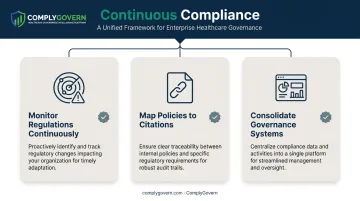
That third point is where most organizations bleed time. Compliance, quality, and risk teams end up duplicating work when they're tracking the same HIPAA obligation in three separate systems.
This is the exact problem ComplyGovern's Policy & Document Governance module addresses. It manages the full policy lifecycle, from creation through retirement, and includes:
- Scheduled reviews that flag outdated policies before they become audit findings
- Version control that maintains a clear audit trail for every policy change
- Standards mapping that links internal policies directly to HIPAA requirements
Because it runs through a Governance Intelligence Engine, a single regulatory update flows automatically through connected policies, controls, and evidence. Executives and boards get a real-time view of policy compliance status, rather than a snapshot assembled the week before a survey.
Frequently Asked Questions
What HIPAA policies and procedures are required?
Privacy, Security, and Breach Notification policies are all mandatory. They cover PHI use and disclosure, ePHI safeguards, and breach response protocols, each requiring a designated responsible official.
What are the new HIPAA rules for 2026?
HHS has proposed Security Rule updates strengthening ePHI cybersecurity requirements, including encryption and multifactor authentication mandates. These remain proposed, not final — organizations should monitor the Federal Register for the finalized rule.
What are the three major rules or parts of HIPAA?
The Privacy Rule, Security Rule, and Breach Notification Rule form HIPAA's core framework, each targeting a different compliance area. Organizations need distinct policies satisfying all three simultaneously, not one combined document.
Can the Privacy Official and Security Official be the same person?
Yes. HIPAA doesn't prohibit combining the roles, though larger organizations typically separate them between administrative/legal leadership and IT security leadership.
How long must HIPAA policies and related documentation be retained?
Six years from the date of creation or the last effective date, whichever is later. This applies to policies, training records, and related compliance documentation.
Are business associates required to have their own HIPAA policies?
Yes, wherever Security Rule and applicable Privacy Rule standards apply to the services they perform. Business associates also carry direct Breach Notification obligations and liability for specific Privacy Rule provisions.