Researchers at Johns Hopkins estimated that medical error contributes to 251,454 deaths annually in the U.S., making it a leading cause of death nationwide, according to research published in The BMJ. Other federal estimates are more conservative, but even the lower figures point to a system that struggles to catch and learn from its own mistakes.
This guide breaks down what actually qualifies as a medical error, why underreporting persists despite decades of awareness campaigns, the legal obligations organizations carry, and the practical steps that build a reporting culture people actually trust.
Key Takeaways
- Near misses vastly outnumber harmful events, yet most still go unreported
- Fear of blame remains the top reason clinicians stay silent about errors
- Fewer than half of U.S. states mandate adverse event reporting, creating coverage gaps
- Adopting a Just Culture approach increases reporting volume
- Centralized platforms close the feedback loop that manual systems often miss
What Qualifies as a Medical Error? Understanding the Types
The National Coordinating Council for Medication Error Reporting and Prevention (NCC MERP) defines a medication error as:
Any preventable event that may cause or lead to inappropriate medication use or patient harm while the medication is in the control of the health care professional, patient, or consumer.
That definition covers prescribing, labeling, dispensing, administration, and monitoring, not just the moment a wrong pill reaches a patient.
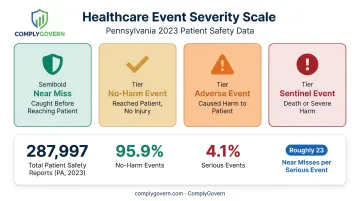
Medical errors exist on a severity spectrum:
- Near misses – caught before reaching the patient
- No-harm events – reached the patient but caused no injury
- Adverse events – caused actual harm
- Sentinel events – resulted in death or severe, permanent harm
Near misses happen far more often than harmful events. Pennsylvania's mandatory reporting database logged 287,997 reports from hospitals and surgical facilities in 2023. Of those, 95.9% were no-harm incidents and only 4.1% were serious events, according to Patient Safety Authority data — roughly 23 near misses for every serious event.
Clinical literature commonly groups errors into four categories:
| Type | Example |
|---|---|
| Diagnostic | Missed or delayed diagnosis |
| Treatment/procedural | Wrong-dose medication or surgical error |
| Preventive | Skipped follow-up or missed prophylaxis |
| Communication/systems | Handoff failure between shifts |
Beyond these categories, errors also break down by what caused them: an action taken or a step missed.
Errors of Commission
These are incorrect actions taken: the wrong medication, wrong dose, wrong-site procedure, or a miscoded chart entry. For instance, administering a full adult dose to a pediatric patient falls squarely into this category. They're rarely intentional, but they still carry real legal and professional consequences, especially when documentation shows the action was preventable.
Errors of Omission
These involve failing to act: a skipped diagnostic test, a delayed treatment, an overlooked symptom during rounds. For instance, failing to reassess a post-op patient's vitals on the scheduled interval is a common omission error in busy units. Omission errors are usually tied to training gaps or missing protocols rather than deliberate negligence, which matters when organizations decide how to respond.
The Real Cost of Underreporting
Underreporting isn't just a paperwork problem. It hides the true scope of patient harm and delays the fixes that would prevent recurrence.
A Department of Health and Human Services review of 770 hospitalized Medicare patients found that 25% experienced harm during their stay, and physician reviewers judged 43% of those harm events preventable. That's one in four Medicare inpatients affected, in a single sample month.
Beyond the harm itself, the financial toll is substantial. A Society of Actuaries analysis estimated that measurable medical errors cost the U.S. healthcare system roughly $19.5 billion annually. About $17 billion of that came from direct medical costs, according to the SOA's economic measurement report.
That figure covers only measurable claims categories like procedural complications and infections. It excludes pain, suffering, and many diagnostic or medication errors entirely, meaning the real number is likely higher.
There's a human cost too. A survey of 3,171 physicians in the U.S. and Canada found that involvement in an error was associated with:
- Anxiety about future errors (61%)
- Loss of confidence (44%)
- Sleep difficulty (42%)
- Reduced job satisfaction (42%)
This creates a vicious cycle. Clinicians who feel shaken by an error often withdraw rather than speak up, and silence compounds the same systemic gaps that caused the original problem.
Common Barriers to Reporting Medical Errors
If reporting were simple, the numbers above would look different. Several well-documented barriers keep clinicians from filing reports, even when they know they should.
- Fear of punitive consequences. In a survey of 308 nurses, 51.3% worried about discipline and 46.5% feared being blamed for errors.
- Reluctance to implicate a colleague. 49% of nurses said reporting a coworker's mistake wasn't their job, and 46.6% expected an unsupportive reaction.
- No simple reporting system. 44.5% of nurses called forms too complicated, and 46.3% said they took too long to complete.
- Ambiguity over what counts. Staff often assume minor errors or near misses aren't worth reporting, skewing data toward only the most severe events.
- Time pressure. Completing an incident report on top of a full clinical shift is its own deterrent.
- Missing feedback. 48% of nurses said they never learned what happened after filing a report, a gap AHRQ also flags as a modifiable barrier among physicians and staff.
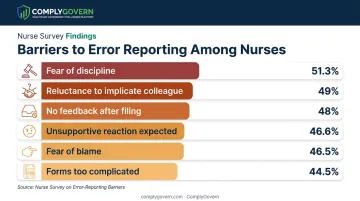
That last point deserves the most attention. Unlike fear or ambiguity, it's a barrier organizations can fix without waiting on legislation or culture change. If a report disappears into a black hole, staff stop filing them.
Closed-loop systems that route incidents through defined review and corrective-action steps, rather than into a static form, give staff visible proof that reporting leads somewhere.
Legal and Regulatory Obligations for Reporting Medical Errors
Mandatory vs. Voluntary Systems
State-level reporting requirements vary widely. A national scan identified adverse-event reporting systems in 26 states plus Washington, D.C., nearly all mandatory except Oregon's voluntary model. Coverage, confidentiality protections, and which events must be reported differ substantially by state, so organizations operating across multiple states can't assume one policy fits every location.
The Joint Commission's Sentinel Event Policy
Organizations aren't required to report sentinel events to The Joint Commission, but doing so is strongly encouraged. Regardless of external reporting, accredited organizations must complete a systematic analysis, typically a root-cause analysis, and a corrective action plan within 45 business days of the event.
The policy explicitly focuses on systems and processes, not individual blame. Accreditation bodies increasingly expect documented proof that corrective actions were tracked through to effectiveness, not just written down and filed.
Platforms like ComplyGovern support this expectation by linking root-cause analysis, corrective action plans, and effectiveness verification in one auditable record — replacing scattered documents with a single tracked workflow.
Disclosure Is a Separate Obligation
Internal incident reporting and patient disclosure are not the same duty. AHRQ and the American Medical Association both ground disclosure in fiduciary responsibility and patient autonomy: patients have a right to know what happened to them, independent of whatever internal safety investigation follows. Organizations without a clear, consistent disclosure policy face greater liability exposure and inconsistent practice across departments.
Best Practices for Reporting Medical Errors and Building a Just Culture
The Basic Reporting Steps
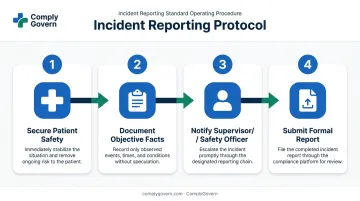
- Secure immediate patient safety — address any ongoing risk before anything else
- Document objective facts, not assumptions or blame
- Notify the appropriate supervisor or safety officer right away
- Submit through the formal reporting channel promptly, while details are fresh
Just Culture Changes the Equation
A Just Culture distinguishes honest human error and systemic failure from reckless behavior, replacing blanket blame with proportional accountability. One 528-bed academic medical center saw event reporting jump 37.31% after implementing Just Culture principles alongside leadership engagement and staff education. That's not a small bump. It's the kind of shift that happens when people believe reporting won't end their career.
Make Reporting Frictionless — and Close the Loop
Complicated forms and dead-end submissions are two of the most fixable barriers on this list. That's precisely where fragmented, manual reporting (spreadsheets, siloed department tools, paper forms tucked in a binder) becomes a barrier in itself. Nobody is checking those forms in real time, and nobody is closing the loop with the person who filed them.
This is the gap ComplyGovern's incident and CAPA workflows are built to close. The platform captures each incident through configurable workflows, runs it through root-cause analysis, and tracks corrective actions until effectiveness is verified, not just marked complete.
Because it's connected to ComplyGovern's Governance Intelligence Engine, a single incident report automatically links to related policies, risk register entries, and quality measures. Executives and boards get real-time dashboard visibility into safety trends instead of a quarterly summary assembled by hand.
Ongoing education matters too. Staff need periodic refreshers on what counts as reportable, how the process works, and what happens after they hit submit. A reporting culture isn't built once. It's maintained.
Frequently Asked Questions
What are the 4 types of medical error?
Clinical literature groups errors into diagnostic (missed diagnosis), treatment/procedural (wrong-dose medication), preventive (skipped follow-up), and communication/systems (handoff failures) categories, each marking a different breakdown point in care.
What are the legal obligations for reporting medical errors?
Obligations vary by state, with fewer than half mandating adverse event reporting and differing rules on confidentiality. Accrediting bodies like The Joint Commission add separate requirements, and patient disclosure remains a distinct legal duty.
How do you report a medical error?
Secure the patient's safety first, then document the objective facts without assigning blame. Notify your supervisor, and submit the report through your organization's formal channel promptly.
What qualifies as a medical error?
Under the NCC MERP definition, any preventable event that could lead to inappropriate treatment or patient harm qualifies, whether or not harm occurred. Near misses count as reportable events, not just incidents causing visible injury.
What is a "just culture" in healthcare error reporting?
A Just Culture distinguishes honest human error and systemic failure from reckless conduct, replacing blame with accountability and learning. Organizations that adopt it see reporting volumes rise as staff stop fearing punishment for honest mistakes.
Who is responsible for reporting a medical error — nurses or physicians?
All clinicians share this responsibility, but nurses submit the large majority of formal incident reports. Physicians report far less frequently, though their reports tend to cover more serious events.