Too many healthcare organizations still treat QA as a checkbox exercise, something to scramble toward before an inspection rather than a living system. The result? Fragmented processes: spreadsheets in one department, shared drives in another, siloed tools that don't talk to each other. These blind spots increase risk and drive survey failures.
This guide breaks down what QA actually means, why it matters, the core principles and accreditation standards behind it, and the best practices for building a program that holds up under real scrutiny.
Key Takeaways
- QA is proactive and preventive — distinct from reactive QC and continuous QI
- Strong QA programs cut medical errors, infections, and readmissions while lowering costs
- Success requires PDCA cycles, cross-functional governance, and CMS/Joint Commission alignment
- Unifying QA, compliance, risk, and governance cuts duplicate effort and speeds survey readiness
What Is Quality Assurance in Healthcare?
Quality assurance (QA) in healthcare is the systematic, proactive set of processes and standards designed to prevent errors before they happen. It's the framework that ensures care stays consistent, safe, and patient-centered across every clinical and operational workflow.
If someone asks "what does QA stand for" in plain terms: it's the discipline of setting the rules of the road before anyone starts driving, establishing standards and training that prevent problems from happening in the first place.
QA vs. Quality Control (QC) vs. Quality Improvement (QI): What's the Difference?
These three terms get used interchangeably far too often, and that confusion creates real operational gaps.
- QA (prevention): Sets standards, responsibilities, and training before errors occur. Example: a pre-surgical "time-out" protocol confirming patient identity and procedure.
- QC (detection): Monitors current performance and flags deviations after they happen. Example: tracking wrong-site surgery incidents once they occur.
- QI (refinement): Uses data to iteratively test and redesign processes for better outcomes over time.
The Institute for Healthcare Improvement notes that QC and QA are commonly confused, with QA typically representing an external, lagged comparison against goals, while QC is internal and real-time. In practice, QA, QC, and QI function as one connected ecosystem: QA builds the guardrails, QC watches for cars going off the road, and QI redesigns the road itself.
The QA Cycle: Plan-Do-Check-Act (PDCA) in Action
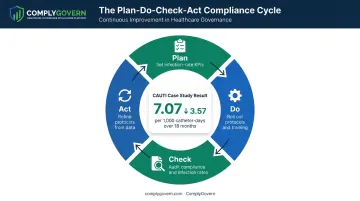
PDCA (sometimes PDSA, swapping "Check" for "Study") is what keeps QA dynamic instead of a static, one-time compliance exercise. Applied to a real scenario like reducing catheter-associated urinary tract infections (CAUTIs):
- Plan — Set infection-rate KPIs and define evidence-based insertion/maintenance standards
- Do — Roll out protocols, staff training, and an infection-prevention bundle
- Check — Audit compliance and track infection rates against baseline
- Act — Refine protocols based on what the data shows
A 2024 quality-improvement study in a Saudi tertiary high-dependency unit used exactly this approach, combining gap analysis, staff education, and a CAUTI bundle over 18 months. CAUTI incidence dropped from 7.07 to 3.57 per 1,000 catheter-days, even as catheter use increased. That's PDCA in practice: continuous refinement fueled by real data over time.
Why Quality Assurance Matters in Healthcare
QA separates organizations that catch problems early from those that discover them during a sentinel event review.
Patient safety and outcomes. A New England Journal of Medicine study of 2,809 admissions across 11 Massachusetts hospitals found that at least one adverse event occurred in 23.6% of admissions, with nearly a quarter of those events judged preventable. Strong QA protocols, including infection bundles, medication reconciliation checks, and standardized handoffs, directly target this preventable slice.
Cost savings and operational efficiency. Quality investment pays for itself. The Fall TIPS program, published in JAMA Health Forum and studied across 900,635 patients at eight hospitals, was associated with a 19% reduction in falls and $22 million in savings over five years. That program funded itself many times over.
Regulatory and accreditation compliance. Facilities must meet CMS Conditions of Participation to begin and continue receiving Medicare and Medicaid reimbursement. Most demonstrate compliance through a CMS-approved accrediting organization, so QA failures put both patient safety and reimbursement at risk.
Patient trust and competitive advantage. HCAHPS scores now feed directly into Hospital Value-Based Purchasing. CMS reduces participating hospitals' DRG payments and redistributes that pool based on performance scores, so hospitals can earn back more, less, or the same as their reduction. Patient experience now carries real financial weight, beyond reputation alone.
Organizational risk reduction. Gaps in QA translate directly into liability exposure. Fragmented, reactive processes make it far harder to catch the small issues before they become the big ones that trigger a malpractice claim or a failed audit finding.
Core Principles and Regulatory Standards Governing Healthcare QA
Foundational Principles of an Effective QA Program
Every durable QA program rests on the same non-negotiables:
- Patient-centered care: standards built around outcomes that matter to patients, not just internal metrics
- Evidence-based standards: protocols grounded in current clinical research, not tradition
- Continuous monitoring: ongoing measurement, not periodic snapshots
- Accountability and transparency: defined roles, open error-reporting systems, and feedback loops that surface risk early rather than after harm occurs
Without a genuine error-reporting culture, a QA program discovers problems only after harm has already occurred.
Key Accreditation Bodies and Standards to Know
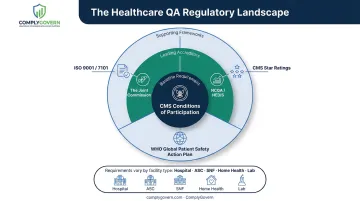
U.S. healthcare QA is shaped by a web of overlapping bodies, each with a different scope:
- The Joint Commission: the most widely recognized accreditor; its accreditation can support Medicare deemed status where CMS has approved the specific program
- CMS Conditions of Participation / state surveys: the baseline federal requirement for Medicare/Medicaid eligibility
- NCQA/HEDIS: the dominant framework for health-plan and population-level performance measurement
Supporting frameworks add further complexity: ISO 9001 (and its newer healthcare-specific ISO 7101:2023), CMS Star Ratings, and WHO's Global Patient Safety Action Plan all layer additional expectations. Requirements also vary sharply by facility type:
| Facility Type | Governing QA Requirement | Core Focus |
|---|---|---|
| Hospital | 42 CFR 482.21 (QAPI) | Data-driven program, governing-body oversight |
| ASC | 42 CFR 416.43 (QAPI) | Adverse events, infection control, improvement projects |
| SNF/Nursing Home | 42 CFR 483.75 (QAPI/QAA) | Facility-wide systems, deficiency correction |
| Home Health Agency | 42 CFR 484.65 (QAPI) | Ongoing, agency-wide data-driven program |
| Clinical Laboratory | CLIA, 42 CFR 493 | Written policies for accurate, reliable testing |
Multi-facility organizations face a real operational challenge here: aligning one governance structure across five or six different regulatory schemes, each with its own vocabulary and evidence requirements.
Best Practices for Building and Implementing a QA Program
Building a QA program that survives contact with an actual survey requires more than good intentions. Here's what works.
Define clear objectives and KPIs. Tie measurable targets (infection rates, readmission rates, patient satisfaction scores) directly to organizational and regulatory goals. Vague goals produce vague accountability.
Establish cross-functional governance. QA can't live inside one department. Effective programs pull in clinicians, quality staff, compliance officers, risk managers, and IT, with visibility running all the way up to executive leadership and the board.
When a quality finding surfaces, it should automatically reach the people positioned to act on it, not sit in a departmental inbox.
Standardize protocols and training. Checklists, standardized order sets, and recurring staff training, reinforced by regular audits and closed-loop feedback, turn one-time policy documents into daily practice.
Replace spreadsheets with centralized QA software. Manual tracking across spreadsheets and shared drives creates version-control failures and blind spots that surface only during an audit.
Platforms like ComplyGovern connect governance, compliance, accreditation, and quality into a single system of record, automatically linking regulations, policies, evidence, and corrective actions. An update in one place flows through the entire chain, replacing scattered documentation with continuous survey readiness instead of a last-minute scramble.
Measure impact continuously. Benchmark against national data: the CDC reported a 9% national decrease in central-line infections (CLABSI) across acute-care hospitals in 2024. Track corrective actions through to verified resolution, not just closure.
Root cause analysis should identify the systemic cause, not just the immediate trigger, with follow-up measures confirming the fix actually worked.
Common Challenges and Future Trends in Healthcare QA
Common Challenges in Practice
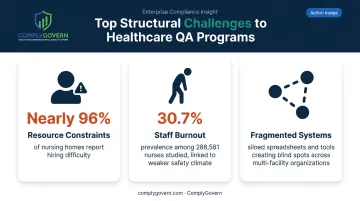
QA programs don't fail because leadership doesn't care. They fail because of predictable, structural friction:
- Resource constraints: nearly 96% of nursing homes report difficulty hiring, and staffing shortfalls make sustained QA engagement harder to maintain
- Staff burnout: a 2024 meta-analysis of 288,581 nurses found 30.7% burnout prevalence, correlated with weaker safety climate and lower care quality
- Fragmented systems: disconnected spreadsheets, shared drives, and departmental tools duplicate work and create blind spots, especially across multi-facility organizations where no one has a single view of organizational status
That last point is the one most within an organization's control. Unifying governance and QA data into one platform doesn't fix staffing shortages, but it does eliminate the duplicate manual effort that makes short-staffed teams even more stretched. These pressures aren't going away, and the next wave of QA requirements will only raise the bar further.
Where Healthcare QA Is Headed
- AI and predictive analytics: early detection of clinical deterioration, adverse drug events, and pressure ulcers, alongside growing attention to bias, model drift, and alert fatigue
- Telehealth and remote-care QA: NCQA's Virtual Care Accreditation program, launched in late 2023, reflects a shift toward patient-centered quality measures that extend beyond traditional in-facility metrics
The organizations that adapt fastest will be the ones already running a connected, real-time QA system, rather than retrofitting new requirements onto spreadsheets.
Frequently Asked Questions
What does QA stand for in healthcare?
QA stands for Quality Assurance: the systematic, proactive process healthcare organizations use to prevent errors and ensure consistent, safe patient care. It sets standards before problems occur, rather than reacting after the fact.
What are the top skills required for a healthcare quality assurance specialist?
Key skills include data analysis, regulatory knowledge (CMS, Joint Commission), clinical process understanding, and strong communication across departments. Familiarity with QA and compliance software platforms is increasingly essential too.
How is quality assurance different from quality control in healthcare?
QA is preventive, setting standards before care is delivered. QC is reactive, monitoring outcomes and catching deviations after they happen. A pre-surgical time-out is QA; tracking wrong-site surgery incidents is QC.
What are the biggest challenges in implementing quality assurance in healthcare?
Resource limitations, staff resistance or burnout, and fragmented, facility-specific regulatory requirements top the list. Multi-site organizations also struggle to align QA across different accreditation frameworks.
Can quality assurance help reduce healthcare costs?
Yes. By preventing errors, infections, and readmissions, QA reduces the costs tied to preventable harm, penalties, and malpractice exposure. The Fall TIPS program alone generated $22 million in savings across eight hospitals over five years.
How often should a healthcare QA program be reviewed or updated?
QA should follow a continuous PDCA cycle, with periodic formal reviews (typically quarterly or annually) rather than a one-time setup. Continuous monitoring, not scheduled snapshots, keeps it effective.