The stakes are real. A missed policy update, a version conflict between departments, or a lost signature page can trigger a failed survey or a patient-safety event. This guide ranks the top healthcare DMS platforms for 2026 and walks through the selection criteria that matter, whether you're running a hospital, an ASC, a skilled nursing facility, or a multi-site health system.
TL;DR
- Healthcare DMS platforms secure policies, protocols, and compliance records beyond basic file storage
- HIPAA-aligned security, workflow automation, and accreditation mapping are now baseline requirements
- This guide ranks 5 top platforms, from AI-powered processors to governance systems like ComplyGovern
- A "how we chose" methodology and FAQ section address common buyer questions below
Overview of Document Management Systems in the Healthcare Industry
A healthcare DMS is a digital platform built to capture, store, organize, and distribute policies, clinical protocols, records, and compliance documents securely. It's the difference between a searchable, audit-ready system and a shared drive full of outdated PDFs no one trusts.
The shift underway in 2026 isn't subtle. Providers are moving away from siloed drives and paper binders toward centralized, often AI-enabled platforms.
That shift shows up in the numbers. The medical document management market was valued at $0.66 billion in 2024 and is projected to reach $2.46 billion by 2035, growing at a 12.7% CAGR, according to Market Research Future's 2024 industry report.
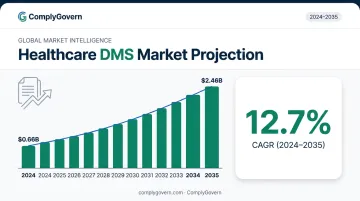
Compliance teams are driving much of that growth, prioritizing platforms that connect documents directly to regulatory and accreditation requirements.
The platforms below are evaluated on compliance capability, automation depth, security, and integration with clinical and governance systems, not just storage capacity or price point.
Top Healthcare Document Management Systems for 2026
Before profiling each platform, here's the lens we used: HIPAA-aligned security, accreditation and regulatory mapping, workflow automation, AI capability, and integration with EHR and clinical systems. We measured every platform on this list against these five factors.
ComplyGovern
ComplyGovern is a healthcare governance and compliance platform where document and policy management is natively unified with accreditation, quality, risk, and regulatory monitoring, rather than a standalone document repository bolted onto a workflow.
What makes it stand out:
- Microsoft 365/SharePoint-native document handling, so organizations already using Microsoft tools don't need a separate system
- Automated policy lifecycle management — templates, review workflows, staff attestation, version control, and scheduled reviews and expirations
- A Governance Intelligence Engine that links every policy to its regulations, standards, and evidence, so one update flows through the entire chain automatically
- Role-specific executive dashboards for the CEO, COO, CMO, CNO, CQO, CCO, CIO, and CRO, plus board and committee views
- Support for all 19 CMS-recognized facility types, from acute care hospitals to DMEPOS suppliers
| Best For | Organizations wanting document management unified with continuous compliance and governance, not just file storage |
| Key Features | Automated policy lifecycle management, HIPAA-aligned security, Governance Intelligence Engine linking policies to regulations and evidence, role-based executive dashboards |
| Integrations | Microsoft 365/SharePoint, Epic, Oracle Health (Cerner), MEDITECH, athenahealth, HL7/FHIR |
Where most policy tools stop at storage and version history, ComplyGovern goes further. It connects that same policy to the accreditation standard it satisfies, the risk register it informs, and the executive dashboard where leadership sees it in real time.
Hyland (OnBase / Intelligent Document Processing)
Hyland built its reputation as an enterprise content services provider, and its Intelligent Document Processing (IDP) capability targets high-volume healthcare document workflows where manual sorting simply doesn't scale.
Differentiators:
- OCR and ICR-based capture that reads both machine-printed text and handwriting
- AI classification and extraction across medical records, referrals, prior authorization, and billing documents
- Ability to process intake from fax, email, EHR, and patient portals simultaneously
| Best For | Large health systems needing high-volume automated document capture and classification |
| Key Features | AI/ML-based extraction, document separation and classification, scalable low-code automation |
| Integrations | EHR workflows, payer systems, enterprise content platforms |
Hyland fits organizations drowning in inbound paperwork, referrals, and prior authorization requests that need sorting before a human ever touches them.
PowerDMS
PowerDMS is a policy and accreditation management platform widely used by hospitals and healthcare facilities to stay survey-ready year-round, rather than scrambling in the weeks before an inspection.
Differentiators:
- Direct mapping of policies to accrediting body standards, including CMS, TJC, DNV, and AAAHC
- Automated staff attestation tracking with reminders and readership confirmation
- Version control that automatically archives prior policy versions while retaining edit and approval history
| Best For | Facilities prioritizing accreditation-standard mapping and staff policy attestation |
| Key Features | Standards manual integration, automated attestation tracking, cloud-based version control |
| Integrations | Mobile app access, training/LMS modules |
If your biggest headache is proving staff actually read and signed off on a policy before survey day, PowerDMS was built for that exact problem.
ComplianceQuest
ComplianceQuest is a Salesforce-built Quality, Risk, and Compliance platform, and document management is one module within a much broader QMS suite rather than a dedicated healthcare DMS.
Differentiators:
- HIPAA-aligned encryption, access controls, and audit trails built on the Salesforce architecture
- Workflow automation for claims and coding documents
- Centralized management of policies, procedures, guidelines, and regulatory documents alongside quality and CAPA functions
| Best For | Organizations that want document management bundled with broader quality/CAPA/audit functionality |
| Key Features | OCR-based search, cloud accessibility, role-based access controls, audit trail logging |
| Integrations | EHR, billing systems, Salesforce ecosystem |
This makes the most sense for organizations already running quality and CAPA processes through Salesforce and wanting document control folded into that same environment.
Laserfiche
Laserfiche has been an enterprise content management provider for decades, and hospitals and clinics use it heavily for records digitization and long-term retention.
Differentiators:
- Strong records retention and lifecycle rules, including automated cutoff and disposition scheduling
- E-forms that prepopulate data, capture signatures, and validate entries before routing
- Workflow automation suited to high document-volume environments like patient intake and referrals
| Best For | Facilities needing robust records retention and forms-based workflow automation |
| Key Features | Document capture, retention scheduling, e-forms, workflow automation |
| Integrations | Broad third-party connector ecosystem, cloud and on-premise deployment options |
Laserfiche is a solid fit if retention scheduling and forms automation matter more to you than deep accreditation mapping.
How We Chose the Best Healthcare DMS
The most common buyer mistake we see: picking a platform on brand recognition or price without checking whether it's actually HIPAA-aligned, mapped to your accreditation standards, or connected to your EHR. That gap doesn't show up until survey week, when it's too late to fix.
We evaluated every platform against factors tied to outcomes healthcare leaders actually care about:
- Security and compliance certifications: Does it support role-based access, audit logging, and encryption in line with HIPAA's technical safeguards?
- Workflow automation depth: Look for real reduction in manual review cycles, not just a digitized version of the same manual process.
- AI and search capability: Staff should be able to find the right document version in seconds, not minutes.
- Integration breadth: Does it connect to your EHR and existing Microsoft or clinical stack, or does it require a separate bridge system?
- Fit across facility types: Built for your setting, whether that's a critical access hospital or a single-site DMEPOS supplier.
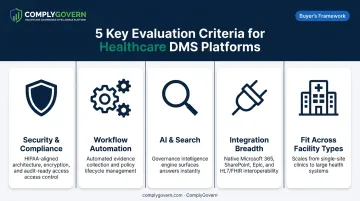
Each factor maps directly to a business outcome: survey readiness, reduced administrative burden, or fewer hours spent reconciling policies across disconnected tools.
Conclusion
The best healthcare DMS is the one that matches your organization's compliance maturity, facility type, and operational scale — not necessarily the one with the strongest brand name. Brand reputation alone won't tell you whether a platform can handle your survey cycle or your EHR integration needs.
Before you sign a contract, dig into scalability, integration depth, vendor support responsiveness, and total cost of ownership. Ask vendors how their platform handles a regulation change, not just how it stores a PDF.
For organizations that want document and policy management unified with continuous compliance, accreditation readiness, and governance visibility from boardroom to bedside, ComplyGovern delivers exactly that.
Frequently Asked Questions
What are the 5 C's of documentation?
Documentation should be clear, concise, complete, correct, and chronological. These principles reduce ambiguity in policies and clinical records and make information easier to verify during an audit or survey.
What is a DMS in a hospital?
A hospital DMS is the digital system used to store, control, and distribute policies, procedures, and records securely. It replaces paper binders and shared drives with a centralized, searchable, and auditable repository.
Is a healthcare DMS the same as an EHR?
No. A DMS manages organizational documents like policies, procedures, and compliance records, while an EHR manages individual patient clinical data. The two systems often integrate, but they serve different purposes.
How much does a healthcare document management system typically cost?
Pricing varies widely based on facility size, deployment model (cloud vs. on-premise), and the modules you need. Request vendor-specific quotes based on your user count and required features rather than relying on a general estimate.
What features should a HIPAA-compliant DMS include?
Baseline features include encryption at rest and in transit, role-based access controls, comprehensive audit trails, and version control. These align with the HHS Security Rule's technical safeguards around access, authentication, and transmission security.
Can a document management system integrate with governance and compliance platforms?
Yes, though integration means connecting two separate systems. Platforms like ComplyGovern take a different approach, unifying document and policy management directly with compliance, accreditation, and risk workflows in one system instead of requiring separate connectors.