Between shifting CMS Conditions of Participation, tighter accreditation survey cycles, state-specific requirements, and expanding privacy obligations, most compliance teams are managing more regulatory surface area than ever with the same headcount they had five years ago. Shared drives and spreadsheets simply can't keep pace.
Regulatory compliance monitoring software changes the equation. Instead of scrambling before every survey, teams get continuous, real-time visibility into where they stand. The healthcare compliance software market reflects this shift directly — TechSci Research projects the sector will grow from $2.94 billion in 2024 to $5.07 billion by 2030, a 9.5% annual growth rate.
This guide ranks the platforms worth evaluating in 2026, from healthcare-specialized tools to broader enterprise GRC systems.
Key Takeaways
- Compliance monitoring software replaces point-in-time audits with continuous regulatory and internal standards tracking
- Prioritize automation depth, framework coverage, and integration with existing clinical or enterprise systems
- This list includes healthcare-specialized tools like ComplyGovern and general enterprise GRC platforms
- The right tool cuts duplicate work across compliance, quality, and risk teams, boosting audit outcomes
Overview of Regulatory Compliance Monitoring Software in Today's Market
Regulatory compliance monitoring software is technology that continuously tracks, evidences, and reports on an organization's adherence to regulatory and internal standards. It replaces manual audits, disconnected spreadsheets, and departmental apps with a connected system that flags gaps as they emerge — not months later during survey prep.
The urgency behind this shift is measurable. In April 2026, HHS's Office for Civil Rights settled four HIPAA ransomware investigations with penalties ranging from $225,000 to $375,000, each requiring a corrective action plan monitored for two years.
These corrective action plans demand two years of continuous evidence, a burden manual processes struggle to sustain.
This pressure isn't limited to hospitals. Ambulatory surgical centers, skilled nursing facilities, and other care settings face similar demands to prove continuous compliance, not just periodic snapshots. Below, we evaluate the platforms that compliance, quality, and risk teams are actively considering in 2026.
Top Regulatory Compliance Monitoring Software Tools in 2026
We evaluated each platform on automation capability, breadth of regulatory coverage, integration ecosystem, industry specialization, and demonstrated customer trust.
ComplyGovern
ComplyGovern is a healthcare compliance and governance platform that unifies nine disciplines into a single system of record: governance, regulatory compliance, accreditation readiness, policy management, enterprise risk, quality performance, incident management, medical staff governance, and AI governance. It's built for every CMS-recognized facility type, from acute care hospitals to single-site DMEPOS suppliers.
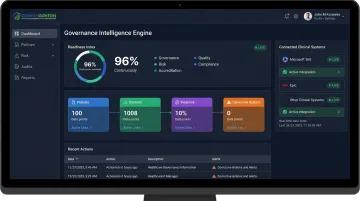
What sets it apart is the Governance Intelligence Engine, which automatically links regulations, accreditation standards, policies, controls, evidence, findings, and corrective actions in one continuous chain. Update a policy, and the change flows through the entire system, eliminating manual cross-referencing.
A few differentiators worth noting:
- Continuous survey readiness replaces last-minute prep with an always-current compliance state, reflected in a live Readiness Index dashboard
- Native Microsoft 365 and SharePoint integration, plus support for Teams, Power BI, and Power Automate, so teams work inside tools they already know
- HIPAA-aligned security, including role-based access control, MFA/SSO, and full audit logging
- Interoperability with Epic, Oracle Health, MEDITECH, and athenahealth via HL7 and FHIR standards
| Category | Details |
|---|---|
| Key Features | Continuous survey readiness, automated evidence collection, role-based executive dashboards, AI governance module |
| Best For | Hospitals, health systems, ASCs, SNFs, and other CMS-regulated facility types |
| Notable Strength | Single unified platform replacing fragmented spreadsheets, shared drives, and departmental apps |
Organizations exploring the platform can request a demo to see how the nine disciplines connect in practice.
Symplr
Symplr is a long-established healthcare operations vendor, with the company reporting use by 9 of 10 U.S. hospitals and more than 400 health plans. Its strength lies in provider credentialing and workforce compliance, areas where hospitals often struggle to keep pace manually.
| Category | Details |
|---|---|
| Key Features | Credentialing, incident management, policy management modules |
| Best For | Large hospital systems needing credentialing-heavy compliance workflows |
| Notable Strength | Deep healthcare workforce and provider data management |
RLDatix
RLDatix focuses on patient safety, risk, and compliance, with the vendor citing more than 10,000 healthcare organizations globally as customers. Its incident reporting and risk register tools tie directly into compliance tracking. This makes RLDatix a natural fit for organizations that treat safety events and regulatory adherence as one connected problem, not two separate workstreams.
| Category | Details |
|---|---|
| Key Features | Risk registers, incident/event reporting, quality analytics |
| Best For | Health systems prioritizing patient safety alongside regulatory compliance |
| Notable Strength | Strong safety-event and risk correlation capabilities |
MetricStream
MetricStream serves regulated industries well beyond healthcare, including finance and manufacturing. Its Connected GRC architecture links risk, compliance, audit, cyber, and third-party risk data, and its configurability makes it appealing to large enterprises with complex, cross-industry regulatory footprints.
| Category | Details |
|---|---|
| Key Features | Configurable GRC workflows, vendor risk management, regulatory change management |
| Best For | Large enterprises needing cross-industry, highly customizable GRC infrastructure |
| Notable Strength | Flexibility across multiple regulatory domains and industries |
NAVEX One
NAVEX One is widely used across industries for ethics and compliance management, particularly whistleblower hotline intake and policy attestation tracking. Organizations that need to pair regulatory monitoring with formal case management often land here.
| Category | Details |
|---|---|
| Key Features | Ethics hotline, case management, policy attestation, training tracking |
| Best For | Organizations prioritizing ethics and whistleblower compliance alongside regulatory tracking |
| Notable Strength | Established incident and case management ecosystem |
AuditBoard (Now Optro)
AuditBoard has been a go-to platform for internal audit and SOX compliance teams, known for audit workflow automation and controls testing. Note the naming change: AuditBoard rebranded as Optro on March 9, 2026, positioning itself as an AI-powered GRC platform. The underlying audit-to-remediation workflows remain the core draw for finance-driven compliance teams.
| Category | Details |
|---|---|
| Key Features | Audit management, controls testing, risk assessment workflows |
| Best For | Internal audit and finance-driven compliance teams |
| Notable Strength | Strong audit-to-remediation workflow automation |
How We Chose the Best Regulatory Compliance Monitoring Software
Most compliance teams make one of two mistakes when selecting software: they choose on price alone, or they ignore how well a tool integrates with existing clinical and enterprise systems. Both lead to costly re-platforming a year later.
We assessed each platform against five factors, each tied to a measurable outcome:
- Regulatory framework coverage: Does it reduce the number of manual gap checks needed across CMS, HIPAA, and accreditation standards?
- Automation depth: Cutting survey prep time from weeks to days matters more than flashy dashboards that don't save real hours.
- Integration capability: Does it connect natively with EHR platforms and productivity tools already in use?
- Industry specialization: Built for healthcare-specific workflows, not a generic risk tool retrofitted for compliance.
- Evidence of client trust: A track record across comparable facility types matters more than marketing claims alone.
Key Features to Look for in Regulatory Compliance Monitoring Software
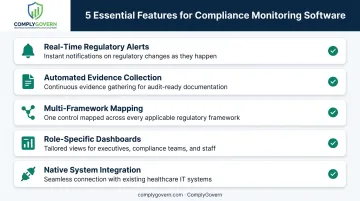
Not every platform on this list solves the same problem. Before you commit, check whether a tool actually delivers on these five capabilities.
- Real-time regulatory change tracking and alerts. The platform should flag new or updated requirements (a CMS Condition of Participation update, a revised Joint Commission standard) before they create a compliance gap, not after a surveyor finds it.
- Automated evidence collection and audit trails. Manual document-gathering ahead of an inspection eats weeks of staff time, so look for tools that maintain evidence continuously and need no last-minute assembly.
- Multi-framework mapping. A single infection control policy might need to satisfy CMS rules, Joint Commission standards, OSHA requirements, and state licensing at once. The strongest platforms map one policy to multiple frameworks instead of forcing duplicate entries.
- Role-specific executive and board dashboards. Compliance officers, CMOs, CROs, and board members all need different views of the same data. Real-time dashboards (not quarterly PDF reports) give leadership genuine line of sight into organizational posture.
- Native integration with existing systems. A tool that doesn't connect to your EHR (Epic, Oracle Health, MEDITECH) or your productivity suite (Microsoft 365) creates a second system of record instead of replacing the fragmented one you already have. That defeats the purpose.
Conclusion
The right regulatory compliance monitoring software matches your operational reality and regulatory complexity, not just a vendor's brand recognition. Before finalizing a decision, weigh scalability, integration readiness, and total cost of ownership as carefully as you'd weigh feature lists.
For healthcare organizations looking to unify governance, compliance, and accreditation readiness into one continuously updated system, ComplyGovern is built specifically for that job. It connects nine governance disciplines through a single Governance Intelligence Engine, spanning everything from the boardroom to the bedside.
Frequently Asked Questions
What is compliance monitoring?
Compliance monitoring is the continuous process of verifying that an organization adheres to regulatory and internal requirements. It replaces one-time audits with ongoing review of processes, procedures, and emerging risk.
What are the 7 pillars of compliance?
The commonly cited pillars are written policies, compliance leadership and oversight, training, communication channels, enforcement of standards, risk assessment and auditing, and responding to detected issues with corrective action.
What are the key techniques for monitoring compliance?
Common techniques include regular audits, automated controls testing, real-time dashboards that flag emerging gaps, and corrective action tracking that closes the loop once an issue is found.
How much does regulatory compliance monitoring software typically cost?
Pricing varies based on facility size, modules needed, and deployment scope. Most enterprise vendors, including ComplyGovern, require a tailored quote rather than publishing fixed rates. Request a demo to get accurate numbers for your organization.
Is compliance monitoring software legally required?
Few regulators mandate a specific software product. The OIG's General Compliance Program Guidance is voluntary, and the HIPAA Security Rule is technology-neutral — but both require documented monitoring plans that software helps satisfy.
What's the difference between compliance monitoring software and a broader GRC platform?
Compliance monitoring tools focus specifically on tracking adherence to regulations and policies. GRC platforms add risk management and audit functionality on top, serving organizations that need a wider enterprise-risk lens alongside compliance tracking.