Healthcare and other regulated organizations are tracking more risk than ever — patient safety events, cyber threats, vendor exposure — while regulators expect proof, not promises. In 2024 alone, HHS recorded 663 large PHI breaches affecting roughly 242.9 million people, with hacking incidents responsible for 81% of reports and 99% of affected individuals.
Risk register software replaces that chaos. It gives compliance, quality, and risk teams one place to identify, score, assign, and track risk instead of chasing five different tabs across three different departments.
This guide compares the 9 best risk register software options for 2026, including platforms purpose-built for healthcare governance.
TL;DR
- Risk register software centralizes risk identification, scoring, ownership, and mitigation
- Selection hinges on risk scoring, ownership workflows, integrations, and framework mapping
- Nine tools compared: ComplyGovern, MetricStream, Resolver, LogicGate, OneTrust, RiskOptics, Riskonnect, LogicManager, and Sprinto
- Healthcare adds accreditation, CMS, and HIPAA demands most generic tools miss
Overview of Risk Register Software in Healthcare & Enterprise Risk Management
A risk register is a living record of identified risks (likelihood, impact, owner, and mitigation status) maintained instead of buried in a spreadsheet no one updates. It's become foundational to enterprise risk management (ERM), compliance programs, and board reporting because auditors and executives need current data, not last quarter's snapshot.
The market reflects that shift. The US eGRC market is projected to grow from $4.92 billion in 2024 to $10.17 billion by 2030, a 13.3% compound annual growth rate.
Healthcare's Extra Layer of Complexity
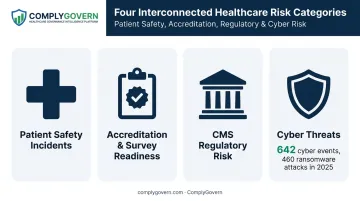
Generic risk registers weren't built for hospitals. Healthcare organizations juggle:
- Patient safety incidents that require root-cause tracking, not just a severity score
- Accreditation and survey readiness across bodies like The Joint Commission, DNV, or AAAHC
- CMS regulatory risk tied to Conditions of Participation and quality reporting
- Cyber threats: healthcare was the most-targeted critical infrastructure sector in 2025, logging 642 cyber events including 460 ransomware attacks
Below, we rank the top risk register software for 2026, starting with platforms designed for regulated and healthcare environments.
Top 9 Risk Register Software for 2026
We weighed each tool on risk scoring depth, ownership and workflow automation, framework mapping, integration ecosystem, and fit for regulated industries.
1. ComplyGovern
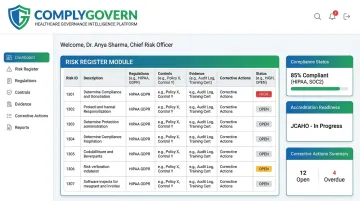
ComplyGovern is a healthcare compliance and governance platform where risk management is one of nine connected disciplines, alongside compliance, accreditation, quality, and policy governance. It replaces the spreadsheets and siloed risk logs many facilities still rely on.
What sets it apart for healthcare: its Governance Intelligence Engine automatically links risks to regulations, controls, evidence, audits, and corrective actions. That gives boards and executives real-time, role-specific dashboards instead of a static risk list nobody opens between audits.
| Key Features | Risk register tied to CMS regulations, accrediting body standards, and internal policies; automated evidence and corrective action tracking; native Microsoft 365/SharePoint integration |
| Best Suited For | Hospitals, health systems, ASCs, SNFs, and other CMS-recognized facility types needing unified governance, not a standalone risk log |
| Notable Differentiator | HIPAA-aligned security with integrations to Epic, Oracle Health (Cerner), MEDITECH, and athenahealth, tying risk data directly to clinical operations |
2. MetricStream
MetricStream is an enterprise-grade GRC platform where risk register functionality lives inside a much broader Connected GRC suite, built for global, complex organizations.
Its strength is analytics — multi-framework support spanning ISO 31000, NIST, COSO, and HIPAA gives executives real-time visibility across risk categories. The tradeoff: some users report a steep learning curve and dashboards that feel dated compared to newer entrants.
| Key Features | Configurable risk levels, workflow automation, regulatory mapping across CCPA, COSO, HIPAA, and NIST |
| Best Suited For | Large, global enterprises managing multi-jurisdiction risk |
| Notable Differentiator | Deep analytics and reporting layered onto a full Connected GRC ecosystem |
3. Resolver
Resolver targets mid-size to enterprise organizations that need detailed risk profiles (descriptions, categories, impact, and likelihood) rather than a bare-bones list.
It connects risks directly to business processes, so teams see contextual impact instead of an isolated score. Scenario modeling adds another layer of insight. New users, however, often find the reporting interface and licensing structure harder to navigate at first.
| Key Features | Risk-to-process mapping, scenario modeling, customizable workflows, incident and compliance integration |
| Best Suited For | Enterprise risk teams needing contextual, process-linked risk views |
| Notable Differentiator | Scenario modeling to simulate risk impact across business functions |
4. LogicGate Risk Cloud
LogicGate is a no-code, highly configurable platform that lets organizations build custom risk registers from scratch, mapped to their specific structure rather than a fixed template.
Workflow automation and visual risk mapping cut down manual work significantly. That flexibility comes at a cost: extensive customization means longer setup and more reliance on support during implementation.
| Key Features | Visual risk mapping, workflow automation, cross-department risk assessment builder |
| Best Suited For | Organizations wanting a flexible, build-your-own risk register structure |
| Notable Differentiator | No-code customization for unique risk scoring and assessment logic |
5. OneTrust Risk Management
OneTrust bundles risk management with security compliance, a natural fit for organizations handling sensitive data under heavy regulation.
A large pre-built library of risk assessments and controls speeds up onboarding, and AI-enabled data discovery helps map where sensitive data actually lives. Customer support responsiveness is the most common complaint in user reviews.
| Key Features | Pre-built risk assessment library, data discovery/mapping, AI-enabled governance |
| Best Suited For | Organizations managing privacy, data governance, and security risk together |
| Notable Differentiator | Multi-product ecosystem spanning privacy, security, and risk in one suite |
6. RiskOptics (ZenGRC)
RiskOptics focuses on relationships (between risks, controls, and business processes) for a more nuanced view than a flat spreadsheet ever gave you.
Its beginner-friendly interface and solid integrations make it accessible across industries, including finance and healthcare. Dashboard personalization and training resources lag behind more established competitors.
| Key Features | Relationship-based risk mapping, customizable risk register fields, cross-system integrations |
| Best Suited For | Teams new to GRC software wanting an easier learning curve |
| Notable Differentiator | Strong usability across multiple non-tech industries, including healthcare |
7. Riskonnect
Riskonnect integrates insurance claims, policy administration, business continuity, and crisis management alongside its risk register, a wider net than most competitors cast.
Quantitative risk modeling (including Monte Carlo analysis) and a mobile app enable real-time reporting from field operations. Implementation can move slowly, though, and admin-side features aren't the most intuitive.
| Key Features | Quantitative risk modeling, mobile risk reporting, insurance and claims integration |
| Best Suited For | Organizations with field operations or insurance-heavy risk exposure |
| Notable Differentiator | Mobile-first risk reporting for distributed or field-based teams |
8. LogicManager
LogicManager combines ERM with corporate governance, serving both tech and non-tech industries — healthcare, banking, and manufacturing among them.
Reviewers consistently praise hands-on customer support and customizable workflows. On the downside, reporting can be slow to generate, and control-to-risk mapping lacks the granularity some larger organizations want.
| Key Features | ERM and governance combined, customizable workflows, business continuity modules |
| Best Suited For | Organizations wanting strong implementation support across varied industries |
| Notable Differentiator | Consistently rated for responsive, hands-on customer service |
9. Sprinto
Sprinto is a GRC automation platform built primarily for tech companies, connecting its risk register to controls, evidence, and frameworks like SOC 2 and ISO 27001.
Its 200+ integrations and continuous control monitoring keep risk scores current automatically, rather than depending on someone remembering to run a quarterly review.
| Key Features | Configurable risk scoring, continuous control monitoring, automated remediation tracking |
| Best Suited For | Tech and SaaS companies needing risk management tied to security compliance frameworks |
| Notable Differentiator | Deep automation connecting risk scoring to real-time control health |
How We Chose the Best Risk Register Software
The most common mistake organizations make is picking a tool based on brand recognition or a generic risk-list feature, then discovering during implementation that it doesn't match how their team actually works.
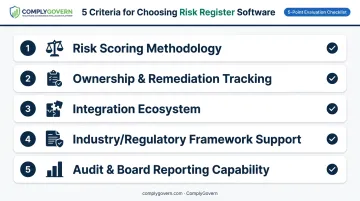
We weighted five factors instead:
- Risk scoring methodology: does it distinguish inherent from residual risk?
- Ownership and remediation tracking: can you assign, escalate, and close the loop?
- Integration ecosystem: does it connect to the systems teams already use?
- Industry/regulatory framework support: ISO 31000, NIST, COSO, HIPAA, and beyond
- Audit and board-reporting capability: can leadership get answers without a manual pull?
For regulated industries like healthcare, one factor outweighs the rest: the ability to map risks directly to accreditation standards, CMS regulations, and clinical systems. This capability separates a tool that simply logs risk from one that proves you actively managed it.
Conclusion
The "best" risk register software depends entirely on your operational goals. A generic tool might satisfy a fast-moving startup just fine. A hospital or health system needs risk tied directly to compliance, quality, and accreditation, or it's just another disconnected list.
Because needs vary this dramatically, pilot 2-3 shortlisted tools before you commit long-term. Test scalability, integration depth, and reporting under real conditions, not a sales demo.
For healthcare leaders specifically, ComplyGovern unifies risk register, compliance, accreditation, and quality functions in one connected system of record, replacing five disconnected tools that don't communicate.
Frequently Asked Questions
What is a software risk register?
A software risk register is a structured, digital repository that logs identified risks, their likelihood, impact, ownership, and mitigation status. It replaces manual spreadsheets with a centralized, continuously updated system.
Does Jira have a risk register?
Jira isn't a native risk register tool, but teams adapt it for project-level risk tracking using custom issue types or third-party Marketplace add-ons. Purpose-built GRC platforms offer far deeper scoring, ownership, and framework mapping than these workarounds.
What is the NIST 800-53 risk register?
A NIST 800-53 risk register documents security and privacy risks mapped against NIST SP 800-53 controls. NIST doesn't publish an official template, so organizations build their own using the framework as a guide.
What should be included in a risk register?
At minimum: risk description, cause, likelihood, impact, risk owner, priority level, mitigation plan, and current status. More mature registers also track review dates and residual risk after controls are applied.
How much does risk register software typically cost?
Pricing varies widely by vendor and scale, from free trial tiers to enterprise contracts running into six figures. Weigh cost against integration depth and framework coverage, not just the sticker price.
Do healthcare organizations need a risk register for accreditation and compliance?
Accreditation bodies and CMS surveys don't always mandate a specific tool, but they do expect evidence of proactive risk management. A current, evidence-backed risk register speeds up survey prep and lowers the odds of citations for undocumented risks.