Introduction
Hospital falls aren't just a nursing problem. In 2024, falls accounted for 776 of the Joint Commission's 1,575 reported sentinel events — 49% of all serious incidents, with 65% resulting in severe harm. Nearly a third happened from beds, and almost one in five occurred during toileting, squarely inside the spaces Environment of Care (EOC) rounds are built to inspect.
Yet many EOC teams still run rounds on paper forms or spreadsheets. The same cracked threshold, the same expired extinguisher tag, the same unlocked medication cart show up round after round because nobody owns the fix and nobody tracks it to closure.
This guide breaks down a complete EOC rounding checklist by category and explains the "5 P's" framework borrowed from nursing rounds. It also shows the tools that turn one-off inspections into continuous, governance-connected readiness.
Key Takeaways
- Organize EOC checklists by function (life safety, infection control, security, utilities), tying each item to its regulatory rationale.
- Checklists only work when each finding has a named owner and a documented resolution deadline.
- Digital rounding tools cut resolution time and give leadership real-time visibility paper trails can't match.
- Most EOC programs' biggest gap is findings that never connect to the broader compliance and governance record.
What Is Environment of Care (EOC) Rounding?
EOC rounding is a scheduled, structured walkthrough that identifies environmental risks before they become incidents. It's proactive by design: teams inspect life safety, security, hazardous materials, and utility systems on a set cadence rather than waiting for an incident report to trigger a look.
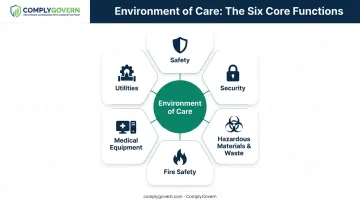
This proactive posture isn't just good practice; it's a regulatory mandate. CMS requires hospitals to be "constructed, arranged, and maintained to ensure the safety of the patient" under 42 CFR 482.41. The Joint Commission organizes its expectations around six environment-of-care functions: safety, security, hazardous materials and waste, fire safety, medical equipment, and utilities.
Meeting these six functions on paper isn't enough: governance follow-through determines whether rounding actually reduces risk. Mature EOC programs don't stop at the department manager's desk. Findings get rolled up through safety and EC committees, then reported to the governing board as part of the hospital's broader quality oversight. If rounding data dies in a binder on a facilities manager's desk, that oversight chain breaks.
Examples of Care Environments Covered by EOC Rounds
A representative round typically covers:
- Patient rooms and ICU/critical care units
- Hallways, corridors, and stairwells
- Restrooms and waiting areas
- Medication rooms and clean utility rooms
- Dietary and kitchen areas
- Behavioral health units, with specific self-harm risk checks
Back-of-house spaces belong on the list too. Mechanical rooms, storage closets, and loading docks carry real fire, security, and infection risks — even though no patient ever sees them. A locked utility closet with an expired inspection tag is just as much a finding as an unlocked medication cart in a hallway.
The Complete EOC Rounding Checklist: What to Inspect, Category by Category
The most effective checklists don't just list tasks. They pair every item with its regulatory standard and the reasoning behind it. That context turns a checklist into an ongoing staff training tool, not just a compliance chore.
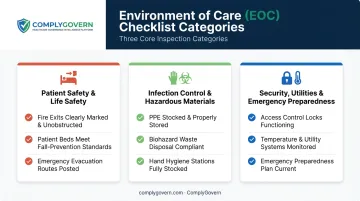
Patient Safety & Life Safety
This category catches the hazards most closely tied to falls and fire, the two risks that dominate sentinel event data:
- Bed and pathway safety: beds locked, walkways clear, mobility aids and call lights within patient reach
- Fire safety basics: exits unobstructed, extinguishers inspected and accessible, self-closing doors latching properly
- Physical hazards: broken floor thresholds, flickering or burned-out lighting, exposed cords or cables
Infection Control & Hazardous Materials
Environmental cleanliness and hazardous waste handling sit at the intersection of EOC and infection prevention. The CDC's environmental infection control guidance covers air, water, environmental services, and regulated medical waste, all worth checking during rounds:
- PPE and isolation stations: supplies stocked at every critical care bedside
- Sharps and biohazard handling: containers unobstructed, upright, and not overfilled; materials disposed of per protocol
- Linen management: carts covered, with a documented "who cleans what" plan for environmental services
Security, Utilities & Emergency Preparedness
This category protects against risks that rarely make headlines until something fails: an unsecured utility room, an expired temperature log, a blocked emergency shutoff.
- Temperature logs: refrigerator and medication storage logs current and reviewed
- Utility security: mechanical rooms secured; emergency equipment accessible and unobstructed
- Floor and access safety: wet-floor signage used and promptly removed; restricted-access areas kept locked
The 5 P's of Rounding and How They Apply to EOC
Nursing teams have used "P" frameworks for intentional rounding for years. The most commonly cited version covers Pain, Position, Personal needs, Placement of items, and Potty — though versions vary across organizations, with some versions substituting possessions, proximity, or patient focus. Check which version your organization has actually adopted before it goes on a badge card.
The discipline behind the framework, not the exact letters, is what translates to EOC rounding. Instead of asking a patient about comfort, an EOC round asks the same structured questions about the environment:
- Is equipment placed within safe, accessible reach?
- Are pathways and exits clear of obstruction?
- Is signage and labeling where it needs to be?
Both models share one goal: catch problems before they cause harm, not after. A nurse who checks call-light placement every hour prevents a fall. A facilities team that checks extinguisher tags every month prevents a fire code citation, or worse. The methodology is identical, even though the checklist items look nothing alike.
Digital Tools for Smarter, More Consistent EOC Rounding
Paper checklists and shared spreadsheets get EOC programs off the ground, but they cap out fast. A clipboard can't send a reminder when a finding sits open for three weeks. A spreadsheet can't show the CNO which unit has the most recurring deficiencies this quarter.
Mobile platforms solve exactly that problem, replacing clipboards with tools built for data coordination, team collaboration, and workflow tracking rather than static forms. The real value comes from the audit trail, the timestamp, and the assignment that follow each finding until it's closed.
Key Features to Look for in EOC Rounding Software
Not every rounding app delivers the same value. Look for:
- Structured, button-based data entry on mobile or tablet devices, delivering faster and more consistent results than free-text notes
- Automated escalation workflows that notify supervisors when a flagged issue isn't resolved within a set timeframe
- Real-time dashboards that aggregate compliance scores and surface recurring deficiencies across units and time periods
These three features eliminate the two most common failure points in paper-based rounding: forgotten follow-ups and invisible patterns.
Moving Beyond Point Solutions to Unified Governance
Here's the catch: even a solid standalone rounding app has a ceiling. Findings get logged and tracked, but they often stay siloed from the organization's broader accreditation, quality, and risk records, recreating the exact fragmentation EOC rounds are supposed to eliminate. A flagged hazard in the rounding app doesn't automatically show up in the risk register, the corrective action log, or the board packet.
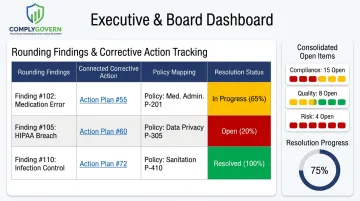
This is the gap ComplyGovern is built to close. Its Governance Intelligence Engine automatically connects findings to corrective action tracking and policy mapping, so a rounding deficiency flows into the same governance chain as every other item, including regulations, standards, controls, evidence, and audits.
Executive and board dashboards then show that finding through to resolution, alongside every other open item across compliance, quality, and risk. Leadership gets one record, not six disconnected ones.
Common Challenges in EOC Rounding (and How to Solve Them)
Most EOC programs don't fail because the checklist is wrong. They fail because of what happens, or doesn't happen, after the round ends.
| Challenge | Why It Happens | How to Solve It |
|---|---|---|
| Irregular rounding schedules | Departments round when they remember, not on a fixed cadence | Automated scheduling and reminder workflows tied to a set interval |
| Undocumented or unowned findings | Issues get flagged verbally, then forgotten | A named owner and resolution deadline on every finding, tracked to closure |
| Siloed clinical, facilities, and compliance teams | Each department works from its own spreadsheet or app | Shared dashboards giving every team real-time visibility into open findings |
The pattern is consistent: whatever isn't assigned, scheduled, or visible tends to repeat. A recurring deficiency on the same unit for three straight quarters almost always points to a tracking gap rather than a training gap. Platforms like ComplyGovern close that gap by automating reminders, assigning owners to every finding, and surfacing open items on a shared dashboard until they're resolved.
Frequently Asked Questions
What is the EOC rounding checklist?
A structured list of environmental safety and compliance checkpoints, covering life safety, infection control, and security, used during scheduled facility inspections. Each item ties back to a specific regulatory or accreditation standard.
What are the 5 P's of patient rounding?
The most commonly cited version covers Pain, Personal needs, Position, Placement of items, and Potty needs. The framework structures nursing rounds around proactive checks rather than reactive response, though variations exist across organizations.
What are examples of care environments?
Common examples include patient rooms, hallways, restrooms, medication rooms, and back-of-house spaces like mechanical rooms and loading docks. EOC rounds cover clinical and non-clinical areas alike.
How often should EOC rounds be conducted?
Frequency is not fixed by federal rule; it is set locally based on risk, facility type, and accrediting body expectations. Most hospitals settle on monthly or quarterly rounds, with more frequent checks in high-risk units.
Who should participate in EOC rounds?
Effective rounds bring together a multidisciplinary team, including infection control, facilities, nursing, and safety officers, rather than one department working alone. That mix catches risks a single perspective would miss.
What's the difference between EOC rounding and infection control rounding?
EOC rounding covers the broader physical environment, including life safety, security, and utilities. Infection control rounding focuses specifically on hygiene, sterilization, and pathogen transmission risks, though the two frequently overlap.