Yet many organizations are still running risk programs on spreadsheets and disconnected departmental tools. That creates blind spots, duplicated work, and board reports assembled the night before a meeting instead of pulled from live data.
This guide breaks down the top ERM platforms for 2026, the features that actually matter, and how to match a platform to your organization's size and industry.
Key Takeaways
- Spreadsheet-based ERM is becoming a liability as regulatory and AI-governance demands accelerate.
- Six platforms lead the 2026 market: ComplyGovern, MetricStream, LogicManager, Resolver, AuditBoard (now Optro), and ServiceNow GRC.
- Continuous monitoring, framework mapping, and executive dashboards are now baseline requirements, not premium add-ons.
- Industry-specific platforms often out-perform generic ERM tools on regulatory depth.
- Total cost of ownership matters more than sticker price when comparing vendors.
Overview of ERM Software in the Enterprise Risk Market
ERM software operationalizes the enterprise risk management lifecycle (identification, scoring, treatment, monitoring, and reporting) inside a single platform instead of scattered spreadsheets and email threads.
The market reflects that shift. The global enterprise governance, risk, and compliance software market was estimated at $72.4 billion in 2025. It's projected to reach $82.9 billion in 2026, according to Grand View Research's enterprise GRC market analysis.
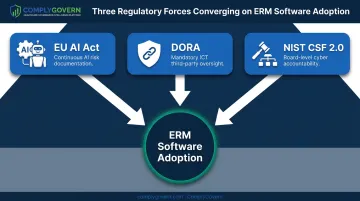
Three forces are pushing adoption hard in 2026:
- The EU AI Act now requires documented, continuous risk management for high-risk AI systems throughout their lifecycle.
- DORA makes ICT third-party risk a mandatory component of financial entities' risk frameworks, complete with due diligence and exit-strategy requirements.
- NIST CSF 2.0's GOVERN function puts cybersecurity risk accountability squarely on organizational leadership, pushing oversight up to the board.
None of these mandates specify a single software product. But they all demand traceability, evidence, and monitoring that spreadsheets simply can't deliver at scale. The section below ranks the platforms best positioned to meet that bar across enterprise and industry-specific use cases.
Key Features to Look for in ERM Software
Not every ERM platform is built the same way. Before comparing vendors, know what separates a credible system from a glorified spreadsheet with a login screen.
Risk Register, Framework Mapping, and Regulatory Alignment
A dynamic, searchable risk register with likelihood/impact scoring is the foundation. If risks live in disconnected tabs across departments, nobody, including the board, has a true enterprise-wide view.
Built-in mappings to COSO ERM, ISO 31000, and NIST RMF, or industry-specific regulations, connect risks directly to the compliance obligations they affect, instead of leaving that work to a spreadsheet formula someone built in 2019.
Continuous Monitoring, Automation, and Board Visibility
Manual, point-in-time assessments miss emerging risks between review cycles. That gap is real: among 405 internal audit respondents, only 12% reported high or advanced continuous-monitoring use, and just 7% reported high or advanced automation use in their risk programs. Platforms with automated evidence collection close that gap.
Static slide decks no longer cut it, either. Boards and audit committees expect real-time, role-specific dashboards that reflect current risk posture, not last quarter's snapshot.
Third-Party Risk and Platform Integration
Regulatory focus on ICT third-party oversight (see DORA) means ERM tools need visibility into vendor and supply chain risk, not just internal operations.
That same connectivity matters internally: native connections to Microsoft 365/SharePoint, ERP or clinical systems, and identity tools reduce implementation friction. Every duplicate data entry point is a future error waiting to happen.
Top ERM Software Platforms for 2026
The rankings below weigh breadth of risk coverage, framework support, industry fit, integration depth, and verified customer feedback from sources like G2 and Gartner Peer Insights.
ComplyGovern
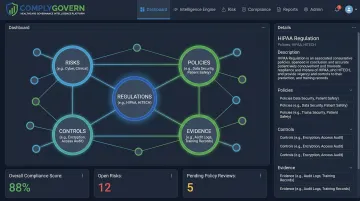
ComplyGovern is a healthcare-focused governance and compliance platform that unifies enterprise risk management with accreditation, quality, policy, and AI governance in one system of record. For hospitals, health systems, and other CMS-recognized facilities, that matters, because risk is tied directly to survey readiness and regulatory obligations rather than abstract policy language.
The platform's Governance Intelligence Engine links risks to regulations, accreditation standards, policies, controls, evidence, quality measures, audits, findings, and corrective actions automatically. When a regulation changes, the impact ripples through every connected policy and control without manual re-entry.
Key differentiators:
- Continuous survey and accreditation readiness instead of last-minute scrambles before a Joint Commission or DNV survey
- HIPAA-aligned security, including MFA/SSO, role-based access control, and encryption at rest and in transit
- Native Microsoft 365/SharePoint integration, plus interoperability with Epic, Oracle Health (Cerner), MEDITECH, and athenahealth for risk data tied directly to clinical operations
| Best For | Hospitals, health systems, ASCs, and other CMS-recognized healthcare facility types needing risk unified with compliance and accreditation |
| Key Features | Governance Intelligence Engine linking risks, controls, policies, and evidence; role-specific executive/board dashboards; automated corrective action tracking |
| Differentiator | The only platform combining ERM with nine connected governance disciplines built specifically for healthcare regulatory complexity |
MetricStream
MetricStream has served large, multinational enterprises for years, with dedicated solutions across financial services and life sciences. It's an established name in complex, multi-framework compliance environments.
What stands out is configurability. MetricStream supports deep customization of risk workflows, a broad framework library, and AI-enabled risk analytics for organizations juggling dozens of regulatory obligations at once.
| Best For | Large global enterprises with complex, multi-framework compliance needs |
| Key Features | Configurable risk workflows, extensive framework library, AI-enabled risk analytics |
| Pricing | Quote-based, generally sized for enterprise budgets. Confirm current terms directly with the vendor |
LogicManager
LogicManager built its reputation on ease of implementation for mid-market organizations building a formal ERM program for the first time. It skips the multi-month configuration slog that larger suites sometimes require.
Pre-built risk taxonomies and guided workflows mean faster time-to-value. That's useful for a team without a dedicated risk technology staff.
| Best For | Mid-market organizations building their first formal ERM program |
| Key Features | Risk taxonomy templates, automated risk scoring, point-and-click reporting |
| Pricing | Tiered pricing, generally more accessible than large enterprise GRC suites. Verify current figures with LogicManager |
Resolver
Resolver operates as a risk intelligence platform, connecting security, compliance, and risk data across an organization. Now part of Kroll, it reports more than 1,000 global customers.
Its strength is incident-to-risk correlation, unifying physical security, cyber, and compliance data into one risk model instead of three separate systems that never talk to each other.
| Best For | Organizations wanting risk intelligence spanning physical security, cyber, and compliance |
| Key Features | Incident-to-risk correlation, configurable risk models, real-time reporting |
| Differentiator | Strength in unifying security operations data with enterprise risk context |
AuditBoard (now Optro)
AuditBoard rebranded to Optro in March 2026, but its audit-first heritage remains the core strength. Built around connected audit, risk, and compliance workflows, it's popular with internal audit teams managing ERM alongside SOX and controls testing.
AI-assisted testing and scenario planning (including Monte Carlo modeling) give internal audit and risk teams a shared view of exposure, rather than two departments running separate risk conversations.
| Best For | Organizations wanting tightly connected internal audit, controls, and ERM workflows |
| Key Features | Connected risk register, AI-assisted testing, in-depth reporting and dashboards |
| Differentiator | Deep internal audit heritage that appeals to CAE and CRO co-owned programs |
ServiceNow GRC
ServiceNow GRC lives inside the broader ServiceNow ITSM/workflow platform. For organizations already running ServiceNow, it's a natural extension rather than a new tool to onboard.
The payoff is tight integration between IT risk and existing service management workflows, including CMDB-linked asset and process risk scoring. For organizations whose biggest risk exposure is operational or IT-driven, this fit is hard to beat.
| Best For | Organizations already using ServiceNow for ITSM wanting native risk and compliance extension |
| Key Features | Workflow automation, IT risk-to-incident linkage, configurable risk dashboards |
| Differentiator | The strongest fit for organizations prioritizing IT/operational risk integration over standalone ERM |
How We Chose the Best ERM Software
Buyers make predictable mistakes when selecting ERM tools. According to Gartner, risk leaders often select platforms based on stakeholder pressure rather than fit, or assume a single vendor with many modules will always outperform a combination of point solutions. That assumption doesn't hold up in practice.
Implementation timelines make this worse than expected. The same research shows that GRC tool evaluations can exceed six months, with implementations requiring at least nine additional months to reach full functionality.
We weighed the following factors for each platform:
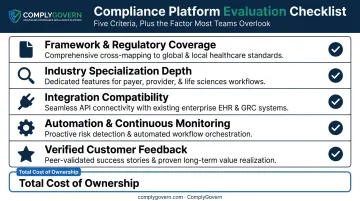
- Framework and regulatory coverage across relevant industries
- Industry specialization depth, not just generic risk coverage
- Integration compatibility with existing tech stacks
- Automation and continuous monitoring capability
- Verified customer feedback from G2 and Gartner Peer Insights
We also weighed scalability and total cost of ownership, including implementation effort, training time, and ongoing admin burden, alongside sticker price. A cheaper platform that takes a year to configure isn't actually cheaper.
Conclusion
There's no universal "best" ERM software. The right fit depends on your organization's size, regulatory complexity, and what's already running in your tech stack. A global manufacturer's needs look nothing like a critical access hospital's.
Before signing anything, request demos, stress-test integration compatibility, and pilot the platform with a real risk register, not a sample dataset built for the sales demo. This step matters most in healthcare, where governance gaps carry real risk.
For healthcare organizations evaluating ERM as part of a broader governance strategy, a unified platform like ComplyGovern connects risk directly with compliance, accreditation, and quality. This approach replaces treating each function as a separate project competing for the same staff time.
Frequently Asked Questions
What are the core components of enterprise IT risk management?
The recurring components across frameworks are risk identification, assessment and scoring, control implementation, and continuous monitoring. These stages repeat in a cycle rather than running once and stopping.
What does enterprise IT risk management do?
It identifies, assesses, and mitigates technology-related risks, cyber threats, system failures, and data exposure, then ties them to broader business risk and compliance objectives. The goal is treating IT risk as part of the enterprise risk picture, tied directly to business outcomes.
How much does ERM software typically cost in 2026?
Pricing varies widely by vendor, deployment size, and module scope (risk-only versus full GRC). Mid-market platforms often use tiered pricing starting around $10,000-$50,000 per year, while enterprise-grade tools with full GRC functionality are typically quote-based and can exceed $100,000 annually depending on user count and modules.
What is the difference between ERM software and GRC software?
ERM software focuses specifically on risk identification and treatment. GRC software bundles governance, risk, and compliance modules together, often including ERM as one component within a larger suite.
Do small and mid-sized organizations need dedicated ERM software?
Increasingly, yes. As risk complexity and regulatory scrutiny grow even for smaller organizations, dedicated ERM software reduces manual spreadsheet errors and supports audit and board reporting requirements that spreadsheets can't reliably handle.
What is the best ERM software for healthcare organizations?
Healthcare organizations benefit most from platforms that unify risk with accreditation, quality, and policy management, such as ComplyGovern, rather than generic risk-only tools. CMS and accreditation-specific requirements demand that level of specificity.