That's the gap automation software is built to close. Compliance officers, IT teams, and executives are replacing reactive audit-prep scrambles with continuous, always-on monitoring that catches problems before a surveyor does.
This guide breaks down what HIPAA automation software actually does, ranks the top platforms worth evaluating, and helps you match the right tool to your organization's size and complexity.
TL;DR
- HIPAA automation monitors controls, collects evidence, and manages policies for year-round audit-readiness
- The right fit depends on facility type, tech stack, and whether you need HIPAA-only or broader governance
- Top platforms compared here: ComplyGovern, Sprinto, Compliancy Group, Drata, and Accountable
- Prioritize integration depth, framework coverage, and executive visibility over brand recognition alone
Overview of HIPAA Compliance Automation Software in Healthcare
HIPAA compliance automation software replaces manual, spreadsheet-driven compliance work with automated evidence collection, risk assessments, policy management, training tracking, and audit prep. It's technology built to protect PHI while cutting down the administrative burden.
The scope of this problem is bigger than most people realize. Healthcare entities range from hospitals and ASCs to home health agencies, labs, and suppliers, and each one juggles overlapping obligations:
- Privacy Rule requirements covering PHI in any form
- Security Rule requirements specific to electronic PHI
- Breach Notification Rule obligations after any unsecured PHI incident
- Accreditation and state survey requirements layered on top
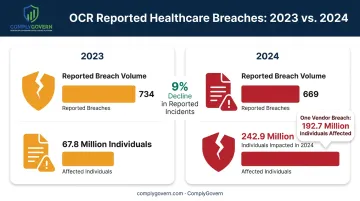
That layering creates real exposure. In 2024, OCR received 663 reports of breaches affecting 500 or more individuals, a 9% drop from 2023, yet those incidents still affected roughly 242.9 million people.
Fewer incidents didn't mean lower risk. A handful of large-scale events, including one vendor breach that grew to affect nearly 192.7 million individuals, can dominate an entire year's exposure.
The next section ranks the top HIPAA compliance automation platforms based on feature depth, healthcare-specific fit, and how well each one scales across different facility types.
Top HIPAA Compliance Automation Software for Healthcare
Each platform below is evaluated on healthcare-specific relevance, breadth of governance coverage, integration capability, and whether it delivers continuous monitoring or just a point-in-time checklist.
ComplyGovern
ComplyGovern is a healthcare governance and compliance platform that unifies governance, compliance, accreditation, quality, risk, policy management, and AI oversight into a single system of record. It supports every CMS-recognized facility type, from academic health systems to single-site DME suppliers.
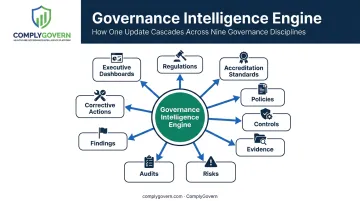
What sets it apart is the Governance Intelligence Engine. It automatically links regulations, accreditation standards, policies, controls, and evidence to risks, audits, findings, and corrective actions, then flows all of that straight into executive dashboards and board reporting.
That's a meaningfully different model than most point solutions. One update to a regulation cascades through every connected policy and control automatically, so staff aren't manually reconciling the same change across five different systems.
ComplyGovern also integrates natively with Epic, Oracle Health, MEDITECH, athenahealth, and the full Microsoft 365/SharePoint stack — replacing fragmented spreadsheets with continuous survey readiness instead of last-minute scrambling.
| Category | Details |
|---|---|
| Key Features | Governance Intelligence Engine, AI Governance module, nine connected governance disciplines in one platform |
| Best For | Health systems, hospitals, ASCs, and any CMS-recognized facility needing unified governance beyond siloed HIPAA point solutions |
| Pricing | Custom quote based on facility type, scope, and number of governance disciplines needed |
Sprinto
Sprinto positions itself as an Autonomous Trust Platform, offering continuous compliance automation across HIPAA alongside frameworks like SOC 2 and ISO 27001.
Its differentiators include automated evidence collection, real-time control monitoring, and built-in security training designed to cut manual compliance work. Sprinto also gets consistent praise for its onboarding support.
| Category | Details |
|---|---|
| Key Features | Continuous control monitoring, automated evidence collection, policy management, integrated security training |
| Best For | SaaS companies, startups, and mid-market healthcare technology teams needing fast multi-framework readiness |
| Pricing | Custom quote based on frameworks and team size |
Compliancy Group
Compliancy Group's platform, The Guard, is built specifically for HIPAA and designed for healthcare practices of all sizes. It covers risk assessments, incident management, and pre-built policy templates.
The standout feature is human support. Dedicated Compliance Coaches work alongside the software, guiding smaller practices that don't have in-house compliance expertise through the process step by step.
| Category | Details |
|---|---|
| Key Features | Risk assessment tools, incident/breach management, vendor and BAA tracking, compliance training LMS |
| Best For | Small-to-mid-sized practices, doctors' offices, and dental or mental health providers |
| Pricing | Tiered plans starting around $99/month, scaling to $449/month for advanced tiers, billed annually |
Drata
Drata is an enterprise GRC automation platform with dedicated HIPAA framework mapping alongside SOC 2, ISO 27001, and HITRUST support.
Its edge comes from deep integrations across cloud, identity, and HR systems, plus agentic AI features that help with security questionnaires and evidence summarization, which proves useful for teams juggling multiple frameworks at once.
| Category | Details |
|---|---|
| Key Features | Continuous monitoring, automated evidence collection, AI compliance assistance, BAA tracking |
| Best For | Healthcare SaaS and technology-centric organizations managing multiple compliance frameworks simultaneously |
| Pricing | Custom quote based on integrations and frameworks |
Accountable
Accountable focuses squarely on HIPAA: risk assessments, training, and vendor/BAA management, built for smaller healthcare providers and business associates.
Its simplified compliance scorecard and breach management workflow are designed for lean teams that don't have dedicated compliance staff. The vendor reports helping organizations reach compliance in an average of 30 days, though that figure is vendor-reported rather than independently benchmarked.
| Category | Details |
|---|---|
| Key Features | Compliance score dashboard, breach notification workflows, employee training tracking |
| Best For | Small practices, digital health startups, and business associates needing an accessible entry point |
| Pricing | Subscription plans starting around $169/month, scaling to $254/month for expanded features |
How We Chose the Best HIPAA Compliance Automation Software
The biggest mistake buyers make is choosing a tool based on brand recognition or a long checklist feature list, without checking whether it actually fits their facility type, existing tech stack, or long-term governance needs.
We evaluated each platform against factors that connect directly to real business outcomes:
- Integration depth with clinical/EHR systems: a platform that can't talk to Epic, Oracle Health, or MEDITECH creates manual data entry, not automation
- Continuous vs. periodic monitoring: a dashboard snapshot isn't the same as ongoing awareness of control drift
- Framework coverage: HIPAA-only tools work fine for single-purpose compliance, but organizations juggling accreditation, quality, and risk need broader coverage
- Executive-level visibility: boards and C-suites need real-time reporting, not quarterly summaries assembled by hand
Risk analysis gaps carry real consequences. In August 2025, OCR settled with an accounting firm for $175,000 after its 15th ransomware enforcement action and 10th case under the Risk Analysis Initiative. This pattern keeps repeating across organizations that treat risk analysis as a one-time exercise instead of an ongoing discipline.
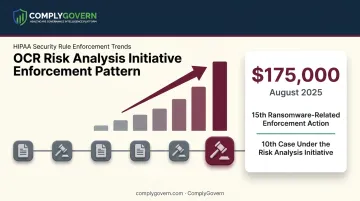
That's the outcome automation should directly reduce: fewer stale risk assessments, faster remediation, and less administrative burden spent reconstructing evidence after the fact.
Conclusion
The right HIPAA automation partner fits your facility type, existing systems, and current governance maturity, regardless of brand recognition.
Before committing, evaluate scalability, integration depth, and total cost of ownership. A platform that looks affordable now but can't grow with additional facilities, frameworks, or accreditation bodies will cost more in workarounds later.
If your organization has outgrown point-in-time HIPAA checklists and needs continuous, unified governance from boardroom to bedside, scheduling a ComplyGovern demo is worth your time. It's built to connect compliance, accreditation, quality, and risk into one system of record instead of five disconnected ones.
Frequently Asked Questions
What is HIPAA compliance automation software?
It's software that automates evidence collection, monitoring, and policy management to maintain continuous HIPAA readiness instead of relying on periodic manual checks.
How much does HIPAA compliance automation software cost?
Pricing varies by organization size, scope, and number of frameworks. Most enterprise-focused vendors offer custom quotes, while some smaller-practice tools publish flat monthly tiers.
Can HIPAA compliance automation software replace a compliance officer?
No. Automation handles repetitive monitoring and evidence collection, but HIPAA still requires designated privacy and security officials to oversee policy decisions and incident response.
What features should I look for in HIPAA compliance automation software?
Look for continuous monitoring, automated evidence collection, policy management, training tracking, and integration with clinical systems like Epic, Oracle Health (Cerner), or MEDITECH.
Is HIPAA compliance automation suitable for both small practices and large health systems?
Yes. Automation scales from simple checklist tools for small practices to enterprise governance platforms covering multiple facilities and frameworks for large health systems.
How long does it take to implement HIPAA compliance automation software?
Most organizations complete initial setup and integrations within a few weeks. Timelines vary based on facility complexity and the number of connected systems, with policy refinement continuing afterward.