Both worlds share a common pain point: fragmented, spreadsheet-driven processes that create errors, compliance risk, and administrative drag. Whether it's an underwriter juggling disconnected rating tools or a compliance officer chasing down the latest version of a policy on a shared drive, manual work slows everyone down.
This guide breaks down both meanings. You'll get the core features and lifecycle stages of insurance PAS, then a closer look at how "policy administration" applies uniquely to healthcare organizations managing governance and compliance documents.
Key Takeaways
- Insurance PAS manages customer policies through quoting, underwriting, issuance, billing, and claims.
- Healthcare "policy administration" means governing compliance and clinical documents, not insurance contracts.
- Automation in either context reduces manual errors and speeds up regulatory readiness.
- Evaluate systems on scalability, integration depth, and built-in security controls before committing.
What Is a Policy Administration System?
A Policy Administration System (PAS) is a specialized software platform that acts as a centralized hub for creating, storing, and managing policies throughout their lifecycle. It replaces manual tracking with structured, rule-based workflows, cutting down on the errors that come from spreadsheets and disconnected files.
In the insurance industry, this is the traditional definition. Analysts like Celent describe PAS as the system of record for every policy an insurer writes, storing coverages, limits, exclusions, and full policy history from issuance through renewal or termination. For life, annuity, and pension products, Gartner's definition extends further, covering product configuration, underwriting, billing, and even claims within the same category.
Here's where confusion sets in: the word "policy" can mean a customer insurance contract, or it can mean an internal organizational rule or procedure document. That single-word ambiguity determines an entirely different software category. A hospital compliance officer and a P&C underwriter are both searching "policy administration system," but they need completely different tools.
For healthcare organizations, that second definition is what matters. An internal policy governs procedures, compliance standards, or clinical protocols rather than a customer contract. Governance platforms like ComplyGovern manage this category, tracking policy versions, approval workflows, and regulatory mapping across an entire health system rather than premiums and claims.
The Policy Lifecycle, Stage by Stage
In the insurance context, a policy moves through several distinct stages:
- Quote and underwriting: The system captures applicant data, calculates premium, and assesses risk against underwriting rules. Some platforms pull in third-party or IoT data to speed this up.
- Issuance, billing, and endorsements: Once approved, the system creates and documents the policy. Premium collection begins, and mid-term changes (adding a beneficiary, adjusting coverage) get processed as endorsements.
- Renewal, cancellation, and reinstatement: Systems automate renewal quoting, calculate earned versus unearned premium on cancellation, and support reinstating lapsed policies when conditions are met.
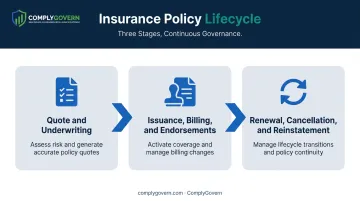
Industry data standards body ACORD documents these as standardized business cases, including New Business Quote, Policy Change, Renewal, and Reinstatement. Still, not every PAS bundles every function into one module. Billing and claims, for instance, are often separate integrations rather than native features.
Key Features to Look for in a Policy Administration System
Whether you're evaluating insurance PAS or a broader policy management tool, certain capabilities separate modern platforms from legacy ones:
- Policy data management — Efficient input, storage, and retrieval of policy-level information across multiple products and lines of business.
- Premium billing and collection — Automated invoicing, payment schedules, and reconciliation without manual entry.
- Underwriting support — Predefined rules engines that assess risk using internal and third-party data, speeding up decisions.
- Claims processing assistance — Capturing, validating, and adjudicating claims from first notice through resolution.
- Self-service portals — Real-time access for policyholders, agents, or internal stakeholders to check policy status.
- Integration and API capabilities — Connections to CRMs, third-party data providers, and compliance or reporting tools.
Not every system offers all six natively. Some vendors treat billing or claims as add-on modules rather than core functionality, so confirm exactly what's included before signing a contract.
Policy Administration in Healthcare Organizations: A Different Kind of "Policy"
Here's where the healthcare meaning diverges sharply. In this context, "policy administration" has nothing to do with insurance contracts. It refers to managing an organization's internal governance documents: compliance policies, clinical protocols, HR policies, and risk procedures.
Most healthcare organizations still handle these across spreadsheets, shared drives, and disconnected departmental apps. The result is duplicated effort, version-control confusion, and staff wasting hours hunting for the "current" version of a policy before an audit or survey.
That fragmentation carries real risk. HIPAA requires covered entities to maintain written or electronic policy documentation, retain it for six years, and update it as operations or regulations change (45 CFR 164.316). Meeting that standard consistently is difficult across scattered files.
When policies go stale or become hard to locate, the downstream consequences show up as regulatory citations and failed accreditation surveys.
Federal oversight backs this up. An HHS Office of Inspector General review found that hospital incident-reporting systems failed to capture 49% of identified patient harm events among hospitalized Medicare patients, pointing directly to gaps in reporting policies and staff awareness of them (HHS OIG, 2025).
Where ComplyGovern Fits
ComplyGovern is built specifically to close this gap. It's a healthcare compliance and governance platform that replaces fragmented policy administration with a single system of record that connects policy management to accreditation, quality, and risk in one place.
Relevant capabilities include:
- Scheduled reviews and version control so no one works from an outdated document
- Standards mapping linking policies to CMS Conditions of Participation, HIPAA, and all nine CMS-approved accrediting organizations, including The Joint Commission and DNV
- HIPAA-aligned security, with role-based access, encryption at rest and in transit, and full audit logging
- Role-specific executive dashboards giving boards and C-suite leaders real-time visibility into policy status, open findings, and accreditation readiness
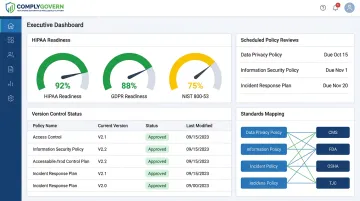
Because the platform's Governance Intelligence Engine links regulations, policies, and evidence automatically, a single policy update flows through the entire compliance chain without staff re-entering data across separate systems.
Benefits of Modern Policy Administration Systems
Regardless of which "policy" you're managing, modernized systems deliver measurable gains over manual processes.
- Improved efficiency: Automated workflows cut processing time and reduce the manual data entry that eats up staff hours.
- Enhanced accuracy: Rule-based processing reduces the human error that's common in spreadsheet-driven tracking.
- Cost savings: Lower operational overhead and fewer compliance penalties free up budget for higher-value work.
The efficiency gains aren't theoretical. According to McKinsey's analysis of IT modernization in insurance, insurers running modernized systems consistently outperform legacy peers:
- Process more than 40% more policies per FTE
- Run IT costs 41% lower per policy
- Cut administrative costs 30% after replacing a proprietary legacy setup, in one case McKinsey cited
Healthcare organizations see a parallel benefit. Replacing spreadsheets and disconnected drives with a unified platform like ComplyGovern eliminates duplicate effort across compliance, quality, and risk teams. Staff shift from document-hunting to actual governance work.
How to Choose the Right Policy Administration System
Picking the right platform (insurance PAS or healthcare governance tool) comes down to four factors.
| Factor | What to Check |
|---|---|
| Scalability | Can it handle growing data volume, policy complexity, and new regulations without a rebuild? |
| Integrations | Does it connect to your existing systems, such as Epic, Oracle Health, MEDITECH, and athenahealth for healthcare, or core insurance platforms via open APIs? |
| Security & compliance | Does it offer encryption, access controls, audit trails, and alignment with HIPAA or GDPR? |
| Vendor support & usability | Is the interface intuitive, and is vendor support responsive enough to minimize disruption during rollout? |
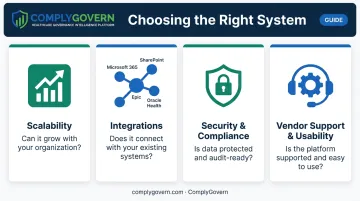
For healthcare organizations specifically, look for a platform that scales from a single-site supplier to a multi-facility health system without forcing a switch to a different product. ComplyGovern, for example, supports every CMS-recognized facility type through the same platform architecture:
- Critical access hospitals and acute care systems
- Ambulatory surgical centers and rural health clinics
- Skilled nursing facilities and DMEPOS suppliers
This native interoperability spans HL7, FHIR, and DICOM standards, keeping clinical and compliance data connected across every site.
Beyond scalability and integrations, don't underestimate usability. A system packed with features that staff find confusing will get abandoned in favor of the same spreadsheets you're trying to replace.
Frequently Asked Questions
What is the role of a policy administrator?
A policy administrator manages the day-to-day lifecycle of policies, whether insurance contracts or internal governance documents. That includes creating, updating, conducting periodic reviews, and confirming ongoing accuracy and compliance.
What is the policy administration system in insurance?
Insurance PAS is software that manages the full policy lifecycle, from quoting and underwriting through issuance, billing, endorsements, and often claims. It serves as the insurer's system of record for customer policies.
What's the difference between an insurance policy administration system and a healthcare policy management platform?
Insurance PAS manages customer insurance contracts and transactions. A healthcare platform like ComplyGovern manages internal governance and compliance documents, such as clinical protocols and HR policies.
What are the key features to look for in a policy administration system?
Prioritize policy data management, workflow automation, integration capabilities, and built-in compliance or security controls. These four areas determine how much manual work the system actually removes.
How does automation improve policy administration?
Automation reduces manual data entry, speeds up processing, and cuts errors common in spreadsheet-based tracking. It also improves regulatory readiness by keeping documentation current and audit-ready.
Is policy administration relevant outside the insurance industry?
Yes. Healthcare, financial services, and other regulated industries use policy administration or management systems to govern internal compliance documents, not customer insurance contracts. HIPAA and FINRA both require formal written policy programs.