Introduction
Healthcare compliance used to run on a calendar. Once a year, teams pulled binders, ran mock surveys, and hoped nothing had slipped through the cracks. That model is breaking down.
CMS Conditions of Participation get revised through ongoing rulemaking, and accrediting bodies like the Joint Commission publish semiannual manual updates. State requirements shift on their own timeline too, often with little warning. A once-a-year checkup can't keep pace with any of that.
That regulatory pace exposes a deeper problem: most organizations still run on fragmented governance. Compliance data lives in spreadsheets and policies sit on shared drives, while quality, risk, and accreditation teams each maintain their own siloed tools. Corrective actions get missed and work gets duplicated. Every survey window still triggers a frantic scramble to catch up.
This guide breaks down what continuous compliance monitoring means and the components that make it work, then walks through the best practices that separate audit-ready organizations from those still scrambling.
Key Takeaways
- Continuous monitoring replaces point-in-time audits with always-on visibility into risk.
- Fragmented systems and understaffed teams make manual compliance unsustainable.
- Automated evidence collection and policy mapping cut administrative burden and drift.
- A unified governance platform connects regulations, policies, and corrective actions seamlessly.
What Is Continuous Compliance Monitoring?
Continuous compliance monitoring is the ongoing, automated tracking of adherence to regulations, accreditation standards, and internal policies in real time. Instead of checking compliance status once a year, organizations maintain constant visibility into controls, evidence, risks, and corrective actions as conditions change.
In healthcare, this spans a wide regulatory footprint:
- CMS Conditions of Participation across every facility type
- State survey requirements that vary by jurisdiction
- Accrediting body standards from Joint Commission, DNV, CIHQ, and HFAP
- Internal policies that must stay mapped to all of the above
Standards don't sit still. Joint Commission publishes revised requirements through semiannual manual updates, posted in both print and its online E-dition. CMS has issued multiple rules revising hospital CoPs in recent years, and QSO memoranda regularly update survey guidance. Tracking that pace manually, across every applicable framework, is where most compliance programs start to buckle.
How Continuous Compliance Monitoring Differs From Traditional Audits
Traditional audits are scheduled, retrospective, and built around point-in-time evidence. Someone pulls documentation, reviews a defined period, and produces a report — often months after the events it covers.
The Office of Inspector General draws a useful distinction here, according to HHS-OIG's General Compliance Program Guidance: auditing is a formal, independent review typically scheduled around an annual risk assessment. Monitoring, by contrast, is routine review of ongoing risks performed during normal operations.
One doesn't replace the other, but monitoring is what catches problems while there's still time to fix them.
Key differences:
| Traditional Audits | Continuous Monitoring |
|---|---|
| Scheduled, periodic reviews | Ongoing, real-time tracking |
| Surfaces issues after the fact | Flags gaps before a surveyor arrives |
| Manual document gathering | Automated evidence collection |
| Point-in-time snapshot | Always-current compliance posture |
Traditional audits often confirm a violation after it has already caused harm or triggered a citation. Continuous monitoring is designed to catch the drift before it becomes a finding.
Key Components of Continuous Compliance Monitoring
A functioning program relies on several connected capabilities working together, not a single standalone tool.
These six capabilities form the foundation:
- Real-time monitoring and alerting: Automated tracking of controls, policies, licenses, and credentials, with instant notifications the moment something expires or falls out of compliance.
- Regulatory and accreditation change tracking: Systems that continuously watch for updates to CMS rules, state regulations, and accrediting body standards, then map those changes directly to affected internal policies and controls.
- Automated evidence collection: Documentation, attestations, and audit trails gathered continuously in the background rather than assembled in a last-minute scramble before survey week.
- Policy management and version control: Policies stay current, get reviewed on schedule, and remain clearly linked to the regulation or standard they satisfy, with no orphaned documents floating in a shared drive.
- Corrective action (CAPA) tracking: Every identified gap gets an owner, a timeline, and a documented path to closure, with a full audit trail behind it.
- Executive and board-level dashboards: Real-time visibility into organization-wide compliance posture, replacing the quarterly slide deck built from someone's spreadsheet the night before a board meeting.
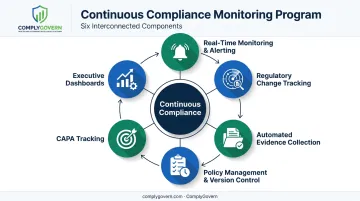
Each component reinforces the others. Change tracking feeds policy updates, which trigger evidence requirements, and gaps in that evidence become CAPA items. Everything eventually rolls up to a dashboard leadership can actually trust.
Why Continuous Compliance Monitoring Matters
The case for continuous monitoring comes down to two things: patient safety and organizational exposure.
Reduced risk, better patient outcomes. Catching a credentialing gap or an expired policy early prevents it from becoming an adverse event, a citation, or a threat to accreditation status. Waiting for the annual audit means problems can run for months before anyone notices.
Continuous survey readiness. When evidence, policies, and corrective actions are always current, there is no pre-survey scramble. Surveyors can show up unannounced under most CMS pathways — organizations relying on annual prep are perpetually exposed in the gaps between cycles.
The financial stakes are real. Recent OIG-reported EMTALA settlement actions have ranged from $40,000 to $340,000 per case, tied to failures like inadequate medical screening exams or improper patient transfers. Beyond the settlement figure, noncompliance can also threaten deemed status or Medicare participation entirely, a risk far larger than any single fine.
Reactive compliance also carries hidden costs that OIG flags routinely, each one triggered after something has already gone wrong:
- Overpayment refunds
- Investigations
- Disciplinary action
- Retraining
- Process overhauls
Continuous monitoring shifts that spending from remediation to prevention.
Best Practices for Building an Effective Continuous Compliance Monitoring Program
Building this capability takes a few disciplined shifts, not a full overhaul of your existing compliance function.
Centralize your regulatory and accreditation inventory. Map every applicable CMS rule, state requirement, and accrediting standard against internal policies and controls in one system, rather than scattering them across departmental spreadsheets.
Automate monitoring and evidence collection. Use tools that continuously track policy reviews, license and credential expirations, and control performance, rather than compiling evidence by hand right before a survey.
Assign clear ownership and accountability. Every control, policy, and corrective action needs a named owner and a defined SLA. Without ownership, compliance drift is inevitable.
Train staff continuously. Build compliance into daily workflows through ongoing, role-specific training instead of a single annual session that nobody remembers by month three.
Conduct regular internal reviews and mock surveys. Test readiness between formal accreditation cycles so your own team, not an external surveyor, finds the gaps first.
Adopt a connected governance platform. Platforms like ComplyGovern replace siloed spreadsheets and departmental apps with a unified system that links regulations, policies, evidence, risks, and corrective actions, eliminating duplicate effort across compliance, quality, and risk teams.
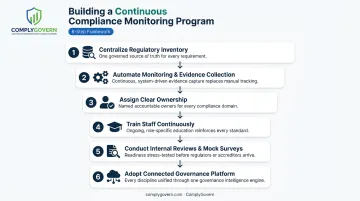
That last point is often the difference between a program that sustains itself and one that collapses once the person who built the spreadsheets moves on.
Common Challenges in Implementing Continuous Compliance Monitoring
Even organizations that want continuous monitoring run into real obstacles.
Fragmented systems and data silos. Most healthcare organizations juggle spreadsheets, shared drives, and disconnected departmental tools. Getting a unified compliance view out of that patchwork is genuinely difficult. It's the single biggest reason continuous monitoring stays aspirational rather than operational.
Resource and skill constraints. According to SAI360's 2023 Healthcare Compliance Benchmark Report, 55% of respondents said compliance burdens were growing faster than their available resources, and 52% described their compliance function as under-resourced.
About a third also reported managing compliance documentation manually or with no formal process at all. Manual continuous tracking doesn't scale against that kind of resource gap.
Keeping pace with regulatory change. Tracking updates across multiple CMS programs, state survey requirements, and accrediting body standards simultaneously (without automation) is close to impossible for any team, no matter how skilled.
These challenges share a common thread: they're structural problems that more effort can't fix. They require different tooling.
Continuous Compliance Monitoring in Healthcare: Why a Unified Platform Matters
Healthcare governance spans six disciplines: governance, compliance, accreditation, quality, risk, and policy management. Most organizations manage these in disconnected systems, creating blind spots and duplicate work.
ComplyGovern's Governance Intelligence Engine was built around that exact problem. It automatically links regulations, standards, policies, controls, evidence, risks, audits, findings, and corrective actions in one system of record, replacing the spreadsheets and siloed departmental apps most organizations still rely on.
Key capabilities include:
- Continuous survey readiness across every CMS-recognized facility type, including acute care hospitals, ASCs, home health agencies, hospice, SNFs, FQHCs, and DMEPOS suppliers, through automated evidence collection, scheduled policy reviews, and ongoing regulatory monitoring.
- Role-specific executive and board dashboards for the CEO, COO, CMO, CNO, CQO, CCO, CIO, and CRO, with real-time visibility into compliance status, quality performance, open findings, and enterprise risk.
- Native integrations with Epic, Oracle Health (Cerner), MEDITECH, and athenahealth, plus native support for Microsoft 365 and SharePoint, so evidence flows in from systems teams already use.
- HIPAA-aligned security architecture, including role-based access control, MFA/SSO, and encryption at rest and in transit.
- International framework coverage for organizations operating in the UK (CQC, UKAS), Australia (NSQHS, ACHS), and New Zealand (HQSC, JAS-ANZ).
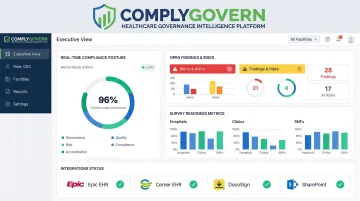
The result is a single source of truth that turns compliance from a reactive scramble into an ongoing operational capability. Organizations interested in seeing how this works in practice can request a demo to walk through the platform live.
Frequently Asked Questions
What does continuous compliance monitoring include?
It includes real-time monitoring and alerting, automated evidence collection, regulatory and accreditation change tracking, policy management, and corrective action tracking, all working together instead of as separate processes.
How is continuous compliance monitoring different from a traditional compliance audit?
Audits are periodic, retrospective snapshots of a defined period. Continuous monitoring runs constantly, catching gaps as they emerge rather than discovering them months later during a scheduled review.
What tools are used for continuous compliance monitoring?
Organizations typically use automated GRC platforms, policy management software, and, in healthcare specifically, unified governance platforms like ComplyGovern that connect compliance, accreditation, quality, and risk in one system.
Is continuous compliance monitoring required for healthcare organizations?
It isn't mandated by name, but CMS Conditions of Participation require ongoing, data-driven QAPI programs, and accrediting bodies expect continuous readiness between surveys — effectively requiring the same outcome.
What are the biggest benefits of continuous compliance monitoring?
Reduced organizational risk, improved patient safety, continuous survey readiness, and elimination of the duplicate manual work that fragmented spreadsheet-based systems create.
How often should healthcare organizations review their compliance controls?
Reviews should happen continuously through automated tools, supplemented by scheduled internal audits and mock surveys between formal accreditation cycles to catch gaps early.