Introduction
A hospital-acquired pressure injury (HAPI) is localized damage to skin and underlying tissue that develops during a hospital stay, not something the patient arrived with. When one occurs, the real question is why your prevention protocols failed, not just how to treat the wound.
That's what Root Cause Analysis (RCA) and Corrective and Preventive Action (CAPA) are for. RCA digs into the systemic gaps behind an injury. CAPA turns those findings into fixes that actually hold.
Skip this process, or rush it, and the same failure repeats. Recurring HAPIs mean more patient harm, exposure under CMS's Hospital-Acquired Condition programs, and greater liability risk.
This article walks through the common causes behind HAPIs, what happens when RCA and CAPA get skipped, a step-by-step methodology for doing it right, and how to sustain prevention long-term.
Key Takeaways
- HAPIs are largely preventable when RCA targets systemic issues, not individual blame.
- Risk assessment delays, repositioning lapses, device pressure, and documentation gaps drive most incidents.
- Structured tools like the 5 Whys and Fishbone diagrams surface true root causes.
- CAPA plans need named owners, deadlines, and measurable success criteria to succeed.
- Continuous monitoring outperforms reactive, after-the-fact investigation for reducing repeat harm.
Common Causes of Hospital-Acquired Pressure Injuries
CMS tracks pressure injuries as a Hospital-Acquired Condition, and for good reason. The Agency for Healthcare Research and Quality (AHRQ) notes that while not every pressure injury can be avoided, most develop because a prevention step was missed, delayed, or inconsistently applied.
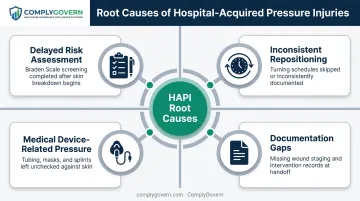
That distinction matters for RCA. HAPIs almost never trace back to one isolated failure. Investigations typically uncover overlapping clinical gaps, broken processes, and staffing shortfalls that compound each other. Here are the four causes that surface most often.
Inadequate or Delayed Risk Assessment
Braden or Norton Scale assessments identify which patients need aggressive prevention measures before skin breaks down. When these assessments get skipped or delayed, high-risk patients go unflagged until damage has already started.
This happens most in high-volume settings:
- Newly admitted ED patients waiting hours for a bed assignment
- ICU patients whose reassessment intervals slip during acute clinical events
- Post-op patients where recovery-room handoffs deprioritize skin checks
Inconsistent Repositioning and Mobility Protocols
Sustained pressure over bony prominences is the mechanical driver behind most pressure injuries. Immobile patients need scheduled turning, and when that schedule breaks down, damage accumulates fast.
The research on optimal turning frequency is less settled than many clinicians assume. A 2023 systematic review of turning and repositioning studies found that the ideal interval remains unclear across ICU, medical-surgical, and long-term care populations.
What's consistent, though, is that individualized, documented repositioning schedules outperform verbal handoffs every time. Understaffed night shifts that rely on "I told the next nurse" instead of a written schedule are a recurring RCA finding.
Medical Device-Related Pressure
Tubes, masks, cannulas, and casts create localized pressure points that routine skin checks often miss, especially when attention focuses on the primary wound site.
A 2024 meta-analysis of over 117,000 patients found a pooled medical device-related pressure injury incidence of 19.3%. The most frequently implicated devices:
- Nasogastric tubes
- Tracheal tubes and BiPAP/CPAP masks
- Oxygen delivery devices
- Urinary catheters and restraints
Patients on prolonged respiratory support are especially vulnerable when no one schedules routine device repositioning or padding checks.
Communication and Documentation Gaps
Every transfer between units is a chance for risk status to get lost. A patient's skin assessment findings from the ED don't always make it into the ICU note, and the ICU findings don't always transfer cleanly to med-surg.
This isn't hypothetical. Qualitative interviews with hospital nurses found that skin inspection and Braden documentation often happened during handover, but workload and understaffing frequently prevented the actual repositioning plan from following through. Fragmented EHR templates make this worse, particularly across multiple care transitions.
What Happens If RCA and CAPA Are Ignored
Skipping or rushing the investigation doesn't make the problem go away. It just delays the consequences, and they compound.
Clinical and financial fallout:
- Recurring HAPIs across units or patient populations
- Reduced Medicare payment under CMS's Hospital-Acquired Condition Reduction Program, which applies a 1% payment reduction to hospitals scoring above the 75th percentile on Total HAC Score
- Separate payment consequences under HAC-POA rules for Stage III and IV pressure ulcers not present on admission
- Accreditation survey citations when documentation shows a pattern of unresolved findings
- Increased litigation exposure, since plaintiff attorneys routinely request RCA records during discovery
There's a reputational cost too, since pressure ulcer rates feed into CMS's PSI 90 measure, which is publicly reported through Care Compare and the Provider Data Catalog. Patients and referring physicians can see it, and a facility with a visibly elevated or unchanging rate loses trust before a single lawsuit is ever filed.
Warning Signs Your Facility Needs a Stronger RCA/CAPA Process
These indicators usually surface well before a formal citation or lawsuit lands:
- HAPI incidence is rising or flat despite prevention protocols already in place.
- The same root cause keeps reappearing across multiple RCAs, meaning prior CAPA actions didn't actually resolve anything.
- Documentation is inconsistent or missing for skin assessments and turning schedules across different units.
If any of these sound familiar, the gap is usually in process design, not clinical skill. Platforms with built-in CAPA tracking, like ComplyGovern's incident and corrective action workflows, flag repeat root causes automatically, before they turn into a fourth or fifth RCA on the same problem.
How to Conduct RCA and Build an Effective CAPA for HAPI
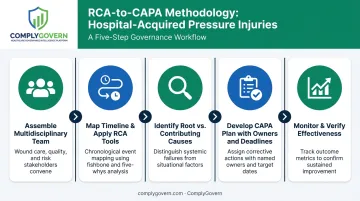
RCA and CAPA work best as a repeatable methodology, not a one-time scramble triggered only after a bad outcome. Here's the sequence that holds up across facilities.
Step 1: Assemble a Multidisciplinary RCA Team
Pull together bedside nursing, a wound care specialist, quality or risk management, and unit leadership. A narrow, single-clinician review almost always lands on "staff error" and misses the equipment, staffing, or process factors sitting underneath.
Most facility policies expect team assembly within 24 to 48 hours of the HAPI being identified. Waiting longer risks losing detail, since staff memory of the specific shift fades quickly.
Step 2: Map the Timeline and Apply Structured RCA Tools
Reconstruct exactly what happened, in order: admission, initial assessment, every reposition, every device placement, every handoff. Then apply structured analysis tools rather than jumping to conclusions.
- 5 Whys: repeatedly asks why a problem occurred until it reaches the underlying system issue
- Fishbone/Ishikawa diagram: groups possible causes into categories (people, equipment, process, environment)
- Fault tree analysis: works backward from the injury to identify contributing branches
Note that The Joint Commission's 45-business-day analysis and action-plan deadline applies specifically to sentinel events. Most HAPIs won't meet that threshold, but it's a useful internal benchmark for how quickly a thorough review should move.
Step 3: Identify Root Causes vs. Contributing Factors
This is where most RCAs go wrong. A missed turn is a proximate cause. The absence of a standardized turning schedule tool, or an unclear reassessment policy, is the actual root cause.
Separating the two matters because corrective actions built on proximate causes tend to be generic ("retrain the nurse") and don't prevent recurrence. Corrective actions built on root causes fix the system.
Step 4: Develop a CAPA Plan With Defined Owners and Metrics
Every corrective action needs three things: a named owner, a deadline, and a measurable success criterion. Vague "re-education" plans without accountability rarely survive past the next staffing crunch.
Typical CAPA actions for HAPI events include:
- Updated repositioning protocol with documented intervals
- New risk-assessment trigger built into admission workflows
- Revised EHR documentation template that carries skin findings across transfers
Assign these before the event record closes, usually within days of RCA completion.
Step 5: Monitor, Verify Effectiveness, and Escalate to Governance
A CAPA plan that's never verified provides no real protection against recurrence. Track completion and HAPI recurrence through structured audits, PDSA cycles, and regular reporting to your quality and safety committee.
This is the step where most facilities lose momentum, particularly when tracking happens across spreadsheets and shared drives that different departments never fully see.
A governance platform like ComplyGovern centralizes RCA findings and CAPA tracking in one record. It automates follow-up reminders as a corrective action owner approaches a deadline, giving quality, risk, and executive teams a shared, real-time view of whether root causes are actually resolved instead of just closed on paper.
Tips for Long-Term Prevention and Control
Sustained prevention requires the same discipline as the RCA process itself, applied continuously rather than after each event.
- Routine monitoring — run scheduled skin assessment audits and review HAPI rate trends monthly through the quality committee, not just after an incident.
- Training and competency — validate staff competency on Braden scoring, repositioning technique, and device-related skin checks on a recurring basis, not a one-time onboarding module.
- Standardized documentation — use consistent EHR templates for skin assessments and turning schedules so findings carry across every care transition.
- Technology-enabled tracking — connect RCA findings, CAPA status, and policy updates in one source of truth, such as ComplyGovern's Governance Intelligence Engine, so a policy change traces back to its originating finding automatically.
Facilities that treat this as a continuous cycle, rather than a reactive scramble, consistently show fewer repeat incidents and stronger accreditation outcomes.
Conclusion
Hospital-acquired pressure injuries have identifiable, often systemic root causes. Structured RCA uncovers them instead of settling for "staff error" as the explanation. CAPA is what converts those findings into lasting prevention, provided it has clear ownership, real deadlines, and follow-through monitoring.
Facilities that run this process continuously, rather than only after a bad outcome forces their hand, see less patient harm, lower regulatory exposure, and fewer surprises during survey season, especially with CAPA tracking centralized on a platform such as ComplyGovern's.
Frequently Asked Questions
What are the 5 steps of RCA?
Assemble a multidisciplinary team, gather data and build a timeline, identify root causes versus contributing factors, develop corrective actions, and monitor effectiveness over time.
What is the best tool for root cause analysis?
There is no single universal best tool. Fishbone/Ishikawa diagrams and the 5 Whys are the most widely used in healthcare RCA, typically paired with timeline analysis to reconstruct events accurately.
What is the tool used to assess pressure injury?
The Braden Scale and Norton Scale are standard risk-assessment tools used to predict pressure injury risk on admission. The PUSH tool tracks healing progress in an existing injury, not risk prediction.
What is the difference between RCA and CAPA?
RCA identifies why an event occurred by examining systemic and process factors. CAPA is the resulting action plan, meaning the specific corrective and preventive steps that resolve the issue and prevent recurrence.
How is CAPA effectiveness measured after a pressure injury RCA?
Facilities track HAPI recurrence rates, audit compliance for the new protocol, and require formal review and closure by the quality or safety committee before considering the CAPA resolved.
Are hospital-acquired pressure injuries reportable to CMS?
Yes. Stage III, Stage IV, and unstageable HAPIs are tracked as quality measures, and Stage III/IV injuries not present on admission affect facility reimbursement under CMS's Hospital-Acquired Condition programs.