Introduction
Healthcare compliance teams are drowning. CMS keeps issuing updated Conditions of Participation, state surveyors show up unannounced, and HIPAA enforcement has not slowed down. Many compliance officers still track all of this in spreadsheets, shared drives, and departmental binders.
That approach breaks down fast. A single missed policy update or an evidence folder nobody can find during a survey can trigger findings, corrective action plans, or in serious cases, loss of Medicare certification.
These stakes are pushing healthcare organizations toward a fundamentally different model.
The shift underway in 2026 is from reactive, audit-time scrambling to continuous compliance readiness powered by AI and integrated governance, risk, and compliance (GRC) platforms. This guide reviews the top compliance automation tools of 2026, how to evaluate them, and what separates healthcare-specific platforms from general-purpose security compliance software.
Key Takeaways
- Compliance automation replaces manual spreadsheets with continuous monitoring and live dashboards.
- 2026 platforms split into general GRC tools (SOC 2, ISO 27001) and healthcare-specific governance systems (CMS, HIPAA).
- Selection should hinge on framework coverage, integration depth, and industry-specific mapping.
- ComplyGovern best serves healthcare organizations needing unified compliance, quality, risk, and accreditation governance.
Overview of Compliance Automation Software in 2026
Compliance automation uses software and AI to continuously monitor systems, collect evidence, and report on adherence to regulatory frameworks. It replaces the old point-in-time audit model, where teams scrambled for weeks before a survey or certification renewal.
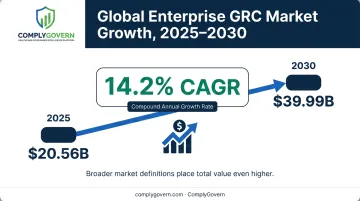
The market has grown quickly. MarketsandMarkets values the global enterprise governance, risk, and compliance (eGRC) market at $20.56 billion in 2025, projecting growth to $39.99 billion by 2030 at a 14.2% CAGR. Other research firms use broader market definitions and land at even higher figures. Either way, organizations are shifting budget toward automated, continuous compliance.
That growth hasn't been distributed evenly across industries, though. Most compliance automation tools started in IT security, built around SOC 2 and ISO 27001. That works fine for a SaaS company chasing a security certification. It doesn't work for a hospital.
Healthcare organizations face a wider net:
- CMS Conditions of Participation covering patient rights, QAPI, infection prevention, discharge planning, and medical staff governance
- HIPAA privacy, security, and breach notification requirements, tracked separately from general IT controls
- Accreditation standards from bodies like the Joint Commission, DNV, and AAAHC
- Quality and patient safety metrics tied to CMS reporting programs
The list below covers both categories: general-purpose compliance automation platforms built for security frameworks, and specialized solutions built for regulated healthcare governance.
Top Compliance Automation Software and Tools in 2026
Rankings here weigh five factors: framework and regulatory coverage, depth of automation, integration ecosystem, AI capability, and fit for the industry being served. A tool that scores well for a SaaS startup won't necessarily fit a skilled nursing facility, and vice versa.
ComplyGovern
ComplyGovern is an intelligent healthcare compliance and governance platform built to unify nine governance disciplines into one system of record:
- Governance and board management
- Regulatory compliance
- Accreditation readiness
- Policy and document governance
- Enterprise risk
- Quality and performance management
- Incident and CAPA management
- Medical staff governance
- AI governance
It replaces the spreadsheets, shared drives, and siloed departmental tools most healthcare organizations still rely on.
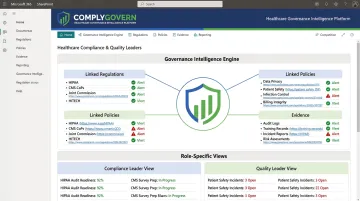
What sets it apart is the Governance Intelligence Engine. It automatically links regulations to accreditation standards, policies, controls, and evidence, while a second chain connects quality measures to risks, audits, findings, and corrective actions. When a CMS rule changes, the impact surfaces automatically across every linked policy and piece of evidence, eliminating manual re-entry.
ComplyGovern supports every CMS-recognized facility type, from acute care hospitals and ASCs to skilled nursing facilities and DMEPOS suppliers, across all three certification pathways: accreditation survey, state survey, and supplier enrollment. It also maps to 14 accreditation bodies, including the Joint Commission, DNV, ACHC, CHAP, NCQA, and CAP.
The platform is built natively on Microsoft 365 and SharePoint, extending into Teams, Entra ID, Power BI, and Power Automate. It also interoperates with Epic, Oracle Health, MEDITECH, and athenahealth using HL7 and FHIR standards, supporting continuous survey readiness rather than last-minute prep.
| Category | Details |
|---|---|
| Best For | Hospitals, health systems, ASCs, SNFs, and other CMS-regulated facilities needing continuous accreditation and survey readiness |
| Key Features | Nine connected governance disciplines, AI Governance module, Microsoft 365/SharePoint-native integration, role-specific dashboards for CEO, COO, CMO, CNO, CQO, CCO, CIO, CRO, and board members |
| Standout Differentiator | HIPAA-aligned security combined with coverage of US federal healthcare law plus UK, Australia, and New Zealand accreditation standards in one platform |
Vanta
Vanta is one of the most widely adopted security and compliance automation platforms, offering a content library spanning 35+ frameworks, including SOC 2, ISO 27001, HIPAA, and GDPR.
The platform's strength lies in its integration ecosystem: Vanta reports over 400 integrations and 1,400+ automated tests for continuous evidence collection. It also offers Trust Center capabilities, letting companies share live compliance posture with prospects and auditors instead of emailing PDFs back and forth.
| Category | Details |
|---|---|
| Best For | SaaS and tech companies pursuing SOC 2, ISO 27001, or HIPAA certification quickly |
| Key Features | Continuous compliance monitoring, automated evidence collection, Trust Center reporting |
| Standout Differentiator | Broad framework library paired with a large integration ecosystem suited to fast-growing tech companies |
Drata
Drata focuses on continuous control monitoring and audit readiness across 25+ frameworks, including SOC 2, ISO 27001, HIPAA, GDPR, PCI DSS, and FedRAMP.
Its integration depth is a major selling point. Drata connects with over 300 tools spanning identity providers, HRIS systems, and cloud infrastructure, and it added more than 1,000 new infrastructure tests for AWS, Azure, and GCP in early 2026. That gives compliance teams a single dashboard showing exactly which controls are passing or failing in real time.
| Category | Details |
|---|---|
| Best For | Mid-market and enterprise tech companies managing multiple overlapping frameworks |
| Key Features | Continuous control monitoring, automated evidence collection, unified integrations dashboard |
| Standout Differentiator | Strong audit-preparation workflows that cut manual documentation effort |
Scrut Automation
Scrut is a GRC platform combining compliance automation, risk management, and audit support across 60+ frameworks with notably deep cloud configuration testing.
The platform tests cloud environments against 230+ CIS benchmarks, giving security teams granular visibility into misconfigurations before they become audit findings. Pre-built policy libraries and a risk scoring model (rated 0–25 based on likelihood and impact) round out the offering.
| Category | Details |
|---|---|
| Best For | Cloud-native companies needing multi-framework compliance with integrated risk management |
| Key Features | 230+ CIS benchmark testing, pre-built policy library, corrective action trackers |
| Standout Differentiator | Combines compliance automation with built-in vendor and cyber risk management in one dashboard |
OneTrust
OneTrust is an enterprise-grade GRC and privacy management platform used by large, multi-jurisdictional organizations to manage compliance, risk, and data governance at scale.
Its privacy tooling covers GDPR, CCPA, and LGPD, alongside data mapping and rights-request automation. OneTrust also supports technology compliance frameworks like ISO 27001:2022, SOC 2, and NIST CSF, and it earned Leader placement in Forrester's Q4 2025 Privacy Management Software Wave.
| Category | Details |
|---|---|
| Best For | Large enterprises with complex, multi-jurisdictional compliance and privacy obligations |
| Key Features | Privacy management, risk assessments, policy and third-party risk workflows |
| Standout Differentiator | Deep focus on data privacy regulations alongside broader GRC capability |
How We Chose the Best Compliance Automation Tools
Rather than relying on marketing pages alone, this evaluation weighed four core factors:
- Framework and regulatory breadth across accreditation and compliance standards
- Depth of automation, including evidence collection, monitoring, and reporting
- Integration ecosystem with existing clinical and enterprise systems
- AI capability for continuous, intelligent compliance management
One buyer mistake shows up constantly: assuming a generic SOC 2 or ISO tool can handle industry-specific governance needs without dedicated framework mapping. A security-first platform built around IT controls simply isn't designed to track QAPI requirements, medical staff peer review, or Joint Commission tracer methodology.
That gap surfaces during a survey, not before it.
Platforms that score well on integration depth and continuous monitoring tend to reduce audit prep time and administrative burden — a pattern reinforced by broader industry adoption trends.
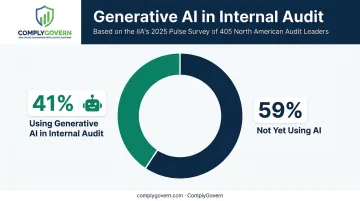
According to the Institute of Internal Auditors' 2025 Pulse survey of 405 North American audit leaders, 41% now use generative AI in internal audit activities. That shift signals continuous, AI-assisted monitoring is becoming standard practice rather than a novelty.
That said, adoption data proves a trend, not a guaranteed ROI. The right evaluation still comes down to whether a platform's framework mapping actually matches your organization's regulatory reality.
Conclusion
There's no single "best" compliance automation tool — only the best fit for your organization's context. A SaaS startup chasing SOC 2 will do fine with Vanta or Drata. A regulated healthcare organization juggling CMS surveys, HIPAA, accreditation cycles, and quality reporting needs something built for that scope specifically.
Before committing to any platform, evaluate on integration depth, scalability, and total cost of ownership, not brand recognition. HIPAA enforcement alone remains a real cost of getting this wrong. As of late 2024, HHS's Office for Civil Rights had received 374,321 complaints since 2003 and settled 152 cases totaling nearly $145 million.
Healthcare organizations looking for a single source of truth from boardroom to bedside can explore ComplyGovern's unified governance platform to see how continuous compliance replaces the annual scramble.
Frequently Asked Questions
What is automating compliance?
Automated compliance uses software and AI to continuously monitor systems, collect evidence, and verify adherence to regulatory frameworks. It replaces periodic manual reviews with ongoing, real-time tracking.
Is compliance being replaced by AI?
No. AI automates repetitive tasks such as monitoring and evidence collection. Human judgment remains essential for interpreting regulations, making risk decisions, and handling auditor or surveyor interactions.
What are the 5 principles of compliance?
There's no single universal standard, but commonly cited principles include accountability, transparency, risk assessment, ongoing monitoring, and continuous improvement. HHS-OIG's official healthcare guidance outlines seven elements, covering written policies, training, and corrective action.
What features should you look for in compliance automation software?
Look for framework coverage matching your industry, automated evidence collection, a strong integration ecosystem, and real-time dashboards. Regulated sectors should also prioritize industry-specific regulatory mapping over generic IT controls.
How much does compliance automation software cost?
Pricing varies by framework count, organization size, and integration needs, and most vendors quote custom pricing rather than a published rate. Weigh the cost against reduced audit fees, lower administrative burden, and fewer findings.
Is compliance automation suitable for healthcare organizations?
Yes, but healthcare organizations get the most value from platforms like ComplyGovern that are built specifically for CMS Conditions of Participation, HIPAA, and accreditation requirements rather than generic SOC 2 or ISO-focused security tools.