Introduction
Ask ten healthcare executives to explain the difference between internal audit and risk management, and you'll likely get ten different answers. Many use the terms interchangeably. That's a problem.
In hospitals, health systems, post-acute providers, and ambulatory clinics, blurred lines between these functions create real consequences: duplicated work, gaps in oversight, and slower responses to emerging threats like cybersecurity breaches or billing compliance failures.
Compliance, quality, risk, and audit teams often operate in separate silos, tracking the same risks in different spreadsheets without ever comparing notes.
This guide breaks down exactly who owns what, the risk categories every organization should know, and the practices that keep both functions sharp and genuinely useful.
Key Takeaways
- Internal audit assures risk processes; risk management owns and executes them — pair, don't merge.
- The Three Lines Model (Management, Risk/Compliance, Internal Audit) is the modern accountability framework.
- Auditors assess inherent, control, detection, and fraud/business risk when planning engagements
- Organizations respond to identified risks through avoidance, reduction, transfer, or acceptance
- Continuous, tech-enabled monitoring is replacing point-in-time reviews in industries like healthcare.
What Is Risk Management in Audit?
Audit risk is the possibility that an auditor issues an inaccurate opinion because errors, fraud, or omissions slipped through undetected. This risk lives in the audit process itself, not in the underlying business risk that audit is designed to catch.
Risk management in audit, then, refers to the systematic process of identifying, assessing, and prioritizing risks so audit effort gets pointed at the areas most likely to cause material harm. It's how auditors decide where to spend their limited hours.
Here's the core distinction that trips people up:
- Risk management is a continuous business function. It owns mitigation, sets controls, and monitors exposure day to day.
- Internal audit periodically tests whether that function is actually working, without taking on operational ownership itself.
The line between these roles has gotten blurrier in recent years. According to the 2025 North American Pulse of Internal Audit, 30% of Chief Audit Executives held direct responsibility for enterprise risk management in 2024, up from just 24% in 2015. Among privately held organizations, that figure jumps to 55%.
This dual-role trend isn't inherently bad, but it demands guardrails. When a CAE owns ERM and also audits it, independence takes a hit unless the organization builds in safeguards, like direct board reporting or an external quality assessment.
The Roles of Internal Audit and Risk Management: Who Owns What
The Three Lines Model Explained
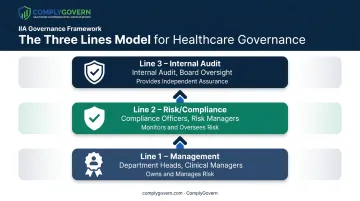
The IIA's Three Lines Model replaced the older "Three Lines of Defense" language in 2020, and it's still the clearest way to divide accountability:
- First line (Management): Owns and operates risk controls daily. Think department heads, clinical managers, and frontline supervisors managing operational risk in real time.
- Second line (Risk/Compliance): Provides oversight and challenge. This includes compliance officers, risk managers, and patient safety teams monitoring whether first-line controls actually hold up.
- Third line (Internal Audit): Delivers independent assurance to the board, with zero operational responsibility for the controls it tests.
In healthcare specifically, this model matters because compliance, quality, risk, and audit teams frequently work in silos across different departments and systems. A hospital might have a compliance officer tracking CMS Conditions of Participation, a risk manager logging incidents separately, and an auditor pulling evidence from yet another source. Nobody sees the full picture.
Platforms like ComplyGovern's Governance Intelligence Engine address this exact gap, linking compliance, risk, and audit evidence into a single system of record so every function works from the same data.
Where Collaboration Strengthens Both Functions
Collaboration doesn't mean merging roles. It means:
- Risk-based audit planning: Audit coverage improves dramatically when teams align their plans with the organization's risk register and current threat intelligence, rather than working from a static annual checklist.
- Joint reporting to boards: A unified view of organizational risk posture beats fragmented updates from three separate teams saying slightly different things.
- Shared risk terminology: Using consistent severity definitions and risk language across both functions prevents confusion when reporting to the board.
IIA research on this coordination found 90% of respondents reported positive outcomes from second- and third-line collaboration, citing better risk coverage (28%) and less duplicated effort (26%). But 20% flagged shared responsibilities as a genuine threat to audit independence, a trade-off worth taking seriously.
Boundaries Internal Audit Should Never Cross
Some activities compromise independence no matter how well-intentioned:
- Designing the risk assessment methodology
- Owning or maintaining the risk register
- Deciding organizational risk appetite
- Implementing the very controls audit will later test
The principle here is simple: an auditor can't build a process and then independently certify it works. That's a conflict of interest, and regulators notice.
Smaller organizations sometimes can't achieve full separation given limited staff. When that's the reality, safeguards like direct board reporting lines or periodic external validation help preserve objectivity even without perfect structural independence.
Types of Audit Risk and Risk Management Strategies
The 4 Types of Audit Risk
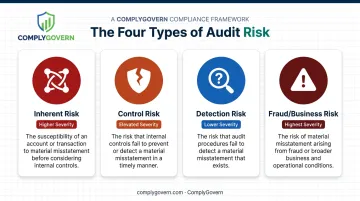
Auditors work with a few core categories:
- Inherent risk — the chance an error occurs because of the nature or complexity of a transaction, before any controls come into play. Complex revenue recognition or estimates are classic examples.
- Control risk — internal controls fail to prevent or catch an error in time.
- Detection risk — the auditor's own procedures miss a misstatement that actually exists.
- Fraud/business risk — an expanded fourth category some frameworks separate out because of its intentional nature, distinct from unintentional inherent risk.
A well-known cautionary tale: the Luckin Coffee case, where fabricated sales records and altered accounting entries went undetected long enough to inflate reported revenue by tens of percentage points across multiple quarters.
That's control risk in action. The company's internal controls simply didn't catch or stop the manipulation, and it cascaded into a full-blown financial reporting failure and a nine-figure regulatory penalty.
The 4 Types of Risk Management Strategies
Once a risk is identified, organizations generally choose one of four responses:
- Avoidance: eliminate the activity that creates the exposure entirely
- Reduction/mitigation: implement controls to lower the likelihood or impact
- Transfer: shift exposure to another party through insurance or contract terms
- Acceptance/retention: consciously tolerate the risk because it falls within appetite
Most mature organizations blend all four, applying different strategies to different risk categories depending on cost and appetite. A hospital might transfer malpractice exposure via insurance while mitigating cybersecurity risk through access controls and encryption.
The 5 C's of Risk Management
Selecting the right response is only half the challenge. Boards and auditors also need a shared vocabulary for discussing risk consistently over time.
The IIA has published a widely referenced "5 C's" list for exactly that purpose: Change Velocity, Crisis Management, Cybersecurity, Compliance, and Culture. The IIA developed this list as a practical lens for board-level conversations, not as a formal ISO or COSO standard.
Embedding these principles into daily operations, not just annual reviews, is what separates a mature risk program from a checkbox exercise. Culture, in particular, is nearly impossible to fake during a survey or audit — it either exists in how staff actually behave, or it doesn't.
Best Practices for Internal Audit and Risk Management
Effective audit and risk management depends on structure and discipline built into every engagement:
- Define scope before fieldwork starts. Use a documented checklist covering key risks, control owners, evidence sources, and timelines for every engagement.
- Align with recognized frameworks. ISO 31000, COSO ERM, and IIA Standard 2120 give audits credibility and consistency that ad hoc approaches can't match.
- Treat risk identification as an ongoing process. A centralized risk register, reviewed through ongoing workshops, interviews, and stakeholder input, beats a static spreadsheet updated once a year.
- Track KRIs continuously. Metrics like time to detect, time to respond, and number of high-risk findings show whether mitigation efforts are actually reducing risk exposure over time.
- Close every audit with a prioritized action plan. Assign ownership, set realistic deadlines, and communicate through a concise executive summary leadership will actually read.
Continuous Readiness in Healthcare
Healthcare compliance teams face this challenge concretely. The HHS-OIG General Compliance Program Guidance recommends compliance risk assessments at least annually, with an audit schedule built from those findings, rather than assembled in a last-minute scramble before a survey.
That reactive scramble is exactly what continuous readiness eliminates. Instead of pulling evidence together in the weeks before a Joint Commission or CMS survey, organizations using platforms like ComplyGovern maintain a live evidence repository that unifies compliance, quality, risk, and audit records into one system. When survey day arrives, the answer to "where's your documentation?" is already known.
How Technology Strengthens Internal Audit and Risk Management
Manual testing has limits. AI-powered analytics and automated evidence collection change the math:
- Reduced manual testing: automated data pulls handle repetitive verification, freeing auditors to focus on investigation and root-cause analysis
- Consistency at scale: algorithms apply the same testing logic across thousands of records, something manual sampling can't replicate
- Real-time dashboards: boards and executives get ongoing risk visibility instead of a quarterly report that's outdated by the time it lands
This is where the fragmentation problem in healthcare governance really shows up. Compliance officers track one thing, risk managers track another, and auditors reconcile it all manually before every board meeting.
ComplyGovern's Governance Intelligence Engine addresses this by connecting policy management, risk registers, audit findings, and corrective actions into a single source of truth. Regulations link through to policies, controls, evidence, quality measures, risks, audits, findings, and executive dashboards in one continuous chain.
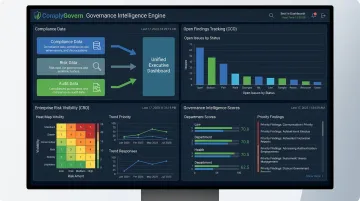
Role-specific dashboards then translate that data for each leader: a CRO gets enterprise risk visibility, while a CCO sees open findings and policy adherence. Both pull from the same underlying data, secured with HIPAA-aligned encryption and role-based access.
Nobody's reconciling three separate spreadsheets before the next board meeting.
Frequently Asked Questions
What is risk management in audit?
Audit risk management is the process of identifying and prioritizing risks so auditors can focus testing on areas most likely to cause a material misstatement or control failure. It shapes where audit hours actually go.
What are the 4 types of audit risks?
Inherent risk (errors from transaction complexity), control risk (controls fail to catch errors), detection risk (auditors miss existing misstatements), and fraud/business risk (intentional misconduct or strategic exposure).
What are the 4 types of risk management?
Avoidance (eliminating the exposure), reduction (lowering likelihood or impact), transfer (shifting exposure via insurance or contracts), and acceptance (consciously tolerating risk within appetite).
What are the 5 C's of risk management?
One widely cited version: Change Velocity, Crisis Management, Cybersecurity, Compliance, and Culture. It's a practical framework for board-level risk conversations, not a formal ISO or COSO standard.
What is the difference between internal audit and risk management?
Risk management owns and operates controls as the second line; internal audit independently tests whether those controls actually work as the third line. One executes, the other verifies.
How often should healthcare organizations conduct risk management audits?
HHS-OIG recommends formal compliance risk assessments at least annually, supplemented by continuous monitoring of key risk indicators, since healthcare regulations change so quickly. Platforms like ComplyGovern automate this ongoing tracking between formal assessments.