That fragmentation isn't just inefficient. It creates blind spots. A policy update in one department doesn't reach risk management. An expired credential slips through because nobody owns the tracking spreadsheet. A survey arrives and staff scramble for three weeks to compile evidence that should have been current all along.
The result: failed surveys, avoidable fines, and — in the worst cases — patient safety incidents that a connected system would have caught.
This guide breaks down what healthcare GRC software actually does, which platforms deserve a spot on your 2026 shortlist, and how to pick the right one based on your organization's facility type, integration needs, and growth plans.
Key Takeaways
- Healthcare GRC software unifies governance, risk, and compliance in one connected system
- Top 2026 platforms pair continuous survey readiness with automated evidence and executive dashboards
- Choose based on regulatory coverage, EHR integration, and facility-type flexibility, not brand name alone
- Leading 2026 options include ComplyGovern, MedTrainer, symplr, Sprinto, AuditBoard, and Compliancy Group
Overview of Healthcare GRC Software in 2026
Healthcare GRC software is a unified platform that connects governance (oversight and accountability), risk management (identifying and mitigating threats), and compliance (regulatory adherence) into a single system of record.
Instead of a compliance officer tracking HIPAA requirements in one spreadsheet, a quality team logging incidents in another, and risk managers maintaining a third, everything lives in one connected environment.
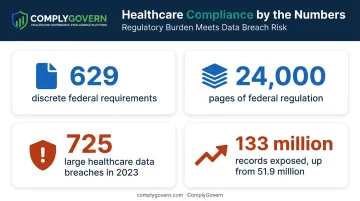
The regulatory burden behind this shift is substantial. A widely cited American Hospital Association analysis identified 629 discrete federal requirements spanning hospital and post-acute care, backed by nearly 24,000 pages of federal regulation.
That count is now years old, but it illustrates the scale hospitals have managed even before more recent CMS rule changes and state-specific survey requirements piled on.
Cybersecurity pressure has compounded the problem. Healthcare data breaches hit a record in 2023, with 725 large breaches exposing more than 133 million records, up sharply from 51.9 million records the year before.
Every breach triggers documentation, notification, and remediation obligations that a fragmented system struggles to handle at speed.
The platforms below are evaluated on four dimensions:
- Regulatory coverage: breadth of frameworks, from HIPAA to CMS Conditions of Participation
- Automation depth: how much evidence collection and monitoring happens without manual input
- Integration capability: connections to EHRs, clinical systems, and Microsoft environments
- Facility-type flexibility: support across hospitals, ASCs, home health, labs, and suppliers
Top Healthcare GRC Software Platforms in 2026
Each platform below serves a different segment of the healthcare compliance market. Some are healthcare-native and built around CMS survey cycles. Others started as general enterprise or cloud-security tools and expanded into healthcare use cases. Knowing which type you're evaluating matters as much as the feature list.
ComplyGovern
ComplyGovern is an intelligent healthcare compliance and governance platform that unifies nine connected governance disciplines into a single system of record. Those disciplines include:
- Governance and board management
- Regulatory compliance
- Accreditation readiness
- Policy and document governance
- Enterprise risk management
- Quality and performance management
- Incident and corrective action
- Medical staff governance
- AI governance
What sets it apart is the Governance Intelligence Engine, which automatically links regulations to accreditation standards, policies, controls, evidence, and corrective actions. Update a policy, and the change flows downstream through every connected control and evidence file without staff re-entering data across separate systems.
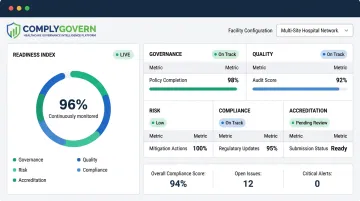
Rather than the typical scramble before a survey, ComplyGovern runs on continuous survey readiness. Its Readiness Index Dashboard shows live, color-coded compliance status across governance, quality, risk, and compliance domains, so leadership isn't guessing where things stand between surveys.
The platform also includes:
- Native Microsoft 365 and SharePoint integration
- Interoperability with Epic, Oracle Health (Cerner), MEDITECH, and athenahealth via HL7 and FHIR
- Built-in AI governance for organizations deploying clinical or administrative AI tools
- HIPAA-aligned security with MFA, SSO, role-based access control, and encryption at rest and in transit
| Category | Details |
|---|---|
| Best For | Health systems, hospitals, and multi-facility organizations needing one unified governance and compliance system of record |
| Key Features | Governance Intelligence Engine, AI governance module, role-specific executive/board dashboards, regulatory framework mapping across the US, UK, Australia, and New Zealand |
| Integration | Native EHR/clinical platform connections (Epic, Cerner, MEDITECH, athenahealth) plus HL7/FHIR support |
Configurations exist for all 19 CMS-recognized facility types, from acute care hospitals and ASCs to DMEPOS suppliers and home infusion therapy providers. This makes ComplyGovern one of the few platforms built to scale across an entire health system's varied facility mix.
MedTrainer
MedTrainer bundles compliance management, learning management, and credentialing into one platform aimed at healthcare organizations of every size. It's a strong fit for teams that want onboarding, training, and policy management under one roof rather than stitched together from separate vendors.
The platform earned recognition as a G2-rated leader in healthcare compliance software, with 4.4/5 across 86 reviews on G2 and 4.3/5 on Capterra. Document management, incident reporting, and credentialing/exclusion monitoring round out its core toolkit.
| Category | Details |
|---|---|
| Best For | Small-to-mid-size healthcare organizations wanting compliance, training, and credentialing bundled together |
| Key Features | Policy and document management, incident reporting, learning management, credentialing and exclusion monitoring |
| Pricing Model | Three tiers (Select, Premier, and Enterprise) with pricing tailored by organization size and complexity; no public flat pricing is listed |
| Notable Consideration | Strong on breadth across compliance, training, and credentialing but thinner on enterprise governance reporting for larger health systems |
symplr Compliance
symplr operates as a healthcare operations platform, with compliance functioning as one module within a much broader suite covering workforce management, provider credentialing, and access management. symplr states its products are used by 9 out of 10 U.S. hospitals, a footprint that applies to the company broadly rather than the compliance module alone.
Its real advantage shows up for organizations already running symplr's provider data or workforce tools, where compliance tracking plugs directly into existing credentialing and privileging workflows.
| Category | Details |
|---|---|
| Best For | Large hospital systems already using symplr's broader provider data and workforce ecosystem |
| Key Features | Compliance management, contract management, access management, provider network management |
| Notable Consideration | Best suited to organizations wanting an all-in-one operations suite rather than a standalone GRC point solution |
If your organization isn't already invested in symplr's ecosystem, adopting it purely for compliance tracking is a heavier lift than platforms built specifically around governance.
Sprinto
Sprinto is an autonomous compliance automation platform focused on continuous control monitoring across HIPAA, SOC 2, ISO 27001, and other cloud-security frameworks. It's rated 4.8/5 on G2, reflecting strong satisfaction among its core user base.
Sprinto's automated evidence collection and vendor risk management workflows make it appealing for organizations that need fast audit turnaround without a large compliance team.
| Category | Details |
|---|---|
| Best For | Digital health, telehealth, and cloud-based healthcare companies needing multi-framework compliance automation |
| Key Features | Continuous control monitoring, automated evidence collection, risk assessment workflows, vendor risk management |
| Notable Consideration | Built primarily for cloud-based organizations — less suited to facility-heavy providers managing CMS surveys and on-premise operations |
If your organization is a telehealth startup or SaaS-based health tech company, Sprinto's framework coverage is a good match. If you're running physical facilities under CMS Conditions of Participation, it's not the primary use case.
AuditBoard
AuditBoard (rebranded as Optro in early 2026) is an audit, risk, and compliance management tool built to identify security gaps and automate compliance assessments. It's positioned as a general enterprise GRC platform with healthcare as one of several industry use cases, not a healthcare-first product.
Jackson Health System's internal audit team is a documented user, moving from a legacy audit tool to AuditBoard's platform with reported efficiency gains.
| Category | Details |
|---|---|
| Best For | Organizations prioritizing internal audit management alongside compliance tracking |
| Key Features | Customizable workflows, audit-ready report generation, collaboration tools, risk assessment modules |
| Notable Consideration | Requires cross-integration setup and additional support for healthcare-specific configuration |
Compliancy Group
Compliancy Group centers entirely on HIPAA compliance, offering a guided program with risk assessments, training, and incident management built specifically for healthcare providers. It's a strong option for smaller practices that want a structured path rather than a blank platform to configure themselves.
| Category | Details |
|---|---|
| Best For | Smaller practices and clinics seeking a guided, HIPAA-first compliance program |
| Key Features | Risk management analytics, HIPAA training modules, incident management, audit response program |
| Notable Consideration | Reporting functionality is more limited compared to enterprise-grade GRC platforms |
How We Chose the Best Healthcare GRC Software
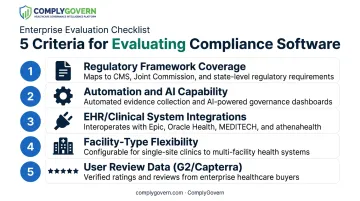
Our evaluation weighed five factors: regulatory framework coverage, automation and AI capability, EHR/clinical system integrations, facility-type flexibility, and user review data from G2 and Capterra.
These criteria surface a pattern most buyers miss. The most common buyer mistake we see is choosing accreditation-only software instead of a unified governance platform. A tool that only handles survey prep looks sufficient until compliance, risk, and quality teams realize they're still duplicating work across three separate systems. That duplication is the exact fragmentation a real GRC platform is supposed to eliminate.
A few weighting principles guided our shortlist:
- HIPAA-aligned security isn't optional: every platform on this list needs to demonstrate encryption, access controls, and audit logging
- Scalability across facility types matters more than most buyers expect. A platform built for hospitals alone won't flex to cover an ASC or home health division
- EHR integration determines how much manual data entry your team avoids day to day
Platforms that check only one or two of these boxes might still be worth considering for a narrow use case. But for organizations trying to eliminate departmental silos entirely, breadth of coverage outweighs a narrow specialty tool every time.
Conclusion
Choosing a healthcare GRC platform is a strategic governance decision that deserves more than a quick checkbox exercise. The right choice should align with how your organization actually operates, factoring in continuous survey readiness, executive visibility, and integration with the clinical systems your teams already use. Don't default to whichever name comes up first in a search.
Before committing, pilot-test your shortlist. Evaluate how well each platform integrates with your existing EHR, and calculate total cost of ownership including implementation time and staff training, not just the subscription line item.
This is the exact challenge ComplyGovern was built to solve: connecting compliance, risk, quality, and policy management into one governance intelligence system, from boardroom to bedside. If you're evaluating platforms for 2026, request a demo to see how continuous readiness could replace your current survey-season scramble.
Frequently Asked Questions
What is GRC in healthcare?
GRC in healthcare integrates governance, risk management, and regulatory compliance into one coordinated framework. It replaces siloed departmental tracking with a shared system of record.
How much does healthcare GRC software cost?
Pricing varies by organization size, number of facilities, and modules needed — compliance-only tools cost less than full governance suites. Most vendors don't publish flat pricing, so request a custom quote based on your specific footprint.
What features should I look for in healthcare GRC software?
Look for policy and document management, automated evidence collection, incident and risk tracking, EHR integrations, and executive dashboards. These five capabilities separate a genuine GRC platform from a basic document repository.
How is healthcare GRC different from general GRC software?
Healthcare GRC must address CMS Conditions of Participation and facility-specific accreditation standards, plus clinical patient safety risks that general corporate GRC tools weren't built to handle. A generic ERM framework doesn't cover survey readiness or HIPAA workflows.
Can healthcare GRC software integrate with EHR systems like Epic or Cerner?
Leading platforms integrate with major EHR systems like Epic, Oracle Health (Cerner), MEDITECH, and athenahealth, typically through HL7 and FHIR standards. Integration depth varies by vendor, so confirm specifics during a demo.
Is healthcare GRC software only for hospitals?
No. Modern GRC platforms support all CMS-recognized facility types, including ambulatory surgical centers, home health agencies, clinical laboratories, and DMEPOS suppliers, not just acute care hospitals.