Introduction
Roughly 1 in 10 patients is harmed during care worldwide, and more than half of that harm is preventable, according to the World Health Organization. That statistic alone should make you uncomfortable with how your organization currently tracks incidents.
Many hospitals and outpatient facilities still rely on paper forms, spreadsheets, and department-specific apps to log adverse events. These tools capture what happened, but rarely confirm whether the fix actually worked. Corrective actions get marked "closed" without verification, and the same incidents resurface months later.
This article breaks down what incident and corrective action (CAPA) management really means in healthcare, and why dedicated software matters. It also covers the features that separate effective platforms from glorified spreadsheets, and how a unified system connects incident data to the rest of your compliance and quality picture.
Key Takeaways
- Incident reporting and CAPA function as a single closed-loop process for resolving safety events
- Paper- and spreadsheet-based tracking drives underreporting and delayed follow-up
- Strong software pairs root cause analysis with CAPA tracking and effectiveness checks
- CMS and Joint Commission surveyors expect documented proof that fixes were verified
- Connecting incident data to broader governance cuts duplicate work and boosts board visibility
What Is Incident & Corrective Action Management in Healthcare?
Incident management is the process of capturing, analyzing, and acting on adverse events, near misses, complaints, and hazards affecting patients or staff. It starts the moment someone reports events such as:
- A patient fall
- A medication error
- A safety concern
- A near miss
Corrective action management, often called CAPA, is different. It's the structured process of finding the root cause behind an incident and implementing (then verifying) a fix so it doesn't happen again. This is what closes the loop that incident reporting alone leaves open.
Here's the problem: most organizations are good at the first half and weak at the second.
An observational study of 227 root cause analyses covering 1,137 recommendations found that only 8% were classified as strong. In fact, 72% of the RCAs produced no strong recommendation at all, according to research published in the International Journal for Quality in Health Care.
Weak actions, like "retrain staff" or "reinforce the policy," rarely change the system that caused the problem in the first place.
That gap matters because incident and CAPA data doesn't live in isolation. It feeds directly into:
- Peer review processes evaluating provider performance
- Enterprise risk registers tracking organizational exposure
- Quality improvement initiatives tied to CMS measures
- Accreditation evidence that surveyors expect to see on demand
When reporting and correction aren't structurally linked, none of those downstream functions get reliable data. Leadership ends up managing risk based on incomplete information.
Common Types of Healthcare Incidents & Events Your System Should Capture
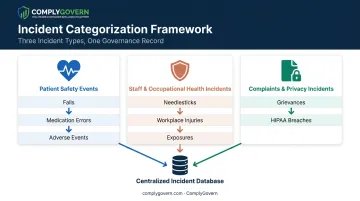
A useful incident management system doesn't just track one category of event. It needs to handle several distinct types, each with its own workflow, while still feeding one centralized database for pattern analysis.
Patient safety events typically include:
- Falls and fall-related injuries
- Medication errors, including near misses
- Adverse events during procedures or treatment
- Hospital-acquired conditions
Staff and occupational health incidents cover a different risk category entirely:
- Needlestick and sharps injuries
- Workplace injuries (lifting, slips, equipment)
- Exposure events involving hazardous materials or infectious disease
Complaints and privacy incidents round out the picture:
- Patient and family grievances
- Formal complaints requiring documented response
- Information security or data-privacy breaches involving protected health information
Each category may need its own intake form and escalation path. A needlestick injury triggers occupational health protocols, while a HIPAA-related privacy incident triggers an entirely different compliance response.
If these events sit in four separate systems, nobody can spot the patterns connecting them. A unit with recurring falls and a spike in staff injuries, for example, often points to a shared root cause such as understaffing.
Why Healthcare Organizations Need Dedicated Incident & CAPA Software
The scale of the problem is larger than most executives realize. A national analysis estimated 795,000 serious harms from diagnostic error annually in the United States, including 371,000 deaths and 424,000 cases of permanent disability, according to research summarized by Johns Hopkins Medicine. That scale of harm reflects a system-level failure to catch and correct problems before they repeat.
Manual tracking makes that failure worse. Organizations relying on spreadsheets, shared drives, and siloed departmental apps commonly run into:
- Lost or incomplete data when incident details live in someone's personal folder instead of a shared system
- Missing visibility into trends because nobody aggregates incidents across units or facilities
- Missed corrective action deadlines since nothing flags an overdue task automatically
- Duplicated effort across compliance, quality, and risk teams entering the same event three different ways
Regulators aren't sympathetic to any of this. Two frameworks define the baseline:
| Requirement | Regulatory Body | What It Demands |
|---|---|---|
| QAPI Program (42 CFR 482.21) | CMS | Tracks medical errors, analyzes root causes, and implements preventive actions, with documented evidence available for CMS review |
| Sentinel Event Policy | Joint Commission | Comprehensive analysis and corrective action plan within 45 business days of a reviewable event, including effectiveness monitoring |
There's a financial angle too. Under the FY 2026 Hospital-Acquired Condition Reduction Program, hospitals in the worst-performing quartile lose 1% of their overall Medicare fee-for-service payments for the year. That's a direct budget consequence tied to unresolved patient harm trends.
Add it up, and fragmented tracking doesn't just create audit risk. It leaves executives and boards without real-time insight into open incidents, overdue corrective actions, or where the organization's exposure actually sits.
Essential Features of Incident & Corrective Action Management Software
Not every platform marketed as "incident management software" actually closes the loop. Here's what separates the ones that do.
Reporting and Root Cause Analysis
Look for automated, role-based incident reporting with mobile-friendly forms configurable by incident type, plus anonymous reporting options. That anonymity matters for building a Just Culture where staff report near misses without fear of blame.
Effective platforms also support structured root cause methodologies rather than a blank text box:
| Method | Best Used For |
|---|---|
| RCA / Fishbone | Retrospective investigation after an adverse event |
| FMEA | Proactive risk mapping before failure occurs |
| PRISMA | Classifying root causes into a structured causal tree |
Closed-Loop CAPA Tracking
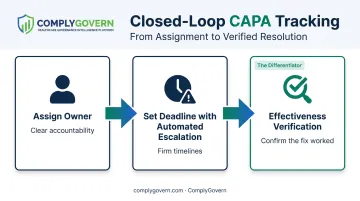
This is where most legacy systems fall short. Strong CAPA tracking requires:
- Assigned owners with clear accountability
- Firm deadlines with automated escalation
- An effectiveness verification step after implementation, not just a checkbox marked "done"
Visibility, Integration, and Security
Once an incident is logged and a corrective action assigned, that data still needs to reach the right people securely. Strong platforms deliver:
- Real-time dashboards giving quality, risk, and executive teams live visibility into open incidents and recurring patterns
- Interoperability with EHR platforms like Epic, Oracle Health (Cerner), MEDITECH, and athenahealth—the same systems ComplyGovern connects to natively—so incident data links to patient records without manual re-entry
- HIPAA-aligned security, including encryption, audit trails, and role-based access controls that support legal defensibility during litigation or survey
Best Practices for Effective Incident Management & Continuous Improvement
Software alone won't fix a broken reporting culture. Pair the platform with these practices.
Build a Just Culture. A Just Culture balances accountability: honest mistakes trigger system fixes, while reckless behavior still warrants discipline. Staff need to trust that reporting a near miss won't end their career.
Apply Plan-Do-Check-Act (or Plan-Do-Study-Act) cycles. Test a corrective action on a small scale, study the results, then roll it out broadly. A systematic review found substantial inconsistency in how healthcare organizations apply this method. That's exactly why the "study" step, not just implementation, needs to be built into your CAPA workflow.
Communicate findings across departments. A lesson learned in the ICU should reach the ED. Isolated fixes rarely translate into organization-wide change unless someone deliberately shares them.
How ComplyGovern Unifies Incident Reporting, CAPA, and Governance
Most of the failures described above trace back to one root issue: incident data lives apart from everything else the organization tracks. ComplyGovern's Governance Intelligence Engine exists to close that gap.
Instead of treating incident reporting as a standalone function, the platform structures data as a connected chain:
- An incident triggers a configurable workflow.
- Root cause analysis feeds directly into corrective action assignment.
- Effectiveness tracking confirms the fix worked before anything gets marked closed.
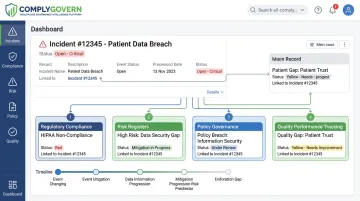
That chain doesn't stop at CAPA closure. Corrective actions link automatically to:
- Regulatory compliance requirements like CMS Conditions of Participation or HIPAA
- Risk registers, so a pattern of incidents surfaces as an elevated organizational risk
- Policy governance, triggering a policy revision when an incident reveals a gap
- Quality performance tracking, tied to CMS measures and patient safety indicators
Because evidence collection runs continuously, facilities stay audit-ready year-round instead of scrambling to pull documentation from scattered drives before an inspection.
Role-specific dashboards give the CMO, CQO, CRO, and board members live visibility into open incidents and overdue corrective actions across every CMS-recognized facility type the organization operates.
The platform's native integrations with Epic, Oracle Health (Cerner), MEDITECH, and athenahealth move incident data from clinical systems into governance workflows without manual re-entry. Combined with HIPAA-aligned encryption, audit logging, and role-based access control, that connection closes the gap where incidents could otherwise fall through the cracks.
Frequently Asked Questions
What's the difference between incident reporting and corrective action management?
Incident reporting captures what happened. CAPA investigates the root cause and verifies a fix actually worked. True incident management requires both working together as one closed loop.
What types of incidents should hospitals track in their software?
Hospitals should track patient safety events, staff and occupational incidents, complaints, and data-privacy events. Each may need its own workflow, but all should feed one centralized system for pattern analysis.
How does incident management software support CMS and accreditation compliance?
It automates documentation, maintains audit trails, and tracks corrective action evidence — exactly what surveyors look for under CMS Conditions of Participation and Joint Commission standards.
Is healthcare incident management software secure and HIPAA compliant?
Reputable platforms use HIPAA-aligned security, including encryption at rest and in transit, role-based access controls, and comprehensive audit logging to protect sensitive incident data.
Can incident management software integrate with our EHR system?
Yes. Modern platforms integrate with systems like Epic, Oracle Health (Cerner), MEDITECH, and athenahealth, allowing incident data to flow directly from clinical records into governance workflows.
How do you know if a corrective action actually worked?
Effective CAPA tracking includes a distinct effectiveness-check step after implementation, not just a task marked complete. Without that verification, you're guessing whether the problem was actually solved.