Physical security isn't slowing down either. Nearly 90% of security professionals now produce formal after-action reports following incidents. Many organizations are still stitching together spreadsheets, shared drives, and disconnected forms to track it all.
The right security incident reporting software changes that. It turns reactive paperwork into proactive risk management, automating evidence collection, alerts, and compliance documentation. This guide breaks down six platforms leading the pack in 2026, including specialized options built for highly regulated fields like healthcare.
Key Takeaways
- Modern platforms replace spreadsheets with centralized logging, alerting, and investigations.
- Prioritize mobile access, customizable forms, strong integrations, and compliance support.
- Solutions span corporate security, IT/DevOps, privacy, and healthcare governance needs.
- Regulated industries need tools that link incidents directly to compliance frameworks.
Overview of Security Incident Reporting Software in 2026
Security incident reporting software is a digital system for logging, tracking, investigating, and resolving incidents. That includes physical security breaches, safety hazards, data exposures, and operational disruptions, all in one searchable record instead of scattered paper trails.
Demand for these tools keeps climbing. According to MarketsandMarkets' industry analysis, the broader incident and emergency management market is projected to grow from $137.45 billion in 2024 to $196.20 billion by 2030, a 6.1% compound annual growth rate spanning software, hardware, and services.
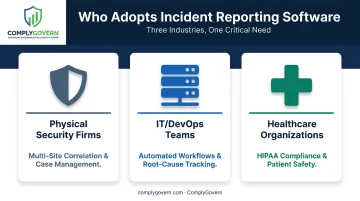
Adoption isn't limited to one type of organization:
- Physical security firms use it for multi-site incident correlation and investigation case management.
- IT and DevOps teams rely on it for automated response workflows and root-cause tracking.
- Healthcare organizations need incident reporting tied directly into HIPAA compliance, patient safety programs, and accreditation surveys.
That last category carries higher stakes than most. A dropped ball in a hospital's incident log risks compliance violations, failed accreditation surveys, and patient harm. With that context in mind, here's how the six platforms below stack up.
Top 6 Security Incident Reporting Software of 2026
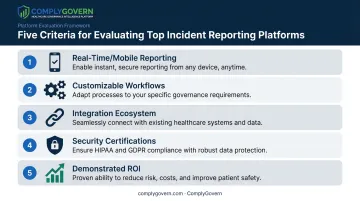
We selected these platforms based on five factors: mobile accessibility, real-time alerting, workflow customization, integration depth, and compliance alignment. Some serve corporate security teams tracking physical incidents across locations.
Others are built for IT outages, data privacy breaches, or healthcare governance. Match the platform to your specific use case, not just its brand recognition.
ComplyGovern
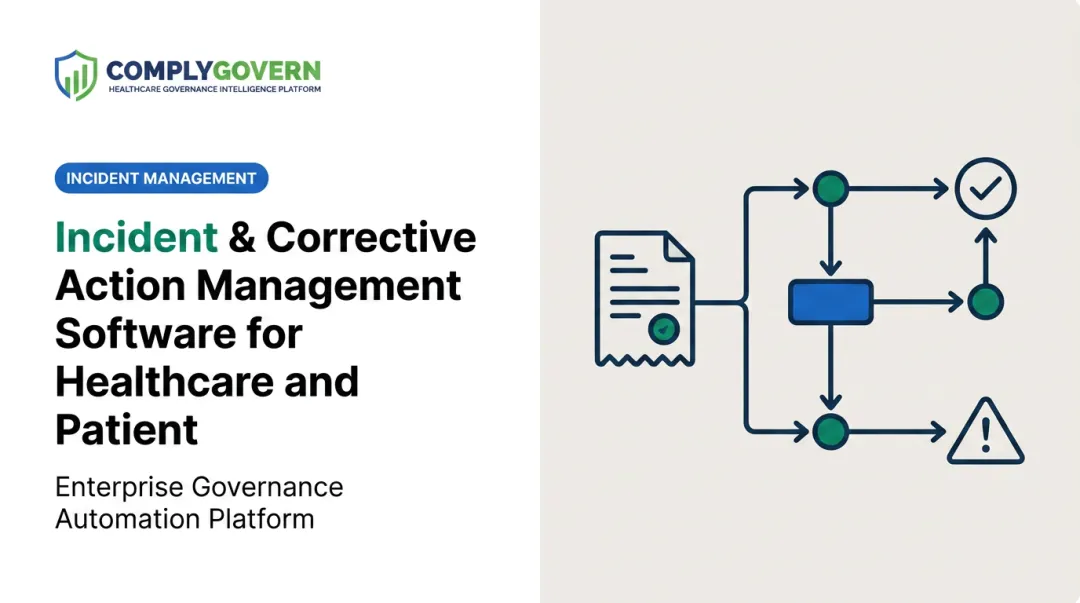
ComplyGovern is a healthcare compliance and governance platform that folds incident reporting into a single system of record alongside risk, quality, policy, and accreditation management.
Incidents flow through the platform's Governance Intelligence Engine, which automatically links each event to relevant regulations, policies, controls, and prior audit findings, replacing the standalone incident log most compliance teams rely on today.
That connectivity is the real advantage for hospitals, ASCs, and skilled nursing facilities. When an incident is logged, the platform routes it to the right stakeholders, assembles supporting evidence without manual cross-referencing, and tracks corrective action effectiveness over time.
Executive dashboards, tuned separately for each C-suite role, surface incident status and compliance posture in real time rather than requiring a status-update email chain.
Security is HIPAA-aligned across the platform, with role-based access control, MFA/SSO, and encryption at rest and in transit. Native interoperability with Epic, Oracle Health (Cerner), MEDITECH, and athenahealth means incident data doesn't sit in a silo separate from clinical systems.
| Category | Details |
|---|---|
| Best For | Healthcare organizations needing incident reporting tied directly to compliance, risk, and patient safety governance |
| Key Features | Automated evidence collection, corrective action tracking, role-specific executive dashboards, HIPAA-aligned security |
| Ideal Users | Hospitals, ASCs, skilled nursing facilities, FQHCs, and other CMS-recognized healthcare facility types |
Preparis
Preparis is a cloud-based business continuity and emergency preparedness platform with a strong incident documentation and alerting layer. Its Incident Manager module functions as a virtual command center, giving teams status visibility during an active event and structured after-action reporting once it's resolved.
What sets it apart is the combination of centralized storage with customizable action plans by incident type, whether that's a weather event, workplace violence scenario, or IT outage. Instant notifications reach key personnel the moment an incident is declared, cutting the lag between detection and response.
| Category | Details |
|---|---|
| Best For | Incident documentation management and business continuity planning |
| Key Features | Real-time alerting, customizable action plans, document storage for audits |
| Pricing | Sales-led via personalized demo; no published pricing tiers |
Rootly
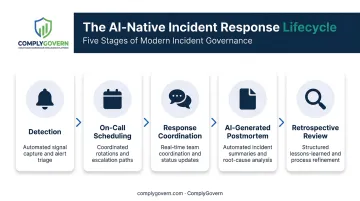
Rootly is an AI-native incident response platform built for technical and security teams that already live in Slack or Microsoft Teams. Rather than forcing a switch to a separate portal, it automates workflows directly inside the chat tools engineers already use.
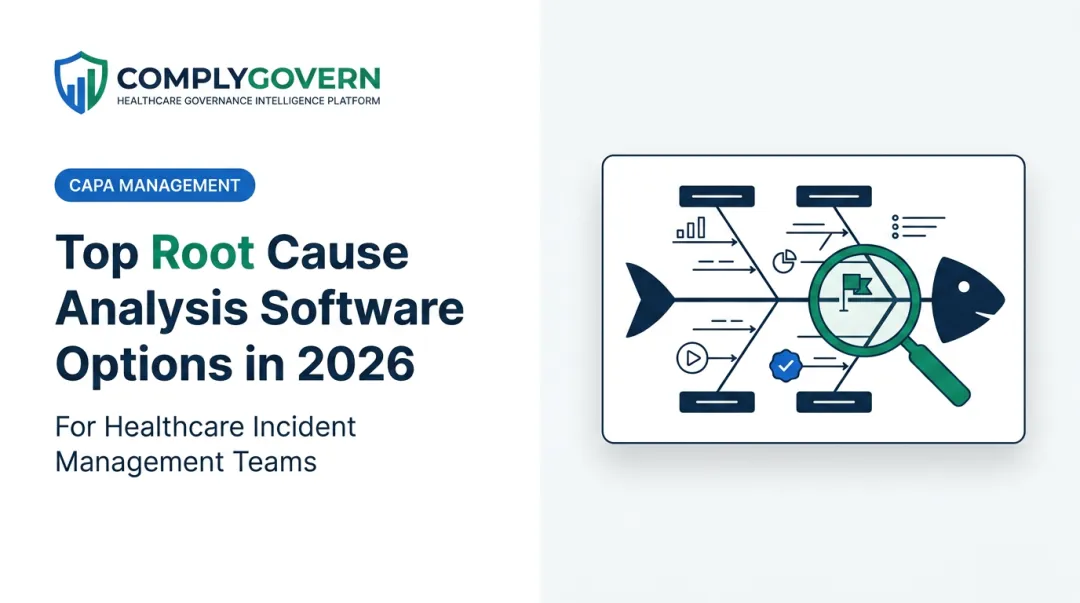
The standout feature is AI-generated postmortems. Rootly drafts timelines and root-cause analysis automatically after an incident closes, saving hours of manual write-up. It also covers the full incident lifecycle from detection through on-call scheduling to retrospective, not just the reporting piece.
| Category | Details |
|---|---|
| Best For | Automating incident response workflows for technical and security teams |
| Key Features | AI-powered retrospectives, on-call scheduling, deep chat tool integrations |
| Pricing | Essentials plan starts at $20 per user/month; two-week free trial available |
Resolver
Resolver is built for corporate security teams managing incidents across multiple physical sites. Configurable intake forms let organizations standardize how incidents get reported, while correlation features connect events across locations to reveal patterns a single-site view would miss.
Risk-based prioritization stands out here. Resolver helps security teams flag which events carry the highest organizational risk, so investigation resources go where they matter most, rather than treating every incident equally.
One documented case study showed a supply chain company achieved a 783% increase in incident reporting volume after adoption, largely from making it easier for frontline staff to submit reports.
| Category | Details |
|---|---|
| Best For | Corporate security incident management across multi-site organizations |
| Key Features | Configurable forms, incident correlation, investigation case management |
| Pricing | Quote-based; pricing varies by deployment scale |
OneTrust
OneTrust is a privacy, security, and third-party risk management platform, and its Privacy Incident Management module is purpose-built for data breach response. It automates the assessment workflows organizations need when a data exposure occurs, tracking regulatory notification tasks against deadlines like GDPR's 72-hour window.
Enterprise integrations with tools like Salesforce and Slack mean incident data doesn't require a separate manual entry step. For organizations juggling multiple regulatory frameworks across regions, that automated regulatory alignment is the main draw.
| Category | Details |
|---|---|
| Best For | Privacy and data breach incident management |
| Key Features | Automated regulatory workflows, risk assessment tools, enterprise integrations |
| Pricing | Sales-led; cost varies by module and deployment scale |
ManageEngine EventLog Analyzer
ManageEngine EventLog Analyzer takes a different angle: log management and real-time threat detection rather than manual incident intake. It continuously monitors network activity, correlates logs across systems, and fires instant alerts when something looks off.
Built-in compliance reporting covers PCI-DSS, HIPAA, and GDPR out of the box, which matters for IT teams who need audit-ready documentation without building custom reports from scratch.
| Category | Details |
|---|---|
| Best For | Real-time incident and threat detection with compliance reporting |
| Key Features | Advanced threat analytics, automated compliance reports, log correlation |
| Pricing | Free edition supports 5 log sources; Professional plan starts around $795/year with a 30-day trial |
How We Chose the Best Security Incident Reporting Software
A common mistake in this space is picking a tool based on name recognition alone rather than fit. A platform known for IT operations might be a poor match for a hospital that needs incident data mapped to CMS Conditions of Participation.
We weighed each platform against these factors:
- Real-time and mobile reporting capability: can staff log an incident from the field, not just a desktop?
- Customizable workflows: does the platform adapt to the organization's incident types, or force a rigid template?
- Integration ecosystem: does it connect to existing tools (EHRs, chat platforms, ticketing systems) instead of creating a new silo?
- Security certifications: SOC 2 reporting and HIPAA-aligned architecture where relevant, since SOC 2's CC7 criteria specifically address incident response controls.
- Demonstrated ROI: measurable outcomes like reduced resolution time or increased reporting participation, not just marketing claims.
Conclusion
There's no single "best" security incident reporting software. The right choice depends on context: a corporate security team tracking physical incidents across ten warehouses has different needs than a hospital compliance officer preparing for a Joint Commission survey.
Before signing a contract, look past the sticker price. Evaluate:
- Scalability as your organization grows
- Integration with the systems you already run
- Total cost of ownership, including implementation and training
Healthcare organizations in particular benefit from platforms that don't treat incident reporting as an isolated task. ComplyGovern connects incident data directly to compliance, risk, and governance workflows, supporting continuous survey readiness instead of a last-minute scramble before inspectors arrive.
Frequently Asked Questions
What is security incident reporting software?
It is a digital system for logging, tracking, and resolving security-related incidents, replacing manual paper forms or spreadsheets. It centralizes documentation so nothing gets lost between departments.
What features should I look for in security incident reporting software?
Prioritize mobile accessibility, customizable forms and workflows, real-time alerts, integrations with existing tools, and relevant compliance or security certifications like SOC 2 or HIPAA alignment.
How is incident reporting different from incident management software?
Reporting documents the event itself. Management covers the full lifecycle, from detection and response through investigation and post-incident review.
How does security incident reporting differ for healthcare organizations?
Healthcare incident reporting must tie into HIPAA compliance, patient safety programs, and accreditation requirements from bodies like the Joint Commission. General corporate security tools typically do not offer that regulatory connection.
How much does security incident reporting software typically cost?
Pricing ranges from free tiers with limited features to per-user monthly plans around $20, up to enterprise contracts priced by scale. Many vendors, especially in healthcare and enterprise security, use sales-led quoting instead of published rates.
Can incident reporting software help with regulatory compliance?
Yes. Automated evidence collection, audit trails, and compliance-mapped reporting reduce non-compliance risk across HIPAA, OSHA, and GDPR frameworks. HIPAA alone requires breach reporting within 60 days (HHS Breach Notification Rule), a deadline automated tracking helps meet consistently.