Organizations that lean on informal check-ins or purely punitive discipline see the fallout fast: burnout-driven turnover, peer review disputes that end up in litigation, and accreditation citations that surface during survey week. Nearly half of physicians reported at least one burnout symptom in 2023, and how organizations evaluate and support them plays a direct role in that number (AMA, 2025).
This guide walks through the regulatory foundation, a best-practice evaluation framework, Just Culture principles for fair accountability, modern review techniques, and the technology that ties it all together into a defensible, engagement-driving program.
Key Takeaways
- Physician oversight demands dual accountability—contracts via administration, competence via peer review
- CMS and accreditation standards demand continuous OPPE plus targeted FPPE, not annual paperwork alone
- Bidirectional feedback models consistently outperform anonymous, one-way reviews for physician engagement
- Just Culture separates system failures from individual misconduct, cutting legal exposure while fixing root causes
- Centralized governance technology reduces manual tracking burden and keeps organizations survey-ready year-round
The Regulatory and Governance Foundation of Physician Performance Management
Physician performance isn't managed through one channel. It runs on two parallel tracks that rarely get enough attention paid to how they interact:
- Employment contract track: managed by hospital or practice administration, covering compensation, conduct, and standard HR discipline
- Medical staff bylaws track: managed through the organized medical staff and peer review process, covering clinical competence and privileging decisions
Confusing the two, or letting administration override peer review authority without proper process, is a common source of legal challenges.
The CMS Floor and Accreditation Ceiling
CMS sets the regulatory minimum. Under 42 CFR 482.22(a)(1), hospitals participating in Medicare must ensure "the medical staff must periodically conduct appraisals of its members," with CMS interpretive guidance requiring this appraisal at least every 24 months (eCFR, 42 CFR 482.22).
Surveyors will pull credentialing files and check whether the hospital actually followed its own bylaws and privileging policies, not just whether one exists on paper.
Accrediting bodies like The Joint Commission build on that floor. Their standards require documented, data-driven, continuous evaluation of practitioner competence as a condition of accreditation, mapped in current standards language to OPPE and FPPE processes rather than a once-a-year checkbox.
OPPE vs. FPPE: Understanding the Two Pillars of Practitioner Evaluation
These two processes work together but serve different purposes:
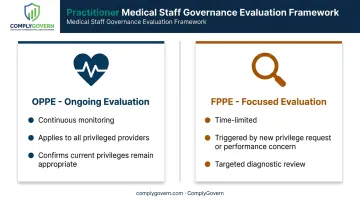
- OPPE (Ongoing Professional Practice Evaluation): continuous, benchmarked monitoring of practitioner performance data used to confirm that current privileges remain appropriate
- FPPE (Focused Professional Practice Evaluation): time-limited, targeted evaluation triggered by a new privilege request, an identified performance concern, or a sentinel event
The distinction matters practically. OPPE is the baseline heartbeat monitor running on every privileged provider. FPPE is the diagnostic workup you order when something specific needs a closer look, or when a physician is granted a new privilege and hasn't yet built a track record.
Undocumented or inconsistent OPPE/FPPE processes remain among the most challenging areas hospitals face during medical staff surveys. Even organizations with strong clinical outcomes get flagged when the paper trail doesn't clearly show how a competence decision was reached.
Building a Best-Practice Framework for Physician Performance Management
A defensible evaluation process starts long before a physician ever sees a scorecard. It starts with clear, documented expectations set before day one of practice.
Shared, measurable goals anchored to a documented practice mission give both sides something to point to when questions arise. Vague expectations are exactly what fuel disputes later, when a physician says "no one told me that was the standard" and the file has nothing to contradict them.
Selecting the Right KPIs and Metrics for Physician Performance
Effective programs track a consistent set of categories rather than a scattershot mix that changes department to department:
- Clinical quality and outcomes — condition-specific process and outcome measures, such as blood pressure control or preventive screening rates
- Patient satisfaction — patient experience data attributed at the individual physician level
- Productivity — typically measured through work RVUs (wRVUs) or collections, per the Medical Group Management Association's (MGMA) standard definitions
- Peer review findings — case-level review outcomes from colleagues in the same specialty
- Compliance and documentation accuracy — adherence to medical staff bylaws, rules, and policies
The Agency for Healthcare Research and Quality (AHRQ) notes that physician-level quality measures can be applied to individual practitioners or to groups, which matters when deciding whether your dashboards track individuals, teams, or both (AHRQ, Measuring the Quality of Physician Care).
Collaborative Peer Review and Progressive Discipline
Here's where the dual-track structure from the regulatory section becomes operational. The organized medical staff should handle peer review assessments, including OPPE and FPPE findings. Administration executes progressive discipline for conduct or contract issues through the employment relationship.
Blurring these two paths creates procedural conflict fast. An administrator who tries to discipline a physician for a clinical competence issue without routing it through peer review invites a due-process challenge.
Frequent, need-to-know communication between executive leadership and medical staff leaders prevents this. Regular touchpoints build consensus before a concern escalates, and they create the documented consistency that supports legally defensible corrective action if it becomes necessary. A centralized medical staff governance platform, like ComplyGovern's, keeps peer review findings, OPPE/FPPE data, and administrative communications in one auditable record, so both tracks stay evidence-ready if a dispute arises.
Applying a Just Culture Approach to Physician Performance Issues
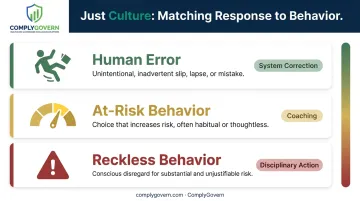
Not every adverse event is a discipline problem. Just Culture gives leaders a structured way to tell the difference between three categories of behavior:
- Human error: an inadvertent slip or lapse; the response is system correction, not punishment
- At-risk behavior: a choice that increases risk when the person didn't recognize it, or mistakenly believed it was justified; the response is coaching
- Reckless behavior: conscious disregard of a substantial, unjustifiable risk; remedial or disciplinary action may be warranted (a peer-reviewed overview of Just Culture models)
Treating a system-induced error the same way you'd treat willful misconduct doesn't just feel unfair to physicians. It also means you never fix the actual process gap that caused the problem in the first place, so it happens again.
Using a Decision-Tree Approach
A structured decision tree, adapted from James Reason's culpability framework, helps leaders sort incidents consistently rather than case by case on gut instinct.
The UK's healthcare Incident Decision Tree applies four sequential tests: deliberate harm, incapacity, foresight, and substitution. Each test asks whether a reasonable, similarly-trained peer would have acted the same way under the same conditions.
When piloted across five NHS organizations covering roughly 35,000 staff, the tool was found useful for guiding fair, consistent incident decisions, not for guaranteeing a particular disciplinary outcome. That's the right expectation to set: the tool supports consistent, defensible reasoning, while final disciplinary judgment still rests with leadership.
Consistent culpability assessment reduces legal and reputational exposure while surfacing the systemic gaps that actually need fixing, not just the individual who happened to be standing there when the system failed. Platforms like ComplyGovern's incident and CAPA workflows help operationalize this consistency, logging each classification decision alongside its corrective action plan for a defensible audit trail.
Modernizing Physician Performance Reviews
The traditional 360-degree review, built on anonymous, one-way feedback, is losing ground for good reason. Physicians receiving a stack of anonymous comments with no chance to respond rarely walk away feeling supported, and the format does little to change future behavior.
Bidirectional conversations flip the model. Instead of only grading a physician, the review asks what support and resources they need to succeed. This single shift changes the entire tone of the meeting from evaluation to problem-solving.
A few specific techniques worth adopting:
- "Continue, start, stop" exercises: a forward-looking alternative to grading that identifies what's working, what's missing, and what needs to end
- Team-dynamics context: evaluating how a physician functions within their care team, not in clinical isolation
- Explicit burnout and wellness discussion: dedicated space to talk about unused time off, workload, and available wellness resources
One documented example of this shift: UNC Physicians Network replaced its anonymous 360-degree process with a bidirectional annual review incorporating "continue, start, stop" discussions and explicit well-being conversations.
Over two years, the organization moved from the bottom third nationally for physician engagement to the top 25%, with actively disengaged physicians dropping from 6.4% to less than 1% (AMA, Time for a New Way).
This is a single case study, not a controlled trial. Even so, the reported gains are concrete, and they tracked directly with the shift from grading physicians to supporting them.
Platforms that unify OPPE, FPPE, and engagement data — like ComplyGovern's medical staff governance module — give leadership one consistent record instead of scattered spreadsheets.
Leveraging Technology to Streamline Performance Management and Compliance
How Technology Simplifies Performance Management and Compliance
Manually tracking OPPE data, FPPE cases, peer review findings, policy attestations, and corrective actions across spreadsheets and shared drives creates a specific kind of chaos:
- Evidence scattered across departmental systems that don't talk to each other
- No real-time visibility for medical staff offices or executive leadership
- Weeks of staff time spent reconstructing files right before survey season
- Duplicate work when compliance, quality, and risk teams all track pieces of the same physician's file separately
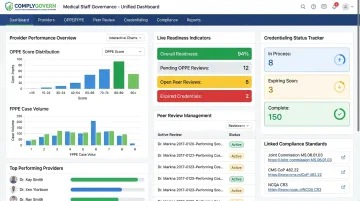
A unified governance platform removes that duplication. ComplyGovern's Medical Staff Governance module, for instance, connects FPPE and OPPE tracking, peer review management, credentialing data, and committee actions into one system of record. Each activity links automatically, through its Governance Intelligence Engine, to the relevant CMS Conditions of Participation and accreditation standards.
Practically, this means:
- Medical staff offices get real-time provider performance dashboards instead of static spreadsheets updated once a quarter
- Executive leadership sees role-specific dashboards, including a live readiness index, without digging through operational-level detail
- Peer review findings automatically flow into corrective action tracking and policy review triggers, so nothing sits in isolation
- Credentialing files stay current continuously rather than getting assembled in a scramble before a survey
Continuous readiness is the target: the evidence trail for every OPPE cycle and FPPE case already exists before a surveyor asks for it, eliminating the reactive scramble before an inspection.
Frequently Asked Questions
What are the 5 pillars of performance management?
Most frameworks cover planning, monitoring, developing, rating, and rewarding. For physicians, this translates to setting clear expectations, tracking OPPE data continuously, offering coaching and support, conducting fair evaluations, and tying outcomes to compensation or advancement.
What is the difference between MSO and PPM?
A Medical Staff Office (MSO) handles credentialing, privileging, and peer review, the governance side of physician oversight. Physician Practice Management (PPM) covers the operational and financial administration of a practice while physicians retain clinical control.
What are the 5 key performance indicators in a hospital?
Common hospital-wide KPIs include readmission rates, patient satisfaction scores, average length of stay, hospital-acquired infection rates, and staff or physician turnover. These measures feed directly into CMS quality reporting and accreditation surveys, making accurate tracking essential for compliance teams.
What is the difference between OPPE and FPPE?
OPPE is continuous, ongoing monitoring used to confirm current privileges remain appropriate. FPPE is time-limited and triggered by a specific event, such as a new privilege request or a performance concern.
How often should physician performance reviews be conducted?
CMS requires medical staff appraisals at least every 24 months, but OPPE data collection is meant to be ongoing, not periodic. Most organizations supplement this with annual comprehensive reviews and real-time monitoring throughout the year.
What happens if a hospital fails to properly document physician performance evaluations?
Undocumented evaluations create accreditation survey citations and weaken legal defense during credentialing disputes or malpractice litigation. They also raise patient safety risk, since performance issues can go undetected without a consistent evaluation trail — which is why automated evidence collection has become standard practice for medical staff offices.