Introduction
Healthcare compliance teams are drowning in complexity. HIPAA hasn't changed overnight, but the surrounding regulatory environment has shifted dramatically.
CMS Conditions of Participation, state-level privacy laws, and an increasingly aggressive OCR enforcement posture are reshaping the stakes. In 2024 alone, OCR closed 22 investigations with resolution agreements or civil penalties, totaling $9,944,612 in settlements, according to HHS's Annual Report to Congress on HIPAA Compliance.
Spreadsheets and shared drives simply can't keep pace. Tracking risk assessments, business associate agreements, and safeguard evidence by hand invites gaps that surveyors and auditors will find.
The smartest healthcare organizations have already shifted strategy. Instead of scrambling before a survey, they're building continuous, automated compliance into daily operations.
This guide breaks down the top HIPAA compliance software tools of 2026, explains how we evaluated them, and helps you match the right platform to your organization type.
Key Takeaways
- HIPAA software automates risk assessments, policy management, and BAA oversight, but staff training remains a human responsibility
- Hospitals need unified governance platforms, small practices need guided workflows, and tech teams prefer automation-first tools
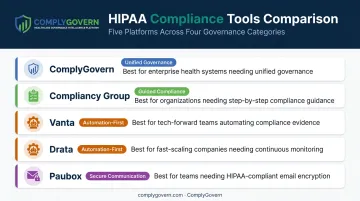
- ComplyGovern, Compliancy Group, Vanta, Drata, and Paubox lead across governance, guided compliance, automation, and secure communication
- Your best fit depends on facility type, in-house compliance resources, and how much automation you need
Overview of HIPAA Compliance Software in Healthcare
HIPAA compliance software helps covered entities and business associates manage the administrative, physical, and technical safeguards required under HIPAA's Privacy, Security, and Breach Notification Rules. That means risk assessments, policy documentation, vendor tracking, and access controls in one place, not scattered across departments.
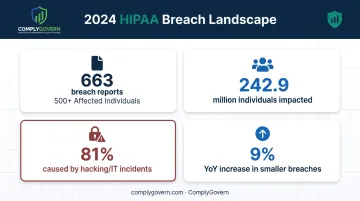
The stakes keep rising. OCR received 663 breach reports affecting 500 or more people in 2024, impacting roughly 242.9 million individuals, per HHS's 2024 Annual Report to Congress on Breaches.
Hacking and IT incidents caused 81% of those cases, while smaller breaches rose 9% year over year.
That combination of bigger hacking incidents and more frequent small breaches is pushing healthcare organizations toward continuous monitoring instead of annual checklists.
That shift makes purpose-built compliance software essential. Below, we break down the leading platforms across four categories:
- Unified governance for enterprise-wide oversight
- Guided compliance for structured checklists
- Automation-first tools for continuous monitoring
- Secure communication for HIPAA-compliant messaging
Each category fits a different type of organization, so "best" depends on your facility type and internal resources.
Top HIPAA Compliance Software Tools in 2026
We selected the tools below for their safeguard coverage, BAA policies, automation depth, and fit across organization types — from single-site clinics to multi-facility health systems.
ComplyGovern
ComplyGovern is a healthcare governance and compliance platform built to replace fragmented spreadsheets, shared drives, and siloed departmental tools with one connected system. Rather than treating HIPAA as a standalone checklist, it links compliance to accreditation, quality, risk, policy management, and AI governance through what it calls a Governance Intelligence Engine.
What sets it apart:
- Supports every CMS-recognized facility type — hospitals, ASCs, SNFs, FQHCs, hospice agencies, DMEPOS suppliers, and more
- Offers continuous survey and accreditation readiness instead of reactive, last-minute prep
- Integrates natively with Epic, Oracle Health (Cerner), MEDITECH, athenahealth, and Microsoft 365/SharePoint
| Category | Details |
|---|---|
| Best For | Hospitals, health systems, and any CMS-recognized facility type needing unified governance across compliance, quality, risk, and accreditation — not just a single-point HIPAA tool |
| Key Features | Governance Intelligence Engine linking regulations, policies, controls, evidence, risks, and corrective actions; role-specific executive and board dashboards; AI Governance module; HIPAA-aligned security built in |
| Differentiator | Unifies nine governance disciplines in one system of record, cutting duplicate effort across compliance, quality, and risk teams while giving boards real-time visibility |
| Consideration | Best suited for organizations ready to consolidate governance, quality, and risk into one system rather than teams wanting a single-point HIPAA checklist tool |
Compliancy Group
Compliancy Group built its platform, The Guard, to walk practices through required HIPAA policies, risk assessments, and documentation step by step. It's less about dashboards and more about hand-holding.
Its edge comes from human coaching paired with software, plus a public-facing Trust Badge that signals active compliance status to patients and partners.
| Category | Details |
|---|---|
| Best For | Small practices and clinics without a dedicated compliance officer |
| Key Features | Editable policy templates, BAA tracking and vendor management, direct access to compliance coaches |
| Consideration | Relies more on manual yes/no input than continuous automated monitoring, so full documentation can take longer to reach |
Vanta
Vanta is a broad trust management platform offering automation-heavy compliance across multiple frameworks, with a dedicated HIPAA product built for tech-forward healthcare companies. It connects to cloud infrastructure, HR systems, and identity tools to continuously monitor safeguards.
The standout feature: hundreds of integrations keep evidence collection running in the background instead of requiring manual uploads.
| Category | Details |
|---|---|
| Best For | Health tech startups and SaaS companies building products that handle PHI |
| Key Features | 400+ native integrations, automated access reviews, HIPAA-specific policy builder, continuous control monitoring |
| Consideration | Value drops for organizations still relying on paper records or legacy on-premise systems; can get pricey for very small teams |
Drata
Drata is an enterprise-focused compliance automation platform that layers AI onto evidence collection and risk assessments. It's often deployed alongside SOC 2 or ISO 27001 programs rather than as a standalone HIPAA tool.
Its differentiator: built for scale across complex, multi-entity healthcare organizations with large employee counts.
| Category | Details |
|---|---|
| Best For | Larger healthtech or multi-framework organizations needing enterprise-grade scaling |
| Key Features | AI-assisted security questionnaire responses, dedicated audit hub, multi-framework evidence mapping |
| Consideration | Initial setup for complex enterprises requires significant internal coordination and IT involvement |
Paubox
Paubox focuses on one specific friction point: secure patient communication. It encrypts outbound email automatically, without forcing patients through a separate portal or login.
The key advantage: patients read secure messages directly in their normal inbox, which tends to improve response rates for provider communication.
| Category | Details |
|---|---|
| Best For | Providers needing HIPAA-compliant patient email without disrupting existing workflows |
| Key Features | Zero-step outbound encryption, HITRUST CSF certification, inbound phishing and ransomware protection |
| Consideration | Priced higher than standard encrypted email add-ons, and lacks message recall or expiry once delivered |
How We Chose the Best HIPAA Compliance Software
Our evaluation centered on safeguard enforcement, not marketing claims. We looked at how each platform actually handles encryption, access controls, and audit logging, drawing on vendor documentation and verified user reviews.
Four criteria mattered most:
- BAA willingness: Any vendor unwilling to sign a Business Associate Agreement was excluded outright. This is non-negotiable under HIPAA.
- Automation depth: Evidence collection, drift detection, and integration breadth were weighted heavily, since compliance fatigue among healthcare teams keeps rising.
- Organizational fit: We considered how well each tool matches different facility types and staffing models, not just a generic "healthcare" label.
- Scalability beyond HIPAA: For larger entities, we favored platforms that extend into accreditation, quality, and risk management rather than staying siloed to one regulation.
As NIST notes, risk assessment under the Security Rule is an ongoing activity, not a one-time static task, a principle that shaped how heavily we weighted continuous monitoring against periodic check-ins.
How to Choose the Right HIPAA Compliance Software for Your Organization
Start with organization type:
| Organization Type | What to Prioritize |
|---|---|
| Solo practice | Guided simplicity — a platform that tells you exactly what to do next |
| Hospital, health system, or multi-facility provider | Centralized governance spanning compliance, quality, risk, and accreditation, not just HIPAA in isolation |
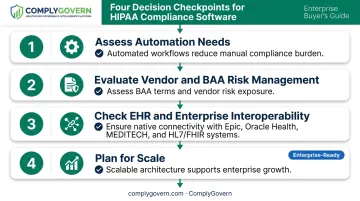
From there, work through these checkpoints:
- Assess automation needs. If compliance sits with IT or operations staff rather than a dedicated governance, risk, and compliance (GRC) team, prioritize platforms that auto-collect evidence and monitor safeguards continuously rather than periodically.
- Evaluate vendor and BAA risk management. Confirm the platform structurally tracks BAAs, vendor risk assessments, and remediation, rather than leaving it to manual spreadsheets that go stale.
- Check EHR and enterprise interoperability. Platforms that connect with Epic, Oracle Health (Cerner), MEDITECH, athenahealth, or Microsoft 365 cut down on duplicate data entry and administrative drag.
- Plan for scale. Choose a system that extends beyond HIPAA into accreditation readiness, quality, and risk management as your organization grows. Migrating platforms later is expensive and disruptive.
A small clinic evaluating tools might reasonably stop at "does this cover my BAAs and give me templates." A 200-bed hospital system asking the same question is setting itself up for a costly rebuild in three years.
Conclusion
Software supports HIPAA compliance, but the organization retains ultimate accountability for meeting it. The right platform reduces manual burden and keeps your organization continuously audit-ready instead of scrambling before a survey. The wrong one just adds another login to manage.
Before committing to a vendor, weigh automation depth, facility-type fit, and governance scope. Price and brand name matter less than whether the tool actually fits how your organization operates day to day.
For healthcare organizations that want one connected system running from the boardroom to the bedside, rather than a point solution addressing HIPAA alone, ComplyGovern was built for exactly that job. Request a demo to see how it fits your facility type.
Frequently Asked Questions
What software is HIPAA compliant?
No software is automatically "HIPAA compliant." OCR (the HHS Office for Civil Rights) doesn't certify or endorse products as such. A tool only supports compliance when it enables required administrative, physical, and technical safeguards and the vendor signs a Business Associate Agreement (BAA).
What AI software is HIPAA compliant?
AI tools can support HIPAA compliance only if the vendor signs a BAA, encrypts PHI, restricts data use for model training, and provides audit logging. AI governance oversight is increasingly expected for healthcare AI deployments too.
What is the best HIPAA compliance software?
It depends on your organization type. Unified governance platforms like ComplyGovern suit hospitals and health systems, while guided or automation-first tools suit smaller practices and health tech teams.
How much does HIPAA compliance software cost?
Pricing varies by organization size, automation depth, and number of facilities or integrations. Some guided platforms start around $99–$449 per month; enterprise governance platforms require custom quotes based on scope.
Does HIPAA compliance software guarantee compliance?
No. Software must be paired with trained staff, documented policies, and active organizational engagement to hold up during an OCR investigation. Automation supports these efforts, but people and processes drive real compliance.
What features should HIPAA compliance software include?
Look for risk assessment workflows, policy management, BAA and vendor tracking, access controls, audit logging, and continuous safeguard monitoring rather than periodic checklists alone.