Introduction
Provider growth, M&A activity, and tighter payer scrutiny have pushed medical staff credentialing out of the back office and into the strategic planning meeting. A single delayed verification can now hold up a hospital acquisition timeline or stall a new service line launch.
Yet most explanations of CVO credentialing stop at definitions. They rarely address what matters most to a CFO or compliance officer.
The real questions are operational: how fast providers start billing, how much liability exposure gets caught before it becomes a headline, and whether your files survive an accreditation survey.
This article breaks down what CVO medical staff credentialing actually is, why it drives measurable operational outcomes, and how organizations extract real value from it instead of treating it as a one-time onboarding checkbox.
Key Takeaways
- Independent CVOs verify credentials in parallel, cutting weeks off traditional timelines
- Continuous monitoring catches license lapses and exclusions between recredentialing cycles
- Standardized, audit-ready files support NCQA, URAC, and delegated credentialing arrangements
- Credentialing delivers full value only when connected to broader risk and governance oversight
What Is CVO Medical Staff Credentialing?
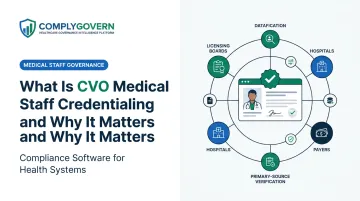
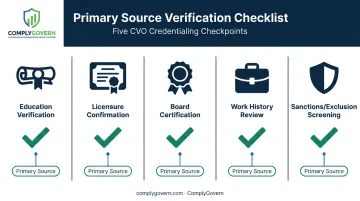
A Credentials Verification Organization performs primary source verification on behalf of a hospital, medical group, or health plan. That means confirming a provider's education, licensure, board certifications, work history, and sanctions status directly with the issuing source rather than accepting self-reported documentation.
You'll find CVO credentialing at work in:
- Hospital and health system medical staff offices
- Ambulatory surgery centers (ASCs)
- Health plans managing network credentialing
- Management services organizations (MSOs) overseeing multi-site provider groups
Most organizations run this process at initial appointment and then again every 2 to 3 years for recredentialing, aligned with current NCQA and Joint Commission reappointment cycles.
Verification unlocks real business outcomes: faster time-to-billing, lower liability exposure, and stronger footing when accreditors or payers request records. Treat CVO credentialing as a strategic input, not a box-checking exercise.
Key Advantages of CVO Medical Staff Credentialing
The advantages below focus on outcomes healthcare leaders already track, not abstract compliance theory. Each one ties directly to a metric your finance, quality, or compliance team monitors: cost, time-to-bill, patient safety incidents, and audit results.
Faster, Compliant Provider Onboarding and Revenue Recognition
Every provider sitting in credentialing limbo is a provider who can't bill. A CVO shortens that limbo by running verification checks across licensing boards, the NPDB, OIG exclusion lists, and SAM simultaneously instead of chasing each source one at a time.
The scale of the problem is real. MGMA reports that credentialing typically runs 90 to 180 days from application submission through final approval, a window where a fully qualified provider generates zero revenue while fixed costs (salary, benefits, overhead) keep accruing.
MGMA's revenue cycle guidance also links credentialing delays directly to downstream claim denials and rework.
That delay compounds during:
- Rapid provider hiring or network expansion
- M&A integration, when multiple credentialing systems must merge
- Seasonal staffing spikes in specialties with high turnover
KPIs to watch: time-to-credential, days-to-first-bill, and monthly revenue leakage tied to idle providers.
Reduced Regulatory and Patient Safety Risk Through Continuous Monitoring
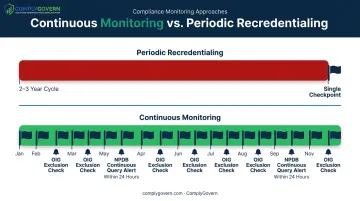
Recredentialing every 2 to 3 years isn't enough on its own. A license can lapse or a provider can land on an exclusion list in month 14 of a 36-month cycle, and nobody notices until an audit or a claim gets flagged.
Mature CVOs solve this with continuous screening of live databases, including monthly OIG exclusion list checks and NPDB Continuous Query, which pushes new report notifications within 24 hours of receipt. That's a meaningful gap closed compared to catching issues only at formal reappointment.
The cost of missing this is not hypothetical. The OIG's own enforcement record includes cases like St. Mary's General Hospital's $32,000 settlement after self-disclosing that it had employed an excluded individual in pharmacy management.
Excluded providers can't bill federal programs, and organizations that miss this exposure face civil monetary penalties, not just reputational damage.
This matters most in large, multi-site networks where tracking hundreds of providers manually across dozens of state boards simply isn't realistic.
KPIs to watch: sanction-detection turnaround time, exclusion-catch rate, malpractice and CMP exposure.
Standardized, Audit-Ready Documentation for Accreditation and Delegated Credentialing
Accreditors don't grade effort. They grade files. Inconsistent or incomplete credentialing documentation is one of the most common reasons organizations fail accreditation surveys or get denied delegated credentialing status by a health plan.
Certified CVOs follow standardized verification protocols built to survive exactly this kind of scrutiny. NAMSS's Ideal Credentialing Standards call for a comprehensive practice history since training, primary source verification of at least the past five years, and written explanations for any employment gap over 30 days.
Files built to that specification, as outlined in NAMSS's own standards document, hold up under both accreditor and payer review.
This becomes critical when:
- Preparing for an NCQA, URAC, or Joint Commission survey
- Pursuing a new delegated credentialing agreement with a health plan
- Managing credentialing across multiple payer contracts with differing documentation expectations
KPIs to watch: audit pass rate, delegation-readiness timeline, file error rate.
What Happens When CVO Credentialing Is Missing or Ignored
Organizations that skip a disciplined CVO process, or apply one inconsistently, tend to run into the same set of problems:
- Error-prone files that trigger payer or accreditor findings during survey
- Reactive firefighting when a lapsed license or undetected exclusion surfaces mid-audit rather than at intake
- Rising administrative costs as internal staff chase primary sources one phone call and one fax at a time
- Scaling failures during provider growth or M&A, when volume outpaces manual capacity
- Delayed revenue recognition and frustrated providers stuck waiting weeks longer than necessary to start seeing patients
None of these show up as a single dramatic event. They accumulate until a survey, a claim denial, or a compliance investigation forces the issue into the open.
How to Get the Most Value from CVO Credentialing
CVO credentialing pays off when it's applied consistently, not selectively. Running rigorous verification on physicians while cutting corners on advanced practice providers or locum staff creates exactly the kind of gap an auditor will find.
A few practices separate organizations that get real value from those that just check a box:
- Apply the same standard everywhere. Every provider type, every facility, every time, regardless of specialty or urgency.
- Review outcomes regularly, not just before a survey. Turnaround time, error rates, and sanction flags should hit a compliance or medical staff leadership dashboard on a recurring basis.
- Act on findings, don't just log them. An expiring license or a flagged sanction that sits in a spreadsheet unaddressed defeats the purpose of catching it.
This is where the real gap shows up for most organizations. Credentialing data often lives in its own silo, disconnected from the policies that govern provider qualifications and the risk registers that should reflect provider-related exposure. It's also cut off from the corrective action workflows that close the loop when something's wrong.
ComplyGovern's Medical Staff Governance module addresses this gap by connecting credentialing, peer review, FPPE, and OPPE data directly into a broader governance structure.
Provider performance and credentialing status feed into the same Governance Intelligence Engine that tracks:
- Policy compliance across every provider type
- Enterprise risk tied to credentialing gaps
- Corrective actions triggered by review findings
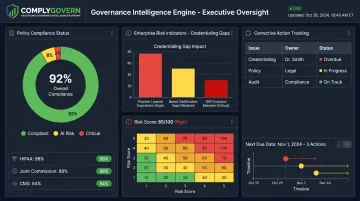
Executives and boards get a continuously updated view instead of a one-time report assembled under deadline pressure.
Conclusion
CVO medical staff credentialing delivers its real value through the control and consistency it brings to the entire provider lifecycle, from first application to every recredentialing cycle after.
Its advantages in faster revenue recognition, reduced regulatory risk, and stronger audit readiness don't show up all at once. They compound over time, provided the process is applied systematically and reviewed continuously rather than dusted off before a survey.
Treat CVO credentialing as an ongoing governance discipline connected to your broader oversight structure rather than a one-time onboarding task, and it becomes a genuine strategic asset for the organization. Platforms like ComplyGovern's Medical Staff Governance module help make that discipline sustainable, connecting credentialing data to your broader compliance and quality picture.
Frequently Asked Questions
How much does CVO credentialing software cost?
Pricing varies by provider volume, verification scope, and whether you're buying software-only or a fully managed CVO service. Most vendors require a custom quote based on your organization's size and needs.
What is CVO Insights for the MD app?
CVO Insights is a reporting feature within the MD-Staff credentialing platform, while MD-App is a separate provider-facing onboarding tool from the same vendor family. Software vendors frequently rebrand features, so verify exact naming and capabilities directly with the vendor before comparing options.
What is the difference between a CVO and in-house credentialing?
A CVO is an outsourced organization performing primary source verification on your behalf. In-house credentialing means building internal staff, technology, and direct database access to do the same work yourself.
How long does CVO credentialing typically take?
Industry benchmarks from MGMA show application-to-approval cycles running 90 to 180 days for standard in-house processes. Dedicated CVOs generally reduce this by running verifications in parallel rather than sequentially.
Is CVO certification required by law?
No federal law mandates NCQA or URAC certification for CVOs. However, certification is widely expected by health plans and accreditors, and it's often a prerequisite for delegated credentialing agreements.
What is delegated credentialing and how does it relate to CVOs?
Delegated credentialing lets a health plan accept your organization's CVO-verified credentialing decisions instead of independently re-verifying every provider. The health plan retains ultimate accountability even though the CVO performs the verification work.