That approach won't survive 2026. Regulatory complexity keeps growing, and boards expect real-time answers, not quarterly guesswork.
The right GRC platform changes the equation. It cuts administrative overhead, sharpens patient safety oversight, and gives executives and boards continuous visibility instead of static reports. The global eGRC software market is projected to hit $57.10 billion in 2026, climbing toward $129.45 billion by 2034, according to Fortune Business Insights — a clear signal that organizations everywhere are moving away from manual compliance tracking.
TL;DR
- GRC platforms unify governance, risk, and compliance into one connected system instead of scattered tools.
- Healthcare orgs need platforms mapped to CMS, accreditation bodies, and state surveys — not generic risk registers.
- This guide covers both healthcare-native platforms and enterprise-wide GRC suites for 2026.
- Selection criteria: regulatory alignment, integration depth, ease of use, and scalability.
Overview of GRC Software in the Healthcare Industry
GRC stands for governance, risk, and compliance — the combined discipline of setting policy, managing exposure, and proving you're following the rules. Every industry deals with some version of this. Healthcare deals with all of it, layered on top of patient safety obligations that carry life-or-death stakes.
A single hospital might answer to several oversight bodies at once:
- CMS Conditions of Participation
- A CMS-approved accrediting organization, such as The Joint Commission or DNV
- State survey agencies
- Federal privacy law
An ambulatory surgical center or skilled nursing facility faces its own distinct combination of these requirements. As CMS explains in its Conditions for Coverage guidance, requirements vary by provider type, with compliance evaluated through state agencies or accrediting bodies that carry deeming authority.
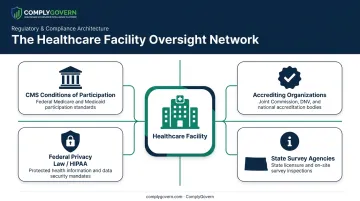
That regulatory patchwork is exactly why generic enterprise tools often fall short here. The platforms worth considering for 2026 range from healthcare-native systems built around accreditation and CMS mapping to broad enterprise GRC suites designed for cross-industry risk management. Facility type and organizational complexity should drive which category makes sense.
Key Features to Look for in Healthcare GRC Software
Not every GRC platform is built for healthcare's specific demands. Here's what separates a tool that actually works from one that just adds another dashboard to ignore.
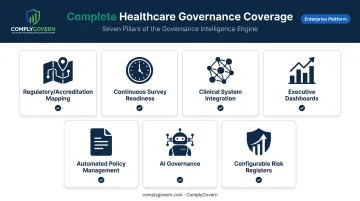
Regulatory and Accreditation Framework Mapping
Generic ISO or SOX-focused platforms weren't built with CMS Conditions of Participation, HIPAA, or accreditor-specific standards in mind. Healthcare organizations need software that maps policies and controls directly to these frameworks out of the box, not tools that require months of manual configuration before they're useful.
Continuous Survey and Audit Readiness
Traditional survey prep looks like this: weeks of scrambling, scattered evidence, and staff pulled off their regular jobs right before a visit. Always-on evidence collection with automated corrective action tracking flips that model, so organizations are prepared on any given day, not just the week before a scheduled survey.
Native Clinical System Integration
A GRC platform that can't talk to Epic, Oracle Health, MEDITECH, or athenahealth via HL7/FHIR creates yet another disconnected system. Interoperability matters because compliance data shouldn't live separately from the clinical reality it's supposed to reflect.
Other must-haves include real-time visibility for leadership, automated policy work, and AI oversight:
- Executive and board-level dashboards that replace departmental spreadsheets with real-time, role-specific views for the CEO, CMO, CRO, and every leader in between
- Automated policy management that eliminates duplicate work across compliance, quality, and risk teams
- AI governance capability, since healthcare organizations increasingly need to govern their own use of AI tools within a compliance framework, a need reinforced by ONC's HTI-1 rule, which sets new AI transparency requirements for certified health IT starting January 1, 2026
- Configurable risk registers that track clinical, operational, and cybersecurity risk in a single system
Top GRC Tools for Healthcare and Enterprise Organizations in 2026
These rankings weigh regulatory alignment, integration depth, usability, and relevance to healthcare or broader enterprise needs.
ComplyGovern — Best for Healthcare Governance, Compliance & Accreditation
ComplyGovern is a healthcare-native platform built to replace the exact problem most compliance teams face: governance scattered across spreadsheets, shared drives, and siloed departmental apps. Its Governance Intelligence Engine connects nine disciplines — governance, regulatory compliance, accreditation readiness, policy management, enterprise risk, quality performance, incident/CAPA, medical staff governance, and AI governance — into a single system of record.
What sets it apart operationally:
- Continuous survey readiness through an always-updating evidence repository tied directly to standards, rather than a scramble before each survey
- HIPAA-aligned security with encryption at rest and in transit, RBAC, MFA/SSO, and full audit logging
- Microsoft 365 and SharePoint-native architecture, meaning it extends tools staff already use instead of introducing a foreign system
- Support for all 19 CMS-recognized facility types, across accreditation-based, state survey, and supplier certification pathways
- Interoperability with Epic, Oracle Health, MEDITECH, and athenahealth, giving leadership a single source of truth from boardroom to bedside
| Category | Details |
|---|---|
| Key Features | Governance Intelligence Engine linking regulations, controls, evidence, risks, audits, and dashboards; AI governance module; automated policy lifecycle management |
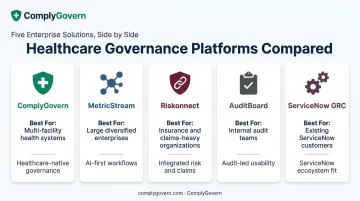
| Best For | Hospitals, health systems, ASCs, SNFs, and any CMS-recognized facility type needing unified governance instead of point solutions |
| Notable Differentiator | The only platform purpose-built to connect governance, compliance, accreditation, quality, and risk in one healthcare-native system of record |
MetricStream — Best for Large Enterprises and Regulated Industries
MetricStream positions itself around an AI-First Connected GRC model, with a long track record serving regulated industries including banking, insurance, and healthcare. Its embedded AI assistants automate policy drafting, audit workflows, and regulatory change tracking, pulling in updates as they happen rather than requiring manual monitoring.
The platform earned recognition as a Leader in the 2025 IDC MarketScape for GRC Software and a Strong Performer in the Forrester Wave for GRC Platforms, Q2 2026, providing solid third-party validation for organizations managing multi-jurisdictional obligations.
| Category | Details |
|---|---|
| Key Features | AI-assisted survey autofill, regulatory alert summarization, risk quantification, low-code customization |
| Best For | Large, multi-jurisdictional enterprises with complex, global regulatory obligations |
| Notable Differentiator | Deep AI-embedded workflows validated by multiple analyst firms |
Riskonnect — Best Overall Integrated Enterprise GRC Platform
Riskonnect's single-source-code architecture unifies enterprise risk management, compliance, internal audit, third-party risk, and business continuity under one roof. Its no-code configurability lets teams build workflows without waiting on IT, and drillable Power BI dashboards give risk managers visibility down to the individual record.
The platform also stands out for combining insurable risk and claims management with core GRC functions, an unusual pairing that appeals to organizations already balancing both priorities.
| Category | Details |
|---|---|
| Key Features | Enterprise risk register, control testing automation, bowtie and heatmap reporting, resilience and BCM modules |
| Best For | Mid-market to global enterprises wanting one platform across risk, compliance, and resilience |
| Notable Differentiator | Combines insurable risk and claims management with core GRC, uncommon among competitors |
AuditBoard — Best for Audit-Led GRC Programs
Now operating under the name Optro, AuditBoard built its reputation on internal audit and SOX compliance workflows. Its interface is genuinely intuitive, which matters when you're asking auditors, control owners, and risk managers across different departments to collaborate in the same system.
Implementation tends to move faster than heavier enterprise platforms, and the centralized evidence repository keeps control testing organized without duplicate spreadsheets floating around.
| Category | Details |
|---|---|
| Key Features | Automated audit planning and execution, centralized evidence repository, control testing workflows |
| Best For | Organizations where internal audit or SOX compliance drives the GRC program |
| Notable Differentiator | Strongest usability for audit teams, though narrower enterprise risk depth |
ServiceNow GRC — Best for Organizations Already on the ServiceNow Platform
ServiceNow GRC extends the broader Now Platform's IT service management workflows into risk and compliance territory. For organizations already running ServiceNow for ITSM or HR, that shared foundation means less friction bringing risk data into existing dashboards and ticketing structures.
Its IT-security-centric approach to risk assessment makes it a natural fit for teams whose compliance concerns skew heavily toward technology risk and vendor management.
| Category | Details |
|---|---|
| Key Features | Policy and compliance management, vendor risk workflows, IT risk assessments within the Now Platform |
| Best For | Enterprises already running ServiceNow for IT service management |
| Notable Differentiator | Seamless extension of existing workflows rather than a standalone GRC specialization |
How We Chose the Best GRC Tools for 2026
Selecting a GRC platform is easy to get wrong. The most common mistake: choosing a generic enterprise tool without healthcare-specific regulatory mapping, then discovering months later that someone on the compliance team is manually building out CMS and accreditation frameworks from scratch.
Forrester's own research backs up this concern, noting that many GRC platforms still require excessive manual data entry and offer only basic workflow automation despite their price tags.
Our evaluation weighed:
- Regulatory and accreditation alignment: does the platform ship with healthcare frameworks pre-mapped, or does your team have to build them?
- Integration depth, meaning how well it connects to existing EHR, ERP, or ITSM systems already in place.
- Configurability — can workflows adapt to your facility type without a lengthy custom-development cycle?
- Analyst recognition: what Gartner, Forrester, and IDC each independently confirm about a platform's strengths.
- Total cost of ownership, beyond the subscription: what implementation and customization actually cost.
Each factor ties directly to outcomes leadership cares about: shorter audit prep cycles, fewer compliance gaps, and dashboards boards can actually trust.
Conclusion
There's no single "best" GRC tool for every organization. The right choice depends on matching platform capabilities to your regulatory environment, facility type, and existing systems — not chasing brand recognition alone.
Before committing, weigh these factors carefully:
- Scalability across facility types and future growth plans
- Integration with existing clinical and enterprise systems
- Total cost of ownership over the full contract term
Healthcare organizations especially need to balance accreditation readiness, quality tracking, and enterprise risk at the same time. A platform that handles only one of those well leaves gaps in the others.
If fragmented spreadsheets and disconnected departmental tools are slowing your team down, it's worth seeing what continuous, board-ready governance actually looks like. Request a ComplyGovern demonstration to see how a healthcare-native platform can replace that patchwork with one connected system of record.
Frequently Asked Questions
What are governance, risk, and compliance tools?
GRC tools are software platforms that centralize policy management, risk tracking, and compliance activities in one system. They replace disconnected spreadsheets, shared drives, and departmental tools with a single, traceable source of truth.
What are the most popular GRC tools?
Widely recognized platforms include MetricStream, Riskonnect, AuditBoard, and ServiceNow GRC. Healthcare organizations increasingly turn to purpose-built platforms like ComplyGovern for native CMS and accreditation alignment that these generalist tools weren't designed to provide.
What are the five risk management tools?
Common categories include enterprise risk registers, incident/CAPA management systems, third-party risk platforms, audit management software, and business continuity/resilience tools. Many modern GRC platforms bundle several of these into one connected system.
What features should healthcare organizations prioritize in GRC software?
Prioritize native regulatory and accreditation mapping to CMS and accrediting bodies, EHR interoperability through HL7/FHIR, and continuous survey readiness rather than periodic manual prep. Executive dashboards and AI governance capability matter increasingly too.
How much does GRC software typically cost?
Pricing varies widely based on modules selected, user count, facility type, and implementation complexity. Buyers should weigh customization and onboarding costs alongside subscription fees, since implementation scope often drives the real total cost.
Is specialized GRC software necessary for HIPAA and CMS compliance?
Generic GRC tools can technically be configured for healthcare, but that requires manually building out CMS, HIPAA, and accreditation frameworks from scratch. Purpose-built platforms like ComplyGovern eliminate that configuration burden with frameworks mapped natively out of the box.