Yet many organizations still treat tracers as a survey-prep checkbox — a "safety walk around" done a few weeks before surveyors show up, then forgotten. That approach leaves real value on the table.
This article breaks down how tracer methodology actually works, why it surfaces system and process gaps that routine audits miss, and how to extract ongoing value from it long after survey season ends.
Key Takeaways
- Tracer methodology traces a patient, system, or process across departments to expose safety and compliance gaps
- Its biggest value comes from internal, ongoing use, not periodic survey prep
- Regular tracers surface hidden failures and strengthen cross-team readiness
- Skipping internal tracers leads to repeat findings and mounting remediation costs
- Governance platforms automate evidence tracking, keeping tracer programs sustainable
What Is Tracer Methodology
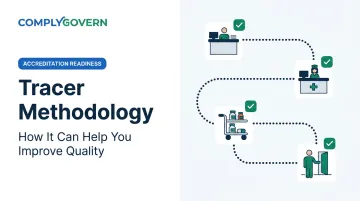
Tracer methodology is an observational technique. Surveyors or internal reviewers select a patient, a high-risk system, or a specific process, then follow it across every department it touches — watching real-time practice against written policy.
It shows up in a few distinct forms:
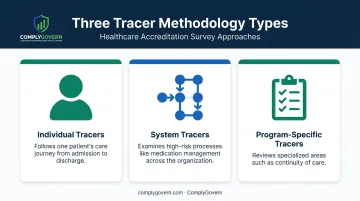
- Individual tracers — following one patient's full care journey from admission through discharge
- System tracers — examining a high-risk process (medication management, infection control, data management) across the entire organization
- Program-specific tracers — reviewing specialized areas like continuity of care
The method applies across a wide range of facility types, including:
- Hospitals and health systems preparing for Joint Commission or similar accreditation
- Ambulatory surgical centers and home health agencies
- Laboratories and other CMS-recognized facility types
It works just as well between surveys, serving as an internal quality audit tool.
The real objective behind tracer methodology is improved patient safety and organizational reliability, whether or not a surveyor is in the building that week. Survey success follows naturally when that deeper work is solid.
Key Advantages of Tracer Methodology
The advantages below focus on measurable outcomes: patient safety, compliance consistency, and care coordination, not abstract survey-readiness theory. Each one ties directly to metrics organizations already track: error rates, RFI counts, survey results, or cross-department consistency.
Uncovers Hidden System and Process Gaps
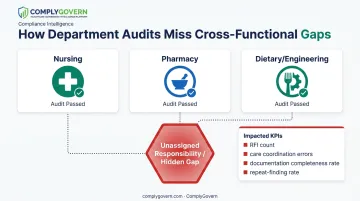
Following one patient's entire journey exposes fragmented care, communication breakdowns, and weak hand-offs that department-level audits simply don't catch. A nursing audit looks at nursing. A pharmacy audit looks at pharmacy. Neither one sees what happens in the gaps between them.
Consider a frequently cited example from tracer training discussions: a hospital tracer revealed that no one, not nursing, not dietary, not engineering, actually owned responsibility for cleaning the ice machine. Three departments assumed someone else had it covered. The result was a missing organizational policy, invisible until someone traced the process end to end.
Why it matters: This level of visibility drives corrective action at the root-cause level instead of surface-level fixes. Joint Commission's analysis of 2025 hospital survey observations found the top clinical opportunity areas included infection-prevention activities, safe medication administration, nursing policy implementation, resuscitation equipment availability, and preanesthesia assessment.
Top physical-environment findings involved interior space safety, pressure relationships, and hazardous chemical handling. These recurring patterns show up again and again precisely because they cross departmental lines.
KPIs impacted:
- RFI count
- Care coordination errors
- Documentation completeness rate
- Repeat-finding rate across survey cycles
Multi-department, high-volume, and high-risk care settings benefit most from this visibility, since responsibility can otherwise slip through unnoticed.
Builds Continuous, Rather Than Reactive, Survey Readiness
Regular internal tracers shift quality management from retrospective chart review to concurrent, real-time observation of active care. Staff aren't scrambling to reconstruct compliance after the fact. They're demonstrating it as care happens.
That shift matters because most deemed-status Joint Commission surveys are unannounced. There's no calendar warning, no six-week prep window. Industry guidance commonly describes the triennial survey window as falling somewhere between 18 and 39 months, meaning readiness has to be a constant state, not a seasonal scramble.
Why it matters: Continuous readiness reduces last-minute preparation costs and lowers the risk of severe findings. Falsification of information, for instance, can trigger a Preliminary Denial of Accreditation decision, a consequence far more costly than the investment of running tracers year-round.
Platforms like ComplyGovern support this shift by continuously monitoring compliance status and automating evidence collection, keeping readiness current rather than reconstructed under pressure.
KPIs impacted:
- Time-to-survey-readiness
- Number of open RFIs at any given time
- Staff competency assessment pass rates
Organizations operating under unannounced survey models, or juggling multiple accreditation and certification cycles, gain the most from this continuous approach.
Drives Cross-Disciplinary Collaboration and Standardization
Effective tracer reviews require multidisciplinary teams (nursing, infection control, environment of care, medication management) evaluating the same patient or process together. That shared lens pushes staff to notice issues outside their own lane, not just their specific discipline.
Why it matters: Shared accountability closes the "someone else's responsibility" gap that breeds inconsistent practice across units. A systematic realist review of 85 hospital-audit studies found that audit feedback legitimizes cross-professional discussion, lowers perceived hierarchy, and lets staff challenge nonadherence, but only when the organization has a genuine safety-focused learning culture. Weak leadership support or poor feedback loops undermine the effect.
KPIs impacted:
- Inter-unit process consistency
- Corrective action closure time
- Multidisciplinary audit completion rate
Multi-unit systems, high-volume facilities, and organizations with a recently identified high-risk population see the biggest impact here.
What Happens When Tracer Methodology Is Missing or Ignored
Skip internal tracers, and problems don't disappear. They just stay invisible until a surveyor , or worse, a patient, finds them.
Joint Commission expects organizations to remain in full compliance at all times, not just during survey windows. Any observed noncompliance can become a Requirement for Improvement (RFI), and if the same issue resurfaces at a later survey, it becomes a repeat finding.
Common consequences of skipping regular internal tracers:
- Inconsistent care processes across units, undetected until a surveyor catches them
- Rising documentation and hand-off errors accumulating between formal reviews
- Reactive, last-minute survey prep instead of steady-state readiness
- Mounting administrative work tied to repeat RFIs and Evidence of Standards Compliance (ESC) submissions
- Growing difficulty maintaining consistent quality practices as the organization adds facilities or service lines
None of this is theoretical. It's the predictable result of treating tracers as a one-time event rather than a repeatable habit, the kind of continuous discipline that platforms like ComplyGovern are built to sustain.
How to Get the Most Value from Tracer Methodology
Tracer methodology pays off when it's applied consistently, reviewed by a knowledgeable multidisciplinary team, and — critically — acted upon rather than just documented and filed away.
The practical building blocks look like this:
- Train staff on current standards: reviewers need to know what the policy says before they can spot a gap between policy and practice
- Assign an experienced team leader: someone who can run a structured review, not just a walkthrough
- Follow through systematically: every finding needs a corrective action, an owner, and a deadline
That third step is where most manual programs break down. Spreadsheets and shared drives can log a finding, but they rarely enforce follow-through, and they almost never connect that finding back to the specific policy version or standard it violated.
This is the operational gap a unified governance platform closes. ComplyGovern's Accreditation Readiness module includes tracer management as a core feature, alongside a standards library, gap analysis tools, and an evidence repository, all built to support continuous readiness rather than episodic prep.
Under the hood, ComplyGovern's Governance Intelligence Engine automatically links accreditation standards to policies, controls, and evidence. When a tracer surfaces a finding, it flows into a configurable corrective-action workflow with root cause analysis and effectiveness tracking, so it doesn't just get logged. It gets closed.
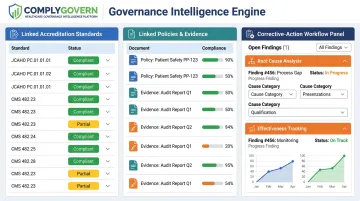
That same connective structure feeds executive and board dashboards in real time. Instead of reviewing isolated survey results once every cycle, leadership sees recurring risk patterns as they emerge, such as:
- The same finding surfacing across multiple units
- A corrective action that's stalled past its deadline
Conclusion
The real value of tracer methodology lies in the control and consistency it brings to everyday care delivery, not the survey outcome itself. Run once a year, tracers catch a handful of problems. Run continuously, they compound: each cycle builds on the last, closing gaps before they become RFIs.
Treat tracer methodology as one piece of a broader continuous-compliance mindset rather than a standalone event, and it becomes a daily operational habit instead of a pre-survey scramble. ComplyGovern automates this cycle, turning evidence collection into continuous monitoring instead of last-minute prep.
Frequently Asked Questions
What are system tracers used for?
System tracers evaluate a specific high-risk process — such as medication management or infection prevention — across multiple departments. They assess organization-wide consistency rather than one patient's individual experience.
How do system tracers work?
Reviewers trace a chosen process through every department it touches, observing practices, interviewing staff, and reviewing documentation at each stop along the way.
What is a system tracer test (tracer process)?
A system tracer test is a structured, multi-stop review where a multidisciplinary team follows a process end-to-end, comparing what should happen according to policy against what actually occurs in practice.
What's the difference between a patient tracer and a system tracer?
A patient tracer follows one individual's full care journey from admission to discharge. A system tracer follows one high-risk process across many patients and departments simultaneously.
How often does the Joint Commission conduct tracer-based surveys?
Full triennial surveys are unannounced, generally occurring within an 18-to-39-month window, with additional random or complaint-driven visits possible outside that cycle.
What is an RFI resulting from a tracer finding?
A Requirement for Improvement is a formal citation for non-compliance found during a tracer. It requires an Evidence of Standards Compliance submission within a set timeframe, often 60 days, to demonstrate corrective action.