Add CMS rule updates, shifting state survey checklists, and new accreditation standards from DNV and CIHQ, and manual tracking through spreadsheets simply can't keep pace anymore.
Regulatory change management (RCM) software helps compliance, quality, and risk teams move from reactive scrambling to continuous survey readiness. The market backs this shift: global RegTech spending is projected to grow from $24.3 billion in 2025 to $29.3 billion in 2026, en route to $112.1 billion by 2033.
This article breaks down five leading RCM platforms for 2026, including tools built specifically for healthcare governance.
Key Takeaways
- Regulatory change management software tracks and operationalizes CMS, HIPAA, and accreditation updates with a full audit trail.
- Weigh healthcare-specific regulatory coverage, AI-driven impact analysis, clinical integration, and audit-trail depth when selecting a platform.
- Five platforms stand out for 2026: ComplyGovern, MetricStream, Riskonnect, Onspring, and Diligent.
- The strongest choice unifies regulatory change with policy, risk, and accreditation management rather than standing alone.
Overview of Regulatory Change Management Software in Healthcare
Regulatory change management (RCM) software tracks incoming regulatory and accreditation updates, assesses their impact, and routes required actions to the right teams — with a documented trail for surveyors.
Healthcare organizations face a distinct version of this challenge. Beyond general compliance obligations, they must track:
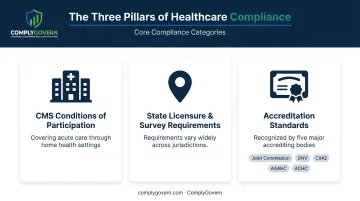
- CMS Conditions of Participation (CoPs) across settings ranging from acute care hospitals to home health agencies
- State licensure and survey requirements, which shift by jurisdiction and facility type
- Accreditation standards from bodies like Joint Commission, DNV, CIHQ, AAAHC, and ACHC, each revising on its own schedule
Without a centralized system, compliance, quality, and risk teams often end up duplicating work, each maintaining separate spreadsheets and shared drives to track the same regulatory obligation. One department updates a policy; another never finds out.
The five platforms below are evaluated on healthcare-specific regulatory intelligence, automation depth, and how well they connect regulatory change to the rest of an organization's governance structure.
Top Regulatory Change Management Software Tools for 2026
Each tool below is assessed on regulatory coverage breadth, AI-driven impact analysis, integration with clinical and GRC systems, and relevance to healthcare organizations specifically.
ComplyGovern
ComplyGovern is a healthcare compliance and governance platform built to unify regulatory change, accreditation, quality, risk, and policy management for every CMS-recognized facility type, from hospitals to single-site DME suppliers.
What sets it apart:
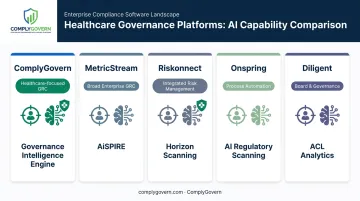
- The Governance Intelligence Engine automatically links regulatory and accreditation updates to policies, controls, evidence, and dashboards, eliminating manual re-entry across separate systems.
- It replaces reactive, pre-survey scrambling with continuous survey readiness: a live Readiness Index tracks governance, quality, risk, and compliance status year-round.
- It's built natively on Microsoft 365 and SharePoint with HIPAA-aligned security, and it's interoperable with Epic, Oracle Health, MEDITECH, and athenahealth through HL7, FHIR, and DICOM standards.
- Regulatory content is mapped for nine CMS-approved accrediting organizations, including Joint Commission, DNV, CIHQ, AAAHC, ACHC, CHAP, NDAC, Quad A, and TCT.
| Best For | Hospitals, health systems, ASCs, SNFs, and every CMS-recognized facility type needing unified regulatory and accreditation change management |
| AI Capabilities | Governance Intelligence Engine for automated regulation-to-policy mapping; dedicated AI Governance module for managing AI systems deployed in healthcare |
| Regulatory Coverage | U.S. federal healthcare laws, nine CMS-approved accrediting organizations, and international standards across the UK, Australia, and New Zealand |
MetricStream
MetricStream is an enterprise GRC suite offering regulatory change management as one module within a much broader risk, audit, and compliance platform used across regulated industries, including healthcare.
The platform tracks obligations from source regulatory content through remediation and uses AiSPIRE, its AI engine launched in 2023, to flag duplicate controls and surface predictive risk recommendations. MetricStream states it monitors 750+ legislative and regulatory authorities worldwide, a substantial coverage claim.
That breadth comes with a tradeoff: implementation typically requires significant time and dedicated budget compared to more focused platforms.
| Best For | Large enterprises needing a full GRC suite with dedicated implementation budgets |
| AI Capabilities | AiSPIRE for predictive risk identification, duplicate control detection, and cognitive recommendations |
| Regulatory Coverage | 750+ legislative and regulatory authorities globally (vendor-stated; verify healthcare-specific feed coverage during procurement) |
Riskonnect
Riskonnect is a cloud-based GRC platform with a dedicated healthcare risk management vertical, connecting patient safety, provider quality, compliance, and claims into one system. Regulatory change tracking runs through integrations with third-party content providers rather than a proprietary regulatory database.
Its standout feature is automated horizon scanning paired with an obligations register that links regulations directly to policies, controls, and incidents. Riskonnect integrates with intelligence feeds like LexisNexis for live regulatory updates, and the vendor reports 140+ healthcare customers using its platform.
| Best For | Healthcare and multi-industry organizations wanting RCM integrated with broader enterprise risk and patient safety modules |
| AI Capabilities | Automated workflows and alerts triggered by third-party regulatory intelligence feeds |
| Regulatory Coverage | Dependent on connected content provider; strong healthcare risk and patient safety focus with 140+ healthcare customers |
Onspring
Onspring is a no-code GRC platform with a dedicated Regulatory Change Management product, launched in 2022, that sits alongside its compliance, policy, and risk modules.
Its main advantage is configuration flexibility. Compliance teams build workflows and reports without pulling in IT resources. AI tools support continuous regulatory monitoring, plain-language summarization of dense regulatory text, and identification of related controls across departments. The tradeoff: it's not healthcare-specific out of the box, so regulatory content must be configured to match your facility mix.
| Best For | Mid-market to enterprise compliance teams wanting configurable workflows without heavy IT involvement |
| AI Capabilities | AI-assisted regulatory scanning, document interpretation, and related-control discovery |
| Regulatory Coverage | Configurable to organizational scope; not healthcare-specific by default |
Diligent
Diligent is an enterprise GRC and board governance platform offering regulatory change management through its Diligent One Platform. It's a strong fit for organizations that need regulatory change tied directly to board-level reporting.
The ACL Analytics AI module parses regulatory content, extracts effective dates and requirements, and benchmarks disclosures against peers. It's a genuinely useful layer for large systems already using Diligent for board governance. Diligent hasn't published a specific count of monitored jurisdictions or regulatory sources, though, so that scope needs confirmation directly with the vendor.
| Best For | Large enterprises, including healthcare systems, needing regulatory change tied to board-level governance oversight |
| AI Capabilities | ACL Analytics for regulatory parsing, summarization, deadline extraction, and predictive trend analysis |
| Regulatory Coverage | Multiple jurisdictions monitored; specific source or jurisdiction count not publicly disclosed |
How We Chose the Best Regulatory Change Management Tools
The most common mistake healthcare organizations make is picking a generic GRC tool that handles regulatory change well for banking or manufacturing, then discovering it has no CMS-specific mapping or accreditation survey workflow. Retrofitting that afterward is expensive and slow.
We evaluated each platform against:
- Healthcare-specific regulatory and accreditation coverage: does it map to CMS CoPs, state surveys, and named accrediting bodies out of the box?
- AI-driven impact analysis: can it flag which policies and controls a given regulatory change actually touches?
- Integration depth: does it connect to EHR systems and Microsoft 365, or does data still live in silos?
- Audit-trail strength: can it produce a defensible history for a surveyor on demand?
- Total cost of ownership: implementation time, training burden, and ongoing licensing.
These factors matter because they translate directly into fewer weeks lost to survey prep and less duplicated work between compliance and quality teams. They also give executives and boards clearer, real-time answers instead of quarterly summaries.
Conclusion
The right RCM partner matches your organization's push toward continuous compliance. Brand recognition alone isn't enough. Healthcare regulatory change is too fragmented: CMS, state surveyors, and multiple accreditors all move on different timelines, and a generic point solution can't keep up.
Before finalizing a decision, weigh scalability, healthcare-specific regulatory depth, and how well the platform integrates with your existing EHR and enterprise systems.
If your organization is ready to move from reactive survey prep to continuous readiness, ComplyGovern is built specifically for that shift, supporting every CMS-recognized facility type.
Frequently Asked Questions
What are some common software tools used in regulatory affairs?
Common categories include enterprise GRC platforms (MetricStream, Diligent), dedicated RCM products (Onspring), and regulatory intelligence feeds (LexisNexis). Healthcare-specific platforms like ComplyGovern combine regulatory tracking with accreditation and quality workflows.
What are the 5 P's of change management?
Prosci's framework references Project, Purpose, Particulars, People, and Performance — a people-focused model for guiding organizational transitions. It's distinct from regulatory change management software, which is process and technology-focused, not a framework for managing employee adoption.
What is regulatory change management software?
It's a platform that monitors incoming regulatory and accreditation updates, assesses their operational impact, and helps teams implement required changes while maintaining a documented audit trail for inspectors and surveyors.
How is regulatory change management different for healthcare organizations?
Healthcare organizations juggle CMS Conditions of Participation and state-level survey requirements, while also managing multiple accrediting bodies, each with its own update cycle. Most industries track a single regulatory framework, not several overlapping ones.
What features should healthcare compliance teams prioritize in RCM software?
Prioritize healthcare-specific regulatory mapping (CMS, accreditors), integration with EHR and clinical systems, and continuous survey readiness features rather than one-time audit-prep tools.
Is dedicated regulatory change management software necessary for smaller healthcare facilities?
Yes. Even single-site facilities like rural health clinics or ASCs face the same CMS and state-level requirement volume as larger systems, just with fewer staff to track it manually. That reality makes centralized software more valuable, not less.