The right CAPA software closes that gap. It shortens resolution time, stops the same nonconformance from resurfacing six months later, and keeps patient safety and accreditation status intact.
This guide isn't written for generic manufacturing quality teams. It's built for healthcare compliance officers, quality directors, and risk managers evaluating CAPA platforms that actually understand CMS Conditions of Participation, state surveys, and accreditor standards. Here's what to look for, and which platforms deliver it in 2026.
Key Takeaways
- QAPI deficiencies are among hospitals' top three cited CoPs, making CAPA tracking a survey-readiness priority
- Healthcare CAPA tools must link to CMS and accreditation standards, not live in standalone spreadsheets
- ComplyGovern leads for healthcare providers, unifying CAPA with governance, risk, and accreditation in one system
- Qualio, MasterControl, AssurX, and Intellect suit life sciences and manufacturing but lack CMS survey alignment
- Weigh regulatory alignment, integration depth, and total cost of ownership, not just feature count
Overview of CAPA Software in Healthcare Compliance
CAPA software is a digital system for logging, investigating, resolving, and verifying corrective and preventive actions tied to nonconformances, incidents, or survey findings.
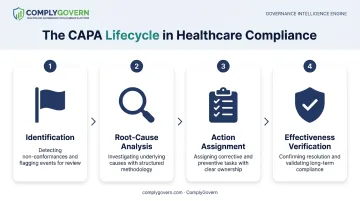
Instead of tracking a corrective action in an email thread or a spreadsheet nobody updates, the system owns the entire lifecycle: identification, root-cause analysis, action assignment, and effectiveness verification.
Why does this matter so much in healthcare specifically? Because CAPA-related deficiencies show up constantly in inspections.
- QAPI deficiencies rank third among 24 hospital CoPs, per CMS survey guidance
- ASCs, SNFs, home health agencies, and hospices all carry explicit federal requirements to identify causes, implement corrective and preventive actions, and sustain the improvement — not just fix it once
- Joint Commission's Evidence of Standards Compliance process requires documented completion dates, accountability, and proof that compliance will hold over time
None of this works well in isolation. A corrective action disconnected from the finding that triggered it, or from the risk register it should feed into, creates duplicate work and blind spots.
The platforms below were evaluated specifically on how well they solve that problem for regulated healthcare providers.
Top CAPA Management Software of 2026
We evaluated each platform on five criteria: regulatory alignment, automation depth, integration capability, healthcare relevance, and verified user reviews from sources like Capterra and G2.
ComplyGovern
ComplyGovern is a healthcare governance and compliance platform that unifies CAPA tracking with accreditation, quality, risk, and policy management across every CMS-recognized facility type — from acute care hospitals to home infusion suppliers.
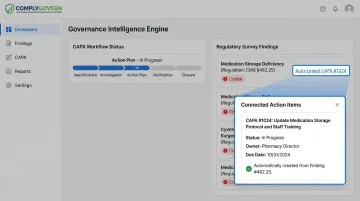
What sets it apart is the Governance Intelligence Engine, which automatically chains corrective actions to the findings that triggered them. When a survey finding, incident, or audit result is captured, the system routes it directly into a corrective action workflow: no manual re-entry, no cross-referencing between disconnected tools.
Add native Microsoft 365/SharePoint integration for evidence storage and HIPAA-aligned security, and CAPA documentation lives in the same environment compliance teams already use daily.
| Category | Details |
|---|---|
| Best For | Hospitals, ASCs, SNFs, home health/hospice, and other CMS-regulated facilities needing CAPA connected to governance and accreditation |
| Key CAPA Features | Auto-linked corrective actions to regulatory findings, automated evidence collection, executive dashboards, continuous survey readiness |
| Integrations | Epic, Oracle Health (Cerner), MEDITECH, athenahealth, Microsoft 365/SharePoint |
| Pricing | Available upon request via sales consultation; enterprise contract model |
Qualio
Qualio is a life-sciences eQMS built for medical device and pharmaceutical companies that need automated CAPA and document workflows without a heavy IT lift. Its reviewer base leans heavily toward medical devices and pharma, not healthcare provider organizations.
Differentiators include built-in risk detection tools, audit-readiness checklists, and a lightweight interface that growing quality teams can adopt quickly.
| Category | Details |
|---|---|
| Best For | Life sciences and medical device startups/scale-ups |
| Key CAPA Features | Document management, risk mitigation workflows, audit checklists |
| Pricing | Available upon request; no free tier |
MasterControl Quality Excellence
MasterControl has decades of history serving regulated manufacturers, with 1,100+ customers concentrated in pharma, biotech, and medical devices. It's a fully integrated QMS spanning quality processes well beyond CAPA alone.
The platform stands out for automating CAPA planning, implementation, and review end-to-end, plus 8D-style problem-solving forms and mobile accessibility for field teams. Pricing starts at $25,000 per year for the Basic plan, according to Capterra's published listing, a useful benchmark for enterprise budgeting.
| Category | Details |
|---|---|
| Best For | Enterprise pharma, biotech, and med device manufacturers |
| Key CAPA Features | Automated CAPA workflows, task monitoring, compliance/audit management |
| Platforms | Web, iOS, Android |
AssurX
AssurX serves high-risk regulated industries beyond life sciences, including food and beverage, tech manufacturing, and general production environments. It's a broader nonconformance and quality suite with CAPA as one core module.
Its strengths are nonconformance management and training resources bundled directly with CAPA workflows, plus support for both cloud and on-premise deployment, a differentiator for organizations with strict data residency requirements.
| Category | Details |
|---|---|
| Best For | High-risk manufacturing and regulated production environments |
| Key CAPA Features | Nonconformance management, CAPA workflows, audit management |
| Platforms | Web and on-premise |
Intellect QMS
Intellect is a no-code, configurable eQMS platform used across manufacturing and life sciences. Its drag-and-drop app builder lets quality teams customize workflows without vendor development tickets.
Standout features include automatic CAPA routing based on role, offline mobile functionality for field audits, and highly customizable workflow logic that scales from mid-size operations to enterprise.
| Category | Details |
|---|---|
| Best For | Mid-size companies wanting a configurable, no-code QMS |
| Key CAPA Features | Automatic CAPA routing, risk reduction management, customizable workflows |
| Platforms | Web, Desktop, iOS, Android |
Key Features to Look for in CAPA Software for Healthcare Organizations
Feature lists look similar across vendors until you test them against a real survey scenario. Here's what actually matters for regulated healthcare providers.
Regulatory and accreditation mapping. The system should tie corrective actions directly to CMS Conditions of Participation, state survey findings, and accreditor standards (Joint Commission, DNV, AAAHC) rather than tracking them as isolated tasks with no regulatory context.
Automated workflows and reminders. Task assignment, deadline tracking, and escalation alerts prevent overdue CAPAs, which remain a common survey finding. QAPI deficiencies are consistently among the most frequently cited hospital CoP violations, so an overdue corrective action compounds an existing risk.
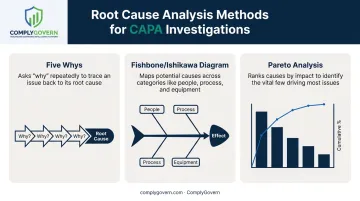
Root cause analysis tools. Look for built-in support for:
- Five Whys: repeated questioning to move past symptoms into actual causes
- Fishbone/Ishikawa diagrams: sorting potential causes into categories like people, process, and equipment
- Pareto analysis: separating the "significant few" causes from the "trivial many," per ASQ's quality resource guidance
Real-time dashboards for executives and boards. Role-specific visibility into CAPA status, aging, and recurrence trends matters because C-suite leaders and board members need a single source of truth, not a quarterly PDF summary compiled by hand.
Integration with existing systems. Seamless connectivity with EHR platforms like Epic, Oracle Health (Cerner), and MEDITECH, plus document control and incident reporting tools, avoids duplicate data entry across departments.
Audit trail and evidence automation. The system should timestamp every corrective action, auto-capture supporting documentation, and compile a defensible record surveyors can review on short notice. That keeps organizations survey-ready year-round instead of scrambling in the weeks before an inspection.
How We Chose the Best CAPA Software
We reviewed vendor documentation, verified user ratings from Capterra and G2, and published feature sets for each platform. One common mistake we specifically avoided: ranking based on brand recognition alone. A well-known manufacturing QMS isn't automatically the right fit for a skilled nursing facility's CAPA needs.
Criteria weighted in this evaluation:
- Healthcare/regulatory alignment: does the platform map to CMS CoPs and accreditation standards, or only to generic ISO/manufacturing frameworks?
- Automation depth: how much of the CAPA lifecycle runs without manual follow-up?
- Integration capability: does it connect to EHRs, document systems, and existing risk registers?
- Scalability across facility types: can it support a single ASC and a multi-site health system equally well?
- Customer support quality: based on verified reviewer feedback from actual users
Pricing transparency and demo availability also factored in. Most enterprise healthcare vendors, including several on this list, require a sales conversation before disclosing pricing, so we noted that upfront rather than guessing at numbers.
Conclusion
The best CAPA software matches your regulatory environment, facility type, and existing systems, not the one with the longest feature list.
Before finalizing a decision, take these steps:
- Request demos from your shortlist of vendors
- Confirm integration compatibility with your EHR or existing QMS
- Calculate total cost of ownership, including implementation fees some vendors add on top of subscription pricing
If your organization needs CAPA connected to full governance, accreditation, and risk management rather than a standalone tracker, ComplyGovern fits that need. Request a demo to see how the Governance Intelligence Engine links findings to corrective actions automatically, from boardroom to bedside.
Frequently Asked Questions
What is CAPA software?
CAPA software is a digital tool for identifying and correcting nonconformances or compliance issues, then preventing them from recurring. It replaces manual tracking in spreadsheets or email with a structured, auditable workflow.
What features should healthcare organizations prioritize in CAPA software?
Prioritize regulatory mapping to CMS CoPs and accreditor standards, automated workflows with deadline tracking, built-in root cause analysis tools, and executive dashboards for leadership visibility.
How does CAPA software support CMS and accreditation survey readiness?
Automated evidence collection and corrective actions linked directly to survey findings keep documentation current at all times. This means organizations stay continuously survey-ready instead of scrambling before an inspection.
What is the difference between a corrective action and a preventive action?
A corrective action fixes a problem that already occurred, addressing its root cause so it doesn't recur. A preventive action proactively mitigates risk before an incident happens at all.
Is CAPA management software required for regulatory compliance?
CMS regulations don't use the term "CAPA" explicitly. However, Conditions of Participation for hospitals, ASCs, SNFs, and home health agencies all require cause analysis and sustained corrective action. Software makes meeting that requirement practical at scale.
How much does CAPA management software typically cost?
Pricing varies widely by vendor, facility size, and modules needed. Most enterprise healthcare vendors require a custom quote, though MasterControl's published Basic plan starts around $25,000 per year as a benchmark.