Introduction
Healthcare compliance teams are done chasing paper trails. In 2026, the shift away from spreadsheets, shared drives, and policy binders scattered across departments is accelerating, and for good reason.
CMS recognizes 20 distinct provider and supplier categories, each with its own Conditions of Participation or Conditions for Coverage, survey cadence, and approved accrediting bodies like The Joint Commission, DNV, and CIHQ. Managing that complexity manually is no longer sustainable.
Automated policy and document governance software replaces reactive audit scrambles with continuous readiness. It reduces survey risk, protects patient safety, and cuts the administrative grind of manual policy tracking.
This guide compares the top platforms for 2026 and how to evaluate them.
TL;DR
- Automated governance platforms centralize the policy lifecycle and link documents to regulations, risks, and audits
- Top 2026 picks pair AI-driven automation with continuous compliance monitoring and clinical system integration
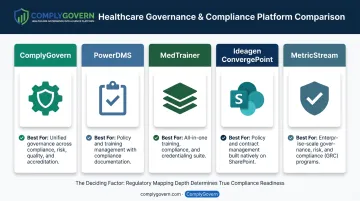
- Leading options: ComplyGovern, PowerDMS, MedTrainer, Ideagen ConvergePoint, and MetricStream
- Choose based on lifecycle automation depth and regulatory mapping, not brand recognition
Overview of Automated Policy & Document Governance Software in Healthcare
Automated policy and document governance software manages the full policy lifecycle, from drafting and review to approval, distribution, attestation, and eventual retirement. The best systems also map every policy directly to the regulatory, accreditation, and risk frameworks it's meant to satisfy.
That mapping matters more in healthcare than almost any other industry. Providers juggle overlapping obligations from CMS, state survey agencies, and CMS-approved accrediting organizations, all operating on different timelines.
Consider the stakes:
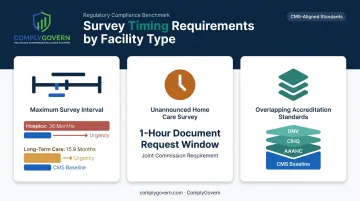
- CMS's FY2025 survey guidance sets provider-specific intervals ranging from a 36-month hospice requirement down to a 15.9-month maximum for long-term care facilities
- Joint Commission home-care surveys are unannounced, and surveyors can request specified documents within one hour of arrival
- Accrediting bodies such as DNV, CIHQ, and AAAHC layer their own survey cycles and documentation standards on top of CMS requirements, multiplying the tracking burden for compliance teams
There's no room for a policy sitting in an outdated shared drive when a surveyor shows up unannounced. Not every governance platform handles this equally well. The comparison below breaks down the top solutions by automation depth, compliance mapping, and integration capability.
Top Automated Policy & Document Governance Software in 2026
These platforms were selected for their policy lifecycle automation, regulatory and accreditation mapping, integration ecosystem, and fit for healthcare-specific governance needs.
ComplyGovern
ComplyGovern is an intelligent healthcare compliance and governance platform built to unify policy management with accreditation, quality, risk, and AI governance in one system of record. It covers all CMS-recognized facility types, from acute care hospitals to single-site suppliers.
What sets it apart is the Governance Intelligence Engine, which automatically links regulations to standards, policies, controls, evidence, risks, audits, and corrective actions. A single regulatory update flows through the entire chain without manual re-entry.
The platform is built natively on Microsoft 365 and SharePoint, carries HIPAA-aligned security, and interoperates with Epic, Oracle Health, MEDITECH, and athenahealth.
| Key Features | Governance Intelligence Engine, automated policy lifecycle workflows, real-time executive/board dashboards, AI governance module, multi-country regulatory mapping (US, UK, Australia, NZ) |
| Best For | Hospitals, health systems, ASCs, SNFs, hospices, FQHCs, and other CMS-recognized facility types needing unified governance rather than siloed point tools |
| Differentiator | A single source of truth from boardroom to bedside, replacing fragmented spreadsheets, shared drives, and departmental apps with one connected system |
PowerDMS
PowerDMS has deep roots in public safety and healthcare, focusing on policy authoring, distribution, and staff training and testing. It suits organizations that want policy management paired tightly with training verification.
Its standout features include direct crosswalk licensing to accreditors like AAAHC, CIHQ, DNV, and TJC, plus built-in testing modules to confirm staff actually understood a policy, not just clicked "acknowledge."
| Key Features | Policy authoring, e-signature attestation, accreditation crosswalks, training and testing modules |
| Best For | Mid-size healthcare and public-sector organizations needing combined policy and training compliance |
| Limitation | Focused primarily on policy and training workflows, with less emphasis on broader enterprise risk and audit integration |
MedTrainer
MedTrainer bundles policy management with credentialing, incident reporting, and staff training into one healthcare-specific compliance suite. It appeals to ambulatory providers and smaller practices that want fewer vendors, not more.
One regional healthcare customer reported an estimated 35% reduction in time and labor after consolidating training and compliance workflows into the platform, according to MedTrainer's own case study.
| Key Features | Policy library, attestation tracking, credentialing, incident management, training assignments |
| Best For | Smaller clinics, ambulatory surgical centers, and providers seeking an all-in-one compliance and training tool |
| Limitation | Better suited to operational compliance bundling than deep enterprise-wide GRC or multi-facility regulatory mapping |
Ideagen ConvergePoint
ConvergePoint runs natively on Microsoft SharePoint, targeting structured lifecycle management and version control for organizations already living in the Microsoft 365 ecosystem.
Drafting happens in Word Online with tracked changes, and access permissions tie directly into Active Directory. For IT teams that don't want to introduce a new platform outside their existing stack, this reduces onboarding friction and IT overhead.
| Key Features | SharePoint-native workflows, version control, attestation tracking, Word Online drafting |
| Best For | Organizations wanting document governance layered directly onto an existing Microsoft 365 environment |
| Limitation | Primarily a policy and contract management tool, with narrower connection to enterprise risk, quality, or healthcare-specific accreditation functions |
MetricStream
MetricStream treats policy governance as one piece of a much larger enterprise GRC suite. It maps policies to risks, controls, and regulations with reporting depth built for large, multi-department organizations.
The platform's policy product covers creation through attestation and exception handling, then layers on graphical dashboards with drill-downs by policy type, audit history, and linked risks.
| Key Features | End-to-end policy authoring/approval, version control, risk/control mapping, advanced analytics |
| Best For | Large health systems with complex, multi-jurisdictional governance structures and dedicated GRC teams |
| Limitation | Broad enterprise scope means more configuration effort upfront, and it isn't purpose-built around CMS or accreditation-specific healthcare workflows |
How We Chose the Best Automated Policy & Document Governance Software
Too many buyers pick a platform based on brand recognition or sticker price alone. That's a mistake. A cheaper tool that doesn't map to your accreditor's standards costs more in survey findings than it ever saved on licensing.
We evaluated each platform against six factors:
- Policy lifecycle automation - how much manual work is actually removed, not just digitized
- Regulatory/accreditation framework mapping - depth of coverage across CMS, state surveys, and accrediting bodies
- Integration capability - connections to EHR, HR, and directory services
- Reporting and dashboard visibility - whether executives and boards get real-time insight
- Scalability across facility types - fit for single-site clinics through multi-facility health systems
- Implementation and support quality - onboarding effort and ongoing vendor responsiveness
These six factors reveal how capable a platform is, but cost still shapes the final decision. Pricing varies widely based on organization size, user count, and workflow complexity. Policy management software in this category commonly ranges from around $4,000 to over $100,000 annually, depending on modules and implementation scope. Request a tailored quote and weigh it against ROI, factoring in reduced audit findings and administrative time saved.
Conclusion
Choosing the right automated policy and document governance platform means prioritizing continuous compliance over standalone document storage. A tool that just digitizes your binder isn't solving the underlying problem.
Before committing to a vendor, evaluate scalability across your facility types, the depth of regulatory mapping, and how well the platform integrates with the clinical and enterprise systems you already run.
If you want to see how one platform connects policy, compliance, accreditation, quality, and risk governance into a single, continuously audit-ready system, request a ComplyGovern demonstration. See how it applies to your organization's specific facility type.
Frequently Asked Questions
How much does policy management software cost?
Pricing depends on organization size, user count, facility type, and workflow complexity. Most vendors, including the ones covered here, provide custom quotes rather than flat pricing.
What is policy automation?
Policy automation uses workflows to handle creation, review, approval, distribution, and attestation without manual tracking. It reduces errors and cuts administrative burden.
What is an example of an automated process?
A common example: automated review reminders trigger stakeholder approvals, route documents for e-signature, and log staff attestations, all without a compliance officer chasing anyone down.
What are the 5 key areas of a good policy?
A strong policy needs:
- Clear purpose and scope
- Defined ownership
- Alignment to relevant regulations or standards
- A set review and renewal schedule
- Documented staff acknowledgment
How does automated governance software support healthcare compliance specifically?
Healthcare-specific platforms map policies directly to CMS regulations, accreditation standards, and HIPAA requirements. This enables continuous survey readiness instead of reactive audit prep the week before.
What should healthcare organizations prioritize when switching from manual to automated policy governance?
Focus on data migration planning, staff training, and integration with existing EHR and HR systems. A phased rollout helps ensure adoption across departments instead of resistance.