Today, RCA drives investigations in hospitals, IT departments, aviation, and anywhere a failure could mean regulatory exposure or physical harm. The tools teams use to run these investigations now determine far more than how fast a problem gets solved.
In healthcare especially, the right RCA software affects patient safety, accreditation outcomes, and how prepared an organization is when regulators come calling. Many teams still struggle with disconnected spreadsheets and templates that don't talk to anything else.
This guide breaks down the top RCA software options for 2026, from general-purpose investigation tools to platforms built specifically for regulated industries like healthcare.
Key Takeaways
- RCA software documents failures thoroughly and prevents recurrence, not just symptoms
- Options range from standalone investigation tools to full compliance-linked governance platforms
- The strongest choice depends on cause-modeling depth, integrations, and fit with your industry
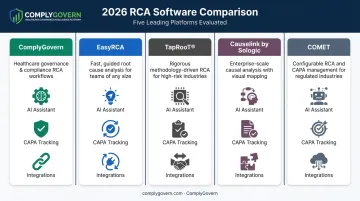
- This guide compares five leading tools: ComplyGovern, EasyRCA, TapRooT®, Causelink by Sologic, and COMET
Overview of Root Cause Analysis Software in Regulated & High-Risk Industries
RCA software gives teams a structured way to identify the underlying cause of an incident, defect, or non-conformance, rather than stopping at the first obvious explanation. That distinction matters more in regulated industries than almost anywhere else.
In healthcare, RCA is directly tied to patient safety events, accreditation surveys, and regulatory reporting. The stakes are real:
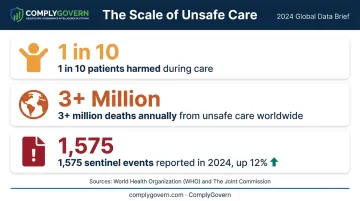
- About 1 in 10 patients is harmed during healthcare delivery, and more than 3 million deaths occur annually worldwide from unsafe care, according to the World Health Organization
- More than half of that harm is considered preventable — roughly 1 in 20 patients
- The Joint Commission received 1,575 voluntary sentinel-event reports in 2024, up 12% from the previous year, with falls accounting for 776 reports and 21% involving patient death
Careful investigation and strong corrective action aren't optional in this environment. They function as the primary safeguard against repeat incidents, not just paperwork filed after the fact.
That's the environment RCA software has to perform in. The tools below range from lightweight investigation platforms built for a single team to enterprise governance systems that embed RCA into a much broader compliance ecosystem.
Top Root Cause Analysis Software Options in 2026
We selected these five tools based on cause-modeling depth, ease of use, corrective action tracking, industry fit, and integration capability.
ComplyGovern
ComplyGovern is a healthcare compliance and governance platform where RCA doesn't run as a disconnected process. It's embedded directly inside quality, risk, and accreditation workflows.
What makes it different: the platform's Governance Intelligence Engine automatically links root cause findings to relevant regulations, internal policies, corrective actions, and executive dashboards. That eliminates the duplicate work compliance, quality, and risk teams typically do when each maintains its own version of the same incident.
The platform is also HIPAA-aligned and integrates with Epic, Oracle Health, MEDITECH, and athenahealth.
| Best For | Hospitals, health systems, and CMS-recognized facilities that need RCA connected to broader governance and continuous survey readiness |
| Key Features | Automated CAPA tracking, cross-departmental collaboration, AI-enabled findings-to-policy mapping, role-specific executive dashboards |
| Unique Advantage | One connected record linking RCA outcomes to nine governance disciplines, instead of spreadsheets, shared drives, and siloed departmental tools |
EasyRCA
EasyRCA is a purpose-built RCA platform supporting 5 Whys, Fishbone, and PROACT methodologies inside a collaborative digital workspace.
Its standout feature is built-in AI assistance — it suggests potential causes, flags logic gaps in an investigation, and summarizes findings once the analysis wraps. A centralized library also makes past RCAs searchable, so teams don't rebuild the wheel every time a similar failure occurs.
| Best For | Reliability, maintenance, and operations teams running frequent investigations across multiple sites |
| Key Features | Visual cause-and-effect modeling, AI-assisted investigation creation, integrated action tracking, real-time collaboration |
| Unique Advantage | Combines methodology flexibility with AI acceleration to cut down documentation time |
TapRooT®
TapRooT® is a long-established, rules-based RCA methodology with supporting software, built for formal, regulatory-driven incident investigations. The system has been refined for more than 30 years, with roots in human-performance research going back over four decades.
It's highly structured. That rigor is exactly what makes it a good fit for serious or compliance-critical events where the investigation itself might be scrutinized later.
| Best For | Organizations investigating major incidents that require rigorous, auditable documentation |
| Key Features | Guided root cause questioning, corrective action guidance, trending and reporting |
| Unique Advantage | Decades of proven methodology used across safety-critical and regulated sectors |
Causelink by Sologic
Causelink is a visual cause-and-effect mapping tool designed for complex, technical investigations. Structured logic diagrams help teams trace a failure systematically back through contributing factors to its actual root cause.
This works especially well for experienced practitioners who need formal, defensible documentation rather than a quick-fix worksheet. Digital templates support 5Whys+, Fishbone, and timeline-based analysis.
| Best For | Technical teams needing detailed, formal causal modeling for complex failures |
| Key Features | Digital RCA templates, collaboration tools, data export capabilities |
| Unique Advantage | Strong emphasis on formal, defensible root cause logic diagrams |
COMET
COMET is an investigation and RCA platform built for high-risk industries where investigation rigor and regulatory defensibility aren't negotiable. Its methodology covers five Root Maps: Communication, Operating Environment, Management, Equipment, and Training.
The platform's taxonomy-based cause coding lets organizations track failure patterns across multiple sites over time, not just within a single incident. COMET Companion, an AI assistant launched in 2024, helps users navigate the platform and configure investigations, though the final cause determination stays with human investigators.
| Best For | Safety-critical and high-risk sectors requiring defensible, cross-functional investigations |
| Key Features | Timeline recording, human and organizational factor analysis, integrated corrective action management |
| Unique Advantage | Integrates with existing systems like Intelex, Enablon, Cority, and IBM Maximo rather than replacing them |
How We Chose the Best RCA Software
The most common mistake teams make when picking RCA software is choosing based on brand recognition alone. A tool that's popular in manufacturing might be a poor fit for a hospital's compliance office, and vice versa.
We weighed five factors instead:
- Cause-modeling depth: Does the tool support rigorous methodologies (5 Whys, Fishbone, PROACT, logic trees), or just a basic template?
- Collaboration and corrective action tracking: Can multiple stakeholders work an investigation together, with fixes tracked through to completion?
- Industry-specific fit: Some tools are built for general use; others map directly to the compliance realities of a specific sector.
- AI capability — does AI genuinely accelerate investigations, or is it just a marketing checkbox?
- Connection to outcomes: Does the tool tie RCA findings to measurable outcomes, whether business results or patient safety improvements, rather than just a completed report?
Conclusion
There's no single "best" RCA software. It depends on whether your organization needs a standalone investigation tool or a platform that connects RCA to a larger compliance and governance strategy.
Before committing, evaluate:
- Integration capability with the systems you already run
- Scalability across facilities, not just a single site
- Long-term cost-effectiveness, weighed against reduced recurrence and compliance risk
Healthcare organizations that need RCA embedded within a unified compliance, quality, and risk platform can see how ComplyGovern connects investigations to continuous survey readiness and executive visibility.
Frequently Asked Questions
Can AI do root cause analysis?
AI can suggest possible causes and flag gaps in an investigation's logic. It can also summarize findings, but it remains a support tool — human judgment still determines the actual root cause.
Is root cause analysis part of Six Sigma?
Yes. RCA sits inside Six Sigma's DMAIC methodology, specifically in the Analyze phase, where teams identify the underlying causes of process variation or defects.
What is root cause analysis software?
It's a structured platform for guiding investigations and documenting evidence, then tracking corrective actions through to completion. This replaces scattered spreadsheets and static templates.
How does RCA support healthcare compliance and patient safety?
RCA helps healthcare organizations investigate adverse events and near-misses. It also supports accreditation and CMS requirements, turning findings into corrective actions that reduce repeat incidents.
What's the difference between RCA and CAPA?
RCA identifies why a problem happened. CAPA (Corrective and Preventive Action) is the process of implementing and tracking the fix based on what RCA uncovered.
How much should organizations budget for RCA software?
Pricing varies by scale, facility count, and feature depth. Weigh the cost against time saved and reduced recurrence rather than focusing on sticker price alone. Lower compliance risk often delivers the biggest long-term return.