Provider onboarding volume keeps climbing, NCQA and Joint Commission requirements keep shifting, and manual, spreadsheet-driven credentialing simply can't keep pace anymore. According to MGMA, traditional credentialing takes 90 to 180 days from application submission through verification and approval. Every one of those days without an active credential is a day of lost billing capacity for that provider.
This guide breaks down what credentialing software actually does, what separates a strong platform from a weak one, and why credentialing is only part of a much bigger compliance picture.
Key Takeaways
- Automated primary source checks and continuous monitoring replace slow, manual spreadsheet verification.
- Evaluate platforms on automation depth, NCQA CVO certification, integrations, scalability, and security.
- Faster onboarding, lower compliance risk, and less administrative burden are the top payoffs.
- Broader governance and accreditation strategy depends on connected, not isolated, credentialing data.
What is Medical Staff Credentialing Software?
Medical staff credentialing software is a digital system that verifies, tracks, and manages provider qualifications throughout their entire lifecycle, from initial application through ongoing recredentialing.
The market spans a wide spectrum:
- Standalone verification tools that automate a single piece of the process, like license checks
- Full-service CVOs (Credentials Verification Organizations) that handle verification on your behalf
- Enterprise provider lifecycle platforms that manage credentialing alongside privileging, enrollment, and ongoing monitoring, such as ComplyGovern's medical staff governance module
Each category solves a slightly different problem, so the right fit depends heavily on your organization's size and internal staffing.
Primary Source Verification (PSV)
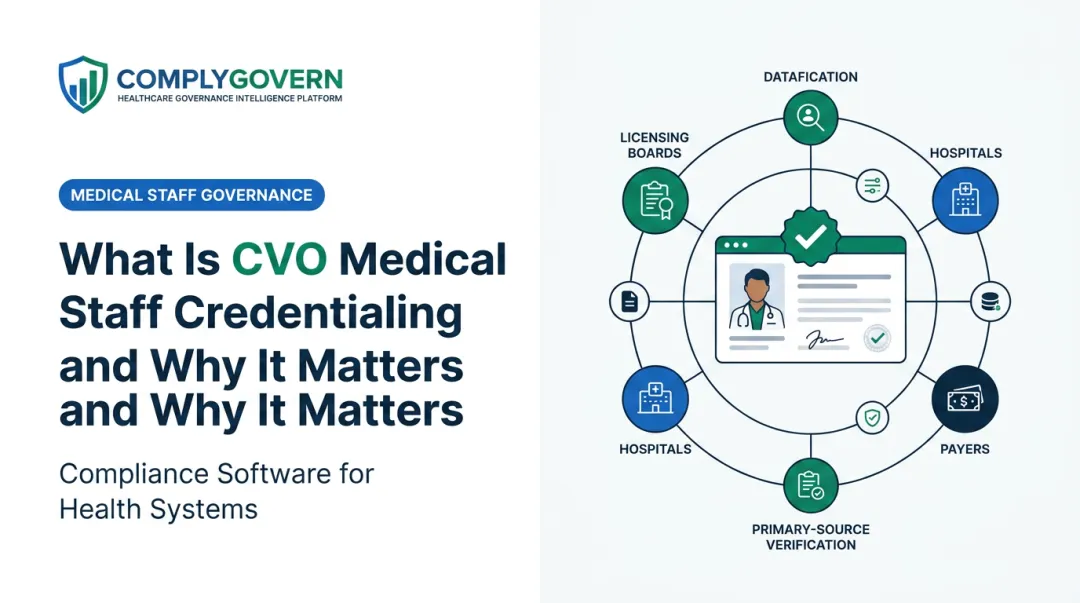
PSV means confirming a provider's credentials directly with the institution that issued them, not just accepting a copy of a diploma or license. CMS defines PSV as verification obtained straight from the organization legally responsible for the original credential.
Automating this step matters because manual PSV is slow and prone to human error. Software that pulls verification data directly from licensing boards, medical schools, and certification bodies cuts out the phone calls, faxes, and follow-up emails that used to eat up days of staff time.
It also closes the door on fraudulent credentials slipping through because someone forgot to double-check a signature.
Centralized Provider Data & CAQH Sync
Every provider has dozens of data points: licenses, malpractice history, board certifications, education records, work history. Without a central repository, that information gets re-entered into multiple systems, and errors multiply with each entry.
Credentialing platforms that sync with CAQH ProView create a single, continuously updated source of truth. Providers attest to their own data, organizations pull from the same verified profile, and nobody's chasing down a fax of the same diploma for the fifth time.
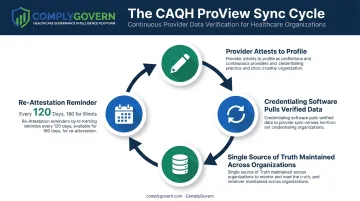
CAQH requires providers to re-attest every 120 days (180 for Illinois), so software that automates that reminder cycle keeps profiles from going stale.
Ongoing Compliance Monitoring & Expirables Tracking
Credentialing doesn't stop once a provider is approved. Licenses expire. Sanctions happen. Malpractice claims get filed.
Strong platforms run continuous screening against:
- OIG's List of Excluded Individuals/Entities (LEIE), updated monthly
- NPDB reports, where Continuous Query enrollment sends notification within 24 hours of a new report, an average of 10 months sooner than standard queries
- State medical board disciplinary databases, which vary by jurisdiction
Without automated monitoring, a lapsed license or a newly filed exclusion can sit unnoticed for months. That's the kind of gap that turns into a Joint Commission finding, or worse, a patient safety incident.
Benefits of Credentialing Software
Manual credentialing processes create measurable operational drag — delayed onboarding, compliance gaps, and mounting administrative overhead. That drag is exactly why healthcare organizations invest in credentialing software.
Here's what a solid platform delivers:
- Faster onboarding and revenue capture — providers start seeing patients and billing sooner instead of sitting in credentialing limbo
- Reduced compliance risk — continuous monitoring catches lapses before they become survey findings
- Stronger patient safety and trust — verified credentials mean patients are treated by qualified providers
- Lower administrative burden — automated data entry and CAQH sync free up medical staff office teams for higher-value work
- Audit-ready documentation — evidence is already organized when a Joint Commission or NCQA surveyor shows up
KLAS Research's 2025 credentialing report found that automation delivers simplified data entry and faster file turnaround across the board, though it also notes fully "no-touch" credentialing isn't a reality yet. Humans still make the final call. Software just clears the path.
What to Consider When Choosing the Best Medical Staff Credentialing Software in 2026
There's no universal "best" platform. The right choice depends on your facility type, how fast you're growing, and whether delegated credentialing with payers is on your roadmap. These six factors turn vague platform comparisons into a decision tied to actual outcomes.
Automation Depth and AI-Driven Verification
Not all "automated" platforms automate the same things. Look for parallel processing (verifying multiple sources simultaneously instead of sequentially) and AI-driven pre-submission validation that flags incomplete or inconsistent applications before they ever reach a reviewer.
This directly affects two numbers that matter: first-pass approval rates and time-to-credential. A platform that catches a missing malpractice disclosure before submission saves you a round-trip that could add weeks.
NCQA CVO Certification and Delegated Credentialing Readiness
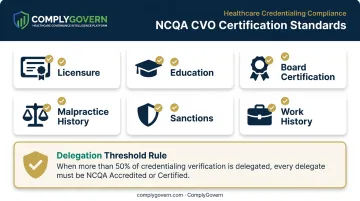
If delegated credentialing with health plans is a goal, NCQA certification isn't optional. NCQA's legacy CVO Certification evaluates verification operations across up to 11 categories, including licensure, education, and malpractice history.
There's a hard rule worth flagging: per NCQA's 2025 credentialing standards, when more than 50% of credentialing verification is delegated, every delegate must be NCQA Accredited or Certified. Ask any vendor for their audited certification history, not just a marketing claim.
Integration with EHR, CAQH, CMS, and Billing Systems
Credentialing data that lives in isolation creates duplicate work everywhere else. When a provider's credentialing status connects to your EHR, scheduling system, and billing platform, you avoid the classic scenario where a provider is scheduled for surgery before their privileges are actually active.
Ask vendors directly:
- Does the platform support HL7 FHIR standards for provider data exchange?
- How does it connect with CAQH ProView specifically?
- Can credentialing status trigger alerts in scheduling or billing systems automatically?
Scalability Across Facility Types and Multi-State Growth
A platform that handles 20 providers cleanly can buckle under 100+ providers spread across five states, each with different licensing boards and disciplinary databases to monitor.
Before signing, ask vendors:
- How does pricing change as provider volume grows?
- Can the system handle multi-state license monitoring without manual configuration for each jurisdiction?
- What does onboarding look like for a health system with multiple hospitals under one credentialing committee?
Compliance Monitoring, Data Security, and HIPAA Alignment
Provider credentialing data is sensitive, and HIPAA's Security Rule requires access controls, audit trails, and authentication safeguards for systems handling electronic protected health information. Encryption at rest and in transit is currently an addressable specification under the rule, but HHS has proposed making it mandatory with limited exceptions.
Don't wait for the rule to change. Choose a vendor that already encrypts everything by default and maintains detailed audit logs of who accessed what and when.
Support Model and Implementation Timeline
A great platform with a poor support model still fails you. Ask about response time guarantees, whether support staff are in-house or offshore, and what a realistic implementation timeline looks like for your facility size.
A vendor promising a two-week go-live for a 200-provider health system is either overselling or underdelivering on data migration.
Beyond Credentialing: How ComplyGovern Strengthens Governance and Compliance
Credentialing software solves one critical piece of the puzzle. But credentialing outcomes don't mean much if they stay siloed from your broader accreditation, quality, and risk picture.
That's the gap ComplyGovern is built to close. ComplyGovern unifies governance, compliance, accreditation, quality, risk, and policy management, including a dedicated Medical Staff Governance module, in one system of record.
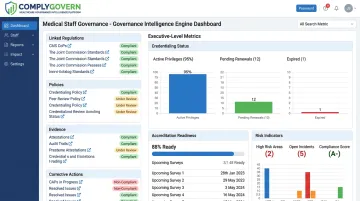
At the center of this is the Governance Intelligence Engine, which automatically links regulations, policies, evidence, and corrective actions. In practical terms:
- Peer review findings, FPPE, and OPPE data connect directly to accreditation readiness workflows
- Provider performance concerns can flow into enterprise risk registers and CAPA tracking without manual re-entry
- Credentialing status feeds role-specific executive dashboards for the CMO, CQO, CCO, and governing boards
A few standout capabilities:
- Continuous survey readiness instead of reactive, last-minute scrambling before an audit
- Native Microsoft 365/SharePoint integration, keeping provider documentation inside the Microsoft ecosystem teams already use
- HIPAA-aligned security, with encryption, role-based access, and audit logging built in
- Interoperability with Epic, Oracle Health, MEDITECH, and athenahealth, so provider data stays synchronized across clinical systems
ComplyGovern supports every CMS-recognized facility type, including Medical Staff Offices. Credentialing outcomes become part of one connected picture from boardroom to bedside, rather than a standalone file waiting to be exported before survey week. If you want to see how this connects for your organization, you can request a demonstration directly.
Conclusion
No single credentialing software is universally "best" for 2026. The right choice is the platform that fits your organization's growth stage, delegation goals, and compliance posture right now, and that fit will change as you scale.
Revisit your choice periodically. Provider volume shifts, regulations get restructured (as Joint Commission's Medical Staff chapter did this year), and what worked for 30 providers might strain badly at 150. Pairing the right credentialing tool with a broader governance platform, like ComplyGovern's Governance Intelligence Engine, turns compliance from a reactive scramble into continuous, audit-ready readiness.
Frequently Asked Questions
How much does healthcare credentialing software cost?
Pricing varies by model: per-user software licensing versus outsourced per-provider service fees. Cost drivers include provider volume and integration needs, plus whether you want a full-service CVO or a standalone verification tool.
What is the best healthcare credentialing software?
"Best" depends on your organization's size, growth goals, and delegation ambitions. Categories range from fast-turnaround automation platforms to enterprise lifecycle suites and compliance-bundled tools, each suited to a different stage of growth.
Can AI do healthcare credentialing?
AI can automate primary source verification and flag document errors, speeding up early-stage processing considerably. Human oversight still handles final credentialing decisions and edge cases that require judgment.
What is the difference between credentialing software and payer enrollment software?
Credentialing verifies a provider's qualifications, training, and licensure. Payer enrollment is the separate administrative process of getting that provider set up with insurance networks so claims can actually be reimbursed.
How long does credentialing typically take with automated software versus manual processes?
Manual credentialing typically runs 90 to 180 days, per MGMA. Automated platforms compress this timeline through parallel verification, though published benchmarks vary by vendor and provider complexity.
Do we still need a governance or compliance platform if we already use credentialing software?
Yes. Credentialing software manages verification, but a governance platform like ComplyGovern connects that data to accreditation evidence and risk registers, then surfaces it in board-level reporting for continuous, organization-wide compliance.