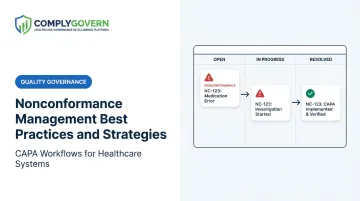
This scenario plays out in healthcare organizations constantly. Nonconformance management is the structured process of identifying, documenting, and correcting deviations from established standards. In healthcare, that scope extends far beyond a defective product. It covers policies, clinical processes, and regulatory requirements tied directly to patient safety.
This guide breaks down the types of nonconformance you'll encounter, the step-by-step process for managing them, and the practices and technology that move organizations from reactive fire drills to continuous compliance.
Key Takeaways
- Nonconformance is any deviation from a standard, regulation, or policy that threatens patient safety and accreditation status
- ISO 9001 Clauses 8.7 and 10.2 require identification, documentation, and corrective action for nonconformances
- A repeatable process from identification through closure reduces recurrence, cost, and regulatory exposure
- Spreadsheets and shared drives remain a leading cause of missed follow-through in nonconformance handling
What Is Nonconformance Management?
A nonconformance is a deviation from expected performance, established requirements, or regulatory standards. It can happen at four levels:
- Product/clinical level — a device, supply, or care delivery step fails to meet spec
- Process level — a workflow isn't followed as designed
- System level — the organization's controls fail to catch a problem
- Regulatory level — a survey or audit finds noncompliance with a specific standard
Most organizations still track these deviations through spreadsheets, departmental logs, and shared drives. That approach creates blind spots. A nonconformance flagged in the ICU rarely gets cross-referenced against a similar issue found in the ED three months earlier, so nobody sees the pattern until a surveyor does.
Nonconformance Under ISO 9001 (What Is an NCR?)
Most quality systems, including many healthcare quality programs, are built on two ISO 9001:2015 clauses. Clause 8.7 (Control of Nonconforming Outputs) requires identifying and isolating a nonconforming output, preventing its unintended use, and applying correction, quarantine, or another disposition. Clause 10.2 (Nonconformity and Corrective Action) requires reacting to the nonconformity, evaluating its cause, and reviewing whether corrective action actually worked.
A Nonconformance Report (NCR) is the formal record capturing what happened, why, and what corrective action followed. ISO 9001 requires this documented information; it just doesn't mandate that the record carry that exact title. Auditors still expect to see that trail, whatever your organization decides to call the form.
Nonconformance in a Healthcare Regulatory Context
Translate this into healthcare terms and a nonconformance takes several familiar shapes:
- CMS Condition of Participation citations
- Joint Commission, DNV, or HFAP survey findings
- Policy gaps surfaced during internal audits
The stakes run higher here than in a typical manufacturing quality concern. An unresolved nonconformance can threaten licensure, accreditation status, and Medicare participation, not just product quality. Patient safety sits at the center of every one of these findings.
Types and Real-World Examples of Nonconformance
Nonconformances generally fall into four categories. Here's what each looks like inside a healthcare facility:
| Category | Definition | Healthcare Example |
|---|---|---|
| Product/Clinical | A supply, device, or clinical output fails standard | Expired medical supply still on the shelf |
| Process | A required workflow step gets skipped | Missed hand-hygiene step during a procedure |
| Documentation | Records or policies fall out of date | Outdated infection-control policy still in circulation |
| Regulatory | A survey identifies noncompliance with a standard | CMS citation for inadequate patient-rights notification |
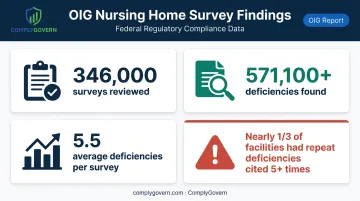
An HHS OIG review of 346,000 nursing home surveys conducted between 2013 and 2017 found over 571,100 deficiencies, averaging 5.5 per standard survey. Nearly a third of facilities had at least one repeat deficiency cited five or more times, a strong signal that root causes weren't being fixed the first time.
Severity Determines Urgency
Not every finding demands the same response. CMS classifies noncompliance by nature and extent:
- Standard-level: noncompliance with one or more standards within a Condition of Participation
- Condition-level: noncompliance serious or widespread enough that an entire Condition is considered unmet
- Immediate Jeopardy: noncompliance has caused, or is likely to cause, serious harm or death, requiring immediate action
Condition-level findings can trigger removal of deemed status. Immediate Jeopardy demands action before the surveyor leaves the building.
For context, the same logic drives product recalls outside healthcare. NHTSA's Takata airbag recall involved roughly 67 million defective inflators, requiring identification, notification, and remedy at massive scale. The mechanics are universal, but the consequences are not: healthcare nonconformance carries licensure, accreditation, and patient-safety weight that a product recall simply doesn't.
The Nonconformance Management Process: Step-by-Step
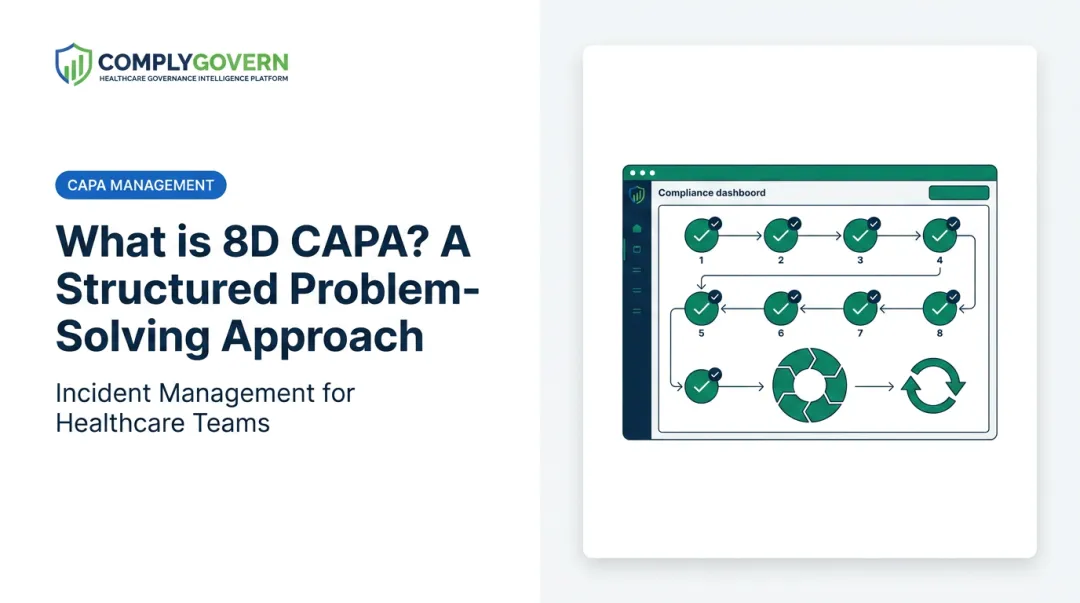
A structured process turns nonconformance from a scramble into a routine. Six steps make up the full cycle.
- Identification — Detect the issue through audits, mock surveys, incident reports, or continuous regulatory monitoring. Waiting for an official inspection to find it first is the most expensive way to learn about a gap.
- Containment — Take immediate action to limit impact. Pause a procedure, restrict a service line, or quarantine affected materials until the issue is understood.
- Documentation — Create a formal finding record capturing the details, supporting evidence, and affected parties. This record becomes your NCR equivalent and your audit trail.
- Root Cause Analysis — Apply a structured method to find the true cause, not just the symptom. The Five Whys technique repeatedly asks why until it surfaces; a fishbone diagram maps causes across categories like people, process, and equipment. Combining both gives you depth and breadth.
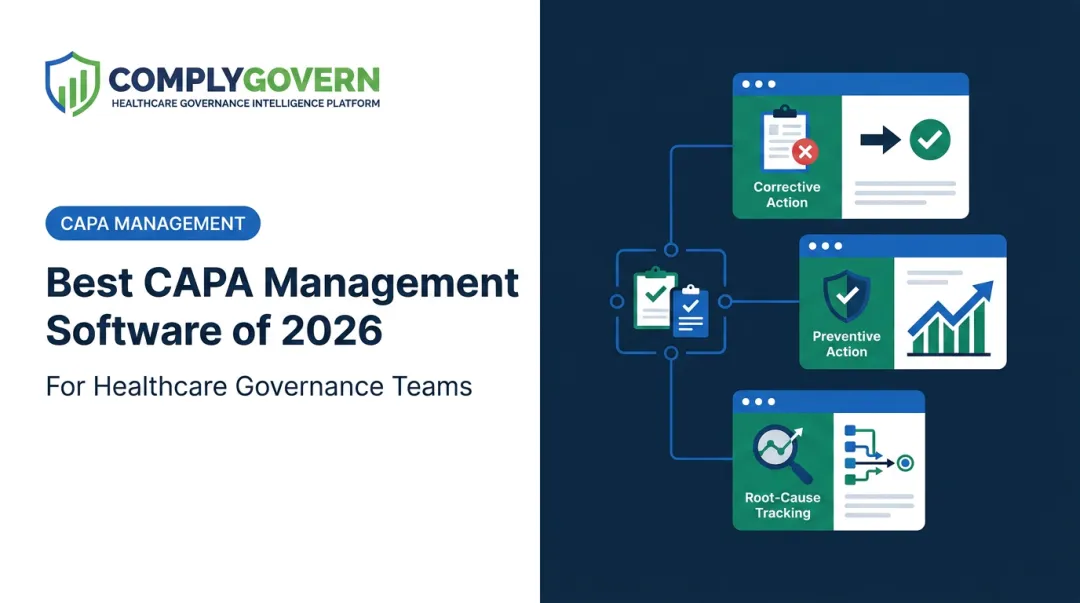
- Corrective and Preventive Action (CAPA) — Implement fixes that address the root cause, not just the symptom, and track preventive measures to stop recurrence elsewhere in the organization.
- Verification and Closure — Confirm the fix actually worked through follow-up audits before closing the record. Full traceability here is what protects you at the next survey.
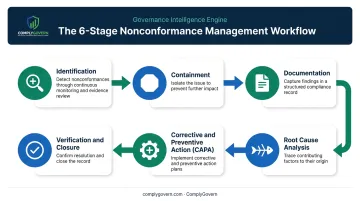
Skip any one of these steps and you get the pattern OIG found in nursing homes: the same deficiency, cited repeatedly, year after year.
Best Practices to Strengthen Nonconformance Management
Process alone won't fix nonconformance handling if the underlying habits are inconsistent. A few practices make the biggest difference:
- Standardize templates across departments: every team should document deviations the same way, so findings can be compared and trended
- Involve cross-functional teams in root cause analysis: quality, compliance, risk, and clinical leadership each catch different angles, strengthening corrective actions before they're finalized
- Run regular trend analysis: recurring findings across departments often signal a systemic issue long before it becomes a formal survey deficiency
- Write fact-based nonconformance statements: include root cause, impact, and corrective action status, and avoid vague language that undermines the record's credibility
None of this requires exotic tooling. It requires discipline and a shared source of truth, which is exactly where most organizations start to struggle.
Overcoming Common Nonconformance Management Challenges with Technology
Here's the pattern that shows up in nearly every healthcare organization we talk to: nonconformance data lives in spreadsheets, shared drives, and separate departmental apps. Compliance tracks one version. Quality tracks another. Risk management keeps its own list. Nobody has the same picture.
That fragmentation causes real damage:
- Duplicate effort between compliance, quality, and risk teams working the same issue independently
- Missed follow-through when a corrective action owner changes roles or forgets a deadline
- Survey preparation that eats weeks of staff time because evidence has to be assembled from scratch
ComplyGovern was built to close that gap. Its Governance Intelligence Engine automatically links nonconformance findings to the policies they affect, the accreditation standards they touch, and the CAPA workflows required to resolve them.
A finding logged during a mock survey connects to the relevant policy, triggers a review, routes into a corrective action workflow, and updates the audit trail — without anyone re-entering the same data three times.
This connected model supports:
- Automated evidence collection across nine governance disciplines, so documentation builds continuously instead of during a last-minute scramble
- Real-time executive and board dashboards showing open findings and corrective action status at a glance
- Enterprise risk trend visibility consolidated from a single source instead of scattered department reports
- A live Readiness Index that gives leadership a continuous view of organizational readiness, rather than a snapshot taken right before a surveyor arrives
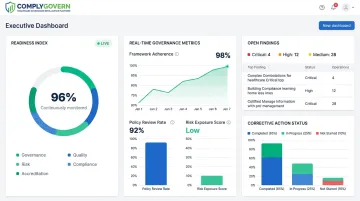
The result: nonconformance management stops being a reactive fire drill and becomes part of how the organization runs every day.
Frequently Asked Questions
What are the steps for control of nonconformance?
The core steps are identification, containment, documentation, root cause analysis, corrective and preventive action (CAPA), and verification/closure. Skipping any step increases the risk of recurrence.
What are examples of nonconformance?
Common examples include an expired medical supply (product), a skipped hand-hygiene step (process), an outdated infection-control policy (documentation), and a CMS citation for inadequate patient-rights notification (regulatory).
What is an NCR in ISO 9001?
An NCR, or Nonconformance Report, is the formal documentation of a deviation, capturing the event, its cause, and corrective actions taken. It fulfills the documented-information requirements under ISO 9001 Clauses 8.7 and 10.2.
What is the difference between corrective action and preventive action?
Corrective action eliminates the cause of a nonconformity that already occurred, preventing it from happening again. Preventive action addresses a potential nonconformity before it ever occurs.
How does nonconformance management differ in healthcare versus manufacturing?
Healthcare nonconformance ties directly to patient safety, licensure, and accreditation status, not just product quality. A citation can jeopardize Medicare participation, a consequence with no real equivalent in a manufacturing recall.
Who is responsible for managing nonconformances in a healthcare organization?
Responsibility typically spans compliance officers, quality departments, risk managers, and department leads. A unified governance system coordinates these roles so accountability doesn't get lost between teams.