Physician use of health AI jumped from 38% in 2023 to 66% in 2024, according to AMA survey data. That's a massive shift in a single year, and most compliance teams haven't caught up.
Many healthcare organizations still track AI tools with the same spreadsheets and siloed departmental systems they've used for years. That leaves boards and compliance officers with no real-time view of how AI is actually being used, or what could go wrong.
This guide breaks down the key risks, the best practices for building an AI governance program, the frameworks worth knowing, and how a unified governance platform closes gaps manual approaches simply miss.
Key Takeaways
- Physician use of health AI nearly doubled in a year, but oversight lagged behind
- Governance, risk management, and compliance are related but distinct, not interchangeable
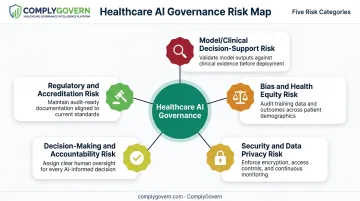
- Healthcare AI risk spans five areas: validity, bias, security, accountability, and regulation
- NIST AI RMF, ISO/IEC 42001, HIPAA, and CMS conditions of participation all apply at once
- Centralized inventories and automated monitoring beat spreadsheets and periodic reviews
What Is AI Governance, Risk, and Compliance (GRC)?
AI governance, risk, and compliance sounds like one thing. It's actually three related but distinct functions working together.
AI governance is the policy and oversight structure that directs how AI gets developed, deployed, and monitored across an organization. It answers questions like: Who approves a new AI tool before it touches a patient chart? Who owns the decision to retire a model that's underperforming?
AI risk management is the ongoing work of identifying, assessing, and mitigating threats tied to AI use. Those threats include biased outputs, security vulnerabilities, and models that degrade in accuracy over time. It's coordinated activity to direct and control risk exposure, not a one-time checklist.
AI compliance is where governance meets the law. It's the specific act of meeting external requirements, HIPAA, FDA guidance, state AI statutes, within the structure governance provides.
Governance vs. Compliance: The Real Difference
This is one of the most common points of confusion, and it matters for how you staff a program.
- Governance sets the decision rights, policies, and accountability structure
- Compliance is the specific act of meeting regulatory and legal requirements inside that structure
- A hospital can be compliant with HIPAA today and still lack the governance structure needed to catch tomorrow's AI risk
- Governance is what makes compliance sustainable, rather than a scramble before every survey
Governance is the operating system. Compliance is one of the applications running on it. You need both, but they aren't interchangeable.
Why AI Governance Matters for Healthcare Organizations
Generic enterprise AI advice doesn't capture what's actually at stake in healthcare. When a marketing chatbot makes an error, someone gets an annoying email. When a triage algorithm makes an error, someone could get the wrong level of care.
The Numbers Behind the Urgency
Adoption has moved fast. Physician use of health AI rose from 38% in 2023 to 66% in 2024, a 74% jump in one year. That's diagnostics, documentation, and triage tools, not back-office experiments.
The financial exposure for getting oversight wrong is real, too. HIPAA penalties, which apply regardless of whether a violation involves AI, range from $145 to over $2.19 million per violation depending on culpability, according to 2026 federal penalty adjustments.
An AI tool mishandling protected health information doesn't get a pass just because a vendor built it.
A Regulatory Landscape That Won't Sit Still
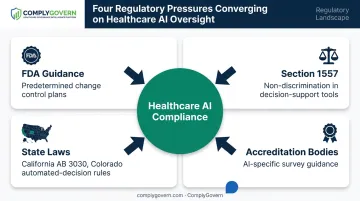
HIPAA is no longer the only rulebook compliance teams need to track:
- FDA guidance now covers predetermined change control plans for AI-enabled medical devices
- Section 1557 requires covered entities to identify and mitigate discrimination in patient-care decision-support tools
- State laws are multiplying: California's AB 3030 requires disclosure when generative AI is used in patient communications, and Colorado's automated-decision rules explicitly include health care services
- Accreditation bodies are publishing AI-specific guidance, signaling where survey expectations are headed
Tracking all of this manually, across separate compliance, quality, and risk teams, means three departments independently evaluating the same AI tool. That's duplicated effort and gaps nobody notices until a survey or incident forces the issue.
This fragmentation shows up at the board level, too. Boards are asking sharper questions, expecting real-time visibility into AI risk exposure rather than a summary buried in a quarterly report.
Key AI Risks in Healthcare and Mitigation Strategies
Healthcare AI carries risks that generic enterprise frameworks don't fully address, because of clinical impact, protected health information, and life-or-death decision contexts.
AI Model and Clinical Decision-Support Risk
Flawed training data or thin validation can make diagnostic or triage tools unreliable outside the settings where they were built. One systematic review of radiology AI models found a fracture-detection tool's specificity fell from 94% internally to 70% when tested on an older trauma population, even though sensitivity barely moved.
Mitigation:
- Validate performance locally, on your own patient population, before go-live
- Require human-in-the-loop review for any output that influences a clinical decision
- Re-validate after vendor updates or major shifts in patient mix
AI Bias and Health Equity Risk
AI models inherit whatever bias lives in the historical data. A widely cited study found a population-health algorithm used cost as a proxy for health need, meaning Black patients had to be considerably sicker than white patients to get flagged for the same level of extra care.
Correcting that proxy would have raised the share of Black patients selected for extra care from 17.7% to 46.5%, according to research published in Science.
Mitigation:
- Conduct regular bias audits across demographic subgroups
- Use diverse, representative training data
- Scrutinize the proxy variables a model optimizes for, not just its headline accuracy
AI Security and Data Privacy Risk
AI systems that touch PHI are attractive targets. A recent review of over 460 healthcare large-language-model studies found nearly 40% didn't report effective PHI-protection measures.
Mitigation:
- Encryption at rest and in transit for any AI workflow touching patient data
- Role-based access controls limiting who can query or export model outputs
- Continuous monitoring aligned with HIPAA Security Rule risk analysis, not a one-time assessment
AI Decision-Making and Accountability Risk
Every AI-driven clinical or administrative decision needs a documented human owner. Without escalation paths, automation runs unchecked, and nobody can explain afterward why a decision was made.
Mitigation:
- Define who reviews AI recommendations before action is taken
- Document override authority for every AI-assisted decision
- Log human interventions so accountability doesn't evaporate once a model is involved
AI Regulatory and Accreditation Risk
Regulations and accreditation expectations around AI are moving faster than most policy manuals get updated. Non-compliance can trigger survey findings, fines, or accreditation setbacks.
Mitigation requires building regulatory monitoring into governance workflows, so new AI-specific requirements get mapped to existing policies automatically instead of surfacing during a survey.
Platforms like ComplyGovern's AI governance module support this work directly, maintaining a live AI model inventory and audit trail so each mitigation step above is documented rather than reconstructed after the fact.
Best Practices for Building a Healthcare AI Governance Risk and Compliance Program
Moving from reactive to continuous AI governance requires a structured, repeatable program, not a one-time policy binder that gets dusted off before surveys.
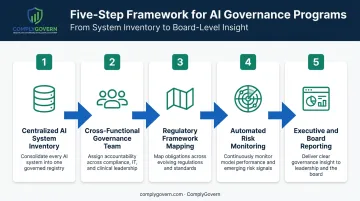
Maintain a Centralized AI System Inventory
Catalog every AI tool in one place, including embedded EHR features, not just the tools IT procured directly. Capture purpose, data sources, vendor, and risk level for each entry.
Without this, organizations can't answer a basic question: how many AI systems are actually running in our environment right now?
Assemble a Cross-Functional Governance Team
Compliance, quality, risk, IT security, clinical leadership, and medical staff representatives should jointly review AI use cases. Decisions made in a single department's silo miss risks the others would have caught.
ComplyGovern's Governance & Board Management capability includes committee management features built for this kind of cross-functional review. Each stakeholder gets a dashboard tuned to the decisions they own, while everyone works from the same underlying data.
Map AI Systems to Regulatory and Accreditation Frameworks
Map each AI tool against applicable rules, HIPAA, state AI laws, CMS conditions of participation, and accreditation standards to surface compliance gaps before a surveyor does.
This is where a platform's regulatory library earns its keep: when a new AI-specific requirement lands, it should connect automatically to existing policies rather than triggering a separate manual review project.
Automate Continuous Risk Monitoring and Corrective Action Tracking
Manual, periodic reviews can't keep pace with how quickly AI systems change. Automated monitoring, alerts, and corrective action workflows catch drift, bias signals, or policy violations closer to real time.
ComplyGovern connects AI risk findings directly to corrective action workflows and executive dashboards through its Governance Intelligence Engine, so an identified issue routes to the right owner without a manual handoff.
Establish Executive and Board Reporting Mechanisms
Live dashboards that give executives and boards direct visibility into AI risk status support faster governance decisions than a static quarterly report ever could.
ComplyGovern's role-specific dashboards surface AI governance alongside compliance status, open findings, and enterprise risk. A CEO or board member sees AI risk as one part of the full governance picture, not an isolated report that arrives too late to act on.
AI Governance Frameworks and Standards Healthcare Organizations Should Know
Healthcare organizations do not need to pick one framework. Most end up layering several, because each does a different job.
| Framework | What It Is | Why It Matters for Healthcare |
|---|---|---|
| NIST AI RMF | Voluntary U.S. risk framework built around Govern, Map, Measure, Manage | Flexible baseline for clinical safety, equity, and accountability controls |
| ISO/IEC 42001 | Certifiable international standard for AI management systems | Repeatable, auditable controls for organizations operating across jurisdictions |
| EU AI Act | Binding law with risk-based categories, from unacceptable to minimal risk | Relevant for organizations with international operations or EU-facing AI outputs |
None of these frameworks replace sector-specific obligations. NIST is voluntary guidance, ISO/IEC 42001 certification confirms a management system exists, and the EU AI Act is only binding where it applies. HIPAA, CMS conditions of participation, and accrediting body standards remain independently enforceable regardless of which general AI framework an organization adopts.
This is the real challenge: layering a general AI framework on top of HIPAA, CMS rules, and Joint Commission or DNV standards without creating five separate compliance projects.
Mapping every framework into one system matters more than picking the "right" one in isolation. A unified platform, such as ComplyGovern's Governance Intelligence Engine, can:
- Link NIST, ISO/IEC 42001, and EU AI Act controls directly to HIPAA and CMS rules
- Maintain one audit trail instead of five parallel compliance projects
- Flag framework overlaps automatically, so teams update policies once instead of five times
How ComplyGovern Simplifies AI Governance for Healthcare Organizations
Most healthcare organizations didn't set out to manage AI oversight through spreadsheets. It just happened, one departmental workaround at a time, until nobody had a full picture.
ComplyGovern's AI Governance capability is built as one of nine connected governance disciplines, replacing that patchwork with a single system of record. Compliance no longer tracks AI risk in one spreadsheet while quality tracks it in another and IT security tracks it somewhere else. Everyone works from the same AI model inventory, risk assessments, and audit trail.
The platform's Governance Intelligence Engine is what makes this more than a shared folder. It automatically links AI-related regulations, policies, risks, evidence, and corrective actions. An update in one place flows through to every policy and control it affects, with no manual re-entry project required. That gives compliance officers continuous audit readiness instead of a scramble before the next survey.
For boards and C-suite leaders, the value shows up in the dashboards:
- HIPAA-aligned security, including encryption at rest and in transit, role-based access control, and MFA/SSO, applies across the AI workflows running on the platform
- Role-specific executive dashboards give CEOs, CMOs, CIOs, CROs, and board members real-time visibility into AI risk status
- Coverage extends across every CMS-recognized facility type, from acute care hospitals to home health agencies and rural health clinics
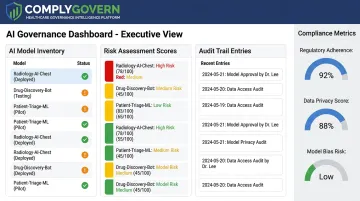
The result is a governance model where AI oversight connects to the same regulations, policies, and corrective action workflows already governing HIPAA, CMS conditions of participation, and accreditation readiness, from the boardroom to the bedside.
Frequently Asked Questions
What are the key principles of AI governance?
Core principles include fairness, accountability, transparency, privacy and security, and human oversight. Trustworthy AI frameworks also add reliability, safety, and explainability to that list.
What is the difference between AI governance and AI compliance?
Governance is the overarching policy and oversight structure, including decision rights and accountability. Compliance is the specific act of meeting regulatory and legal requirements within that structure.
Who is responsible for AI governance in a healthcare organization?
Responsibility spans executive leadership, compliance officers, clinical leadership, IT security, and the board. A cross-functional governance committee typically coordinates these efforts rather than one department acting alone.
What frameworks should healthcare organizations follow for AI governance?
NIST AI RMF and ISO/IEC 42001 provide general AI risk and management structures. Healthcare organizations also need to layer in HIPAA, CMS conditions of participation, and accreditation standards.
How often should AI systems be audited for compliance?
Continuous monitoring works better than periodic audits, since AI systems change quickly. Formal reviews should happen at least annually, and immediately after any significant system update.
What happens if a healthcare organization fails to meet AI compliance requirements?
Consequences can include regulatory fines, accreditation findings, reputational damage, and increased patient safety risk. HIPAA penalties alone can reach into the millions of dollars per violation.