An effectiveness check is the step that actually confirms whether the root cause was eliminated, not just whether someone completed an assigned task. Skip it, and you're closing CAPAs based on hope rather than evidence.
Regulators aren't ambiguous about this. CMS Conditions of Participation require hospitals to measure and track quality indicators until improvement is sustained, and Joint Commission's sentinel event process requires documented effectiveness monitoring before an action plan is considered resolved. Internal governance policies typically mirror these expectations.
This article covers what you need before running an effectiveness check, the verification methods available, how to interpret results without jumping to conclusions, and the mistakes that lead teams to close CAPAs too early.
Key Takeaways
- Verify the root cause is eliminated, not just that the task was completed
- Match trend analysis, periodic review, or audits to risk level and data volume
- Define the metric, pass/fail criteria, and review period before implementation begins
- Use an independent reviewer, separate from the implementation team, for credible, audit-ready results
What You Need to Verify CAPA Effectiveness
A reliable effectiveness check depends on decisions made before implementation, not scrambling for data afterward. If you haven't defined your metric, baseline, and review window in advance, any result you get afterward is open to interpretation. Get the setup right, and verification becomes a straightforward comparison against a standard everyone already agreed to.
Metrics and Indicators Required
Healthcare organizations typically track one or more of these indicators to gauge whether a corrective action actually worked:
- Recurrence rate of the original nonconformance or event
- Complaint and incident report rates tied to the same process
- Patient safety event data, including severity trends
- Internal audit or survey findings from the affected area
- Trend data collected over a defined comparison period
The common thread: these are objective, measurable data points, not staff assurances that "things seem better."
CMS's hospital Conditions of Participation require organizations to measure and analyze quality indicators, including adverse events, and track performance until improvement is sustained before treating an action as resolved (42 CFR 482.21). Subjective judgment calls, however confident, don't satisfy that standard.
Preconditions and Setup
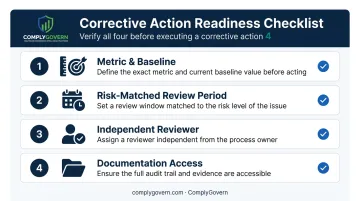
Before implementing any corrective action, lock in:
- The effectiveness metric and baseline: define what you're measuring and pull comparison data before the fix goes live, not afterward
- A risk-matched review period: base the length on how often the original issue actually occurs, not a default like "three months"
- An independent reviewer — someone with no role in implementing the action, named before the check begins
- Documentation access — incident logs, prior audit records, and policy version history the reviewer will need
Retrofitting a baseline after the fact is one of the most common setup failures. If you don't know your pre-implementation rate, you have nothing credible to compare against. Platforms like ComplyGovern address this by linking evidence, findings, and corrective actions inside one system of record, so incident logs, audit history, and policy versions are already assembled when the review period opens rather than scattered across departmental spreadsheets.
Methods to Verify CAPA Effectiveness
Which method to use depends on the risk level of the original issue, how much data you have, and whether the failure was about a paper policy or actual day-to-day practice. Most organizations end up using more than one.
Trend Analysis
Trend analysis compares data over time, weighing pre-implementation rates against post-implementation rates, to see whether the pattern has genuinely shifted rather than dipped temporarily.
What it requires: an incident tracking system, complaint logs, and basic statistical trending tools. A simple run chart works for most cases.
How it works:
- Establish the baseline recurrence rate before the corrective action went live
- Collect data across the defined post-implementation window
- Compare the two periods and confirm the improvement is real, not a temporary blip
This method is strongest for recurring or systemic issues where there's enough data volume to spot a real pattern. It's far less useful for rare events: a quiet quarter doesn't mean much if the event only happens once a year anyway.
Periodic/Scheduled Review
A quality or governance committee builds checkpoints into the calendar to confirm the action is still in place, and still working, well after the initial fix.
What it requires: a quality review board calendar, a CAPA tracking log, a spot on the management review agenda, and a named owner accountable for follow-through.
How it works:
- Schedule review checkpoints at defined intervals after implementation
- Reassess whether the action is still being followed and still producing results
- Document findings and escalate any deviation immediately, not at the next checkpoint
This works well for confirming sustained compliance, but only if the checkpoints actually happen. Skipped reviews are a common failure point when teams run at capacity.
Surprise Audits and Sampling
Unannounced audits and sample-based reviews check whether the corrective action is truly happening in daily practice, not just documented as happening.
What it requires: an audit checklist, a sampling plan, and a representative subset of records or process instances.
How it works:
- Select a representative sample without advance notice, then observe whether the action is being consistently applied
- Record findings and compare against the expected compliance rate
This reveals real-world adherence that documentation alone can't show: staff can sign a checklist without following the new process. The tradeoff is resources; surprise audits are labor-intensive and impractical to run continuously.
| Method | Best for | Watch out for |
|---|---|---|
| Trend analysis | Recurring, high-volume issues | Rare events can skew results |
| Periodic review | Sustained compliance over time | Skipped checkpoints |
| Surprise audits | Real-world adherence, not just paperwork | Resource-intensive |
Platforms like ComplyGovern that unify incident tracking, CAPA workflows, and audit checklists in one system make it far easier to run these methods side by side, instead of piecing together data from spreadsheets and shared drives.
How to Interpret CAPA Effectiveness Check Results
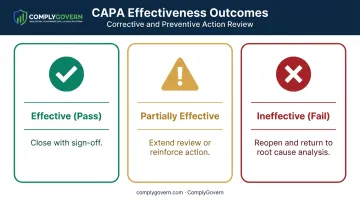
Misreading the data here is where CAPAs go wrong. Close too early on a result that only looks clean, and the underlying issue resurfaces, along with the audit finding that comes with it. There are really three outcomes worth acting on:
- Effective (Pass): The metric shows no recurrence of the original issue within the defined review period. Document the evidence and proceed to formal closure with sign-off.
- Partially Effective (Minor Deviation): Some improvement is visible, but the issue still occurs at reduced frequency. Extend the review period or reinforce the action — don't close it yet.
- Ineffective (Fail): The issue recurs at a similar rate, or a new problem emerges. Don't close the CAPA; reopen it and return to root cause analysis. A failed check usually means the true root cause was never identified in the first place.
Joint Commission's sentinel event process reflects this same logic formally. Its current policy requires effectiveness monitoring and documented sustained improvement, with the follow-up measure tracked for at least 120 days before an action plan is considered resolved.
That specific timeframe applies to sentinel events, not every CAPA, but the principle carries over: sustained data, not a single clean data point, determines the outcome.
Common Errors in CAPA Effectiveness Checks
Most false "effective" conclusions trace back to a handful of repeatable mistakes. Watch for these patterns in your own CAPA log:
- Closing on the due date, not the data — treating a calendar deadline as proof of resolution, regardless of what the metrics show
- Mistaking silence for success — assuming "no further complaints" means the issue is fixed, without a defined metric or review window to confirm it
- Defaulting to a fixed review period — using the same three-month window for every CAPA regardless of how often the original issue occurs
- Letting the implementer grade their own work — allowing the person or team that implemented the action to also verify it
- Skipping the baseline comparison — reviewing post-implementation data without a documented "before" number
Incident report counts alone can also understate what's really happening. An HHS OIG review found that hospitals failed to capture roughly half of patient-harm events in a sampled Medicare population. A "zero recurrence" result built entirely on self-reported incidents is weaker evidence than it looks.
Best Practices for Reliable CAPA Verification
- Use objective, measurable evidence and pass/fail criteria defined before implementation, not judgment calls made after the fact
- Build independence into the workflow by assigning a reviewer who wasn't part of implementation
- Feed effectiveness outcomes into management review and board reporting, so leadership sees whether governance processes are actually working, not just documented as complete
Even when teams follow these practices, manual tracking is where most of it breaks down. Spreadsheets don't flag an overdue effectiveness check. Shared drives don't link a corrective action back to the audit finding that triggered it in the first place.
ComplyGovern's Incident & Corrective Action module keeps corrective actions and effectiveness tracking connected within the same workflow, rather than treating them as separate steps someone has to remember to follow up on.
The platform's Governance Intelligence Engine links quality measures, risks, audits, and findings directly to the corrective actions they generate. An independent reviewer can then see the full chain, including baseline data, prior audit records, and policy history, without hunting across departments.
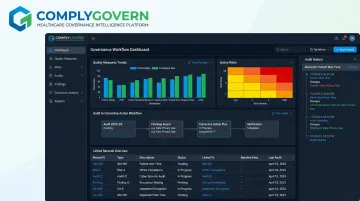
That same chain feeds executive dashboards built for roles from the CQO to board committee chairs, giving leadership real-time visibility into which CAPAs are open, under review, or verified effective.
Conclusion
An effectiveness check is what separates a genuinely resolved problem from a paperwork exercise. A corrective action might look complete on paper (signed, dated, filed) but that says nothing about whether the root cause is actually gone.
Accurate, well-timed verification protects patients and keeps your organization in a continuous state of survey readiness, instead of scrambling to reconstruct evidence when a surveyor asks for it. Platforms like ComplyGovern automate that evidence trail, linking every CAPA to the data that proves it worked.
Let the results dictate what happens next:
- Formal closure when the data confirms the root cause is gone
- An extended review period when the picture is mixed
- A reopened investigation when the issue resurfaces
Anything else is just guessing with better paperwork.
Frequently Asked Questions
How to verify effectiveness of CAPA?
Verification requires a pre-defined metric, a documented baseline for comparison, a review period matched to the issue's risk and frequency, and an independent reviewer confirming the original problem hasn't recurred.
What is an example of an effectiveness check?
A hospital retrains staff on a new medication-reconciliation process. It then tracks the recurrence rate of that specific error over a defined post-training period, such as 90 days, to confirm the process change eliminated the issue.
How long should a CAPA effectiveness check take?
Duration should match the frequency and risk of the original issue, not a fixed default. A high-frequency process failure might show results in weeks; a rare, high-severity event may need months to confirm sustainment.
What happens if a CAPA effectiveness check fails?
Reopen the CAPA and revisit the root cause analysis rather than closing it with a note. A failed check almost always signals the true root cause was never correctly identified.
Who should perform the CAPA effectiveness check?
Someone independent from the team that implemented the corrective action. Independence reduces bias in the result and strengthens the credibility of the documentation during an audit or survey.
Do healthcare accreditation and regulatory standards require effectiveness checks?
Yes. CMS Conditions of Participation require measured, sustained improvement before an action is considered resolved. Joint Commission's sentinel event process similarly requires documented effectiveness monitoring before an action plan closes.