Introduction
A survey citation lands on your desk. The clock starts ticking, and now you need a corrective action plan that will actually hold up under scrutiny, not just paper over the problem until the next visit.
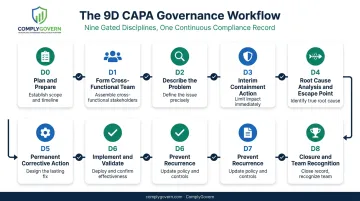
8D CAPA refers to using the Eight Disciplines (8D) methodology to investigate, contain, correct, and prevent recurrence of quality, safety, or compliance issues. The framework is a structured, team-based, nine-step process running from D0 through D8.
This explanation targets healthcare compliance, quality, and risk management teams at hospitals, ASCs, SNFs, home health agencies, and other CMS-regulated facilities. If you're responsible for responding to incidents, nonconformances, or accreditation findings with documented corrective action, this applies to you.
Here's the problem: "8D" and "CAPA" get used interchangeably, and that confusion causes teams to either skip disciplines under time pressure or over-formalize a minor administrative slip. This article covers where 8D came from, how the D0-D8 flow actually works, where it fits in healthcare, and where it falls short of FDA, CMS, and accreditor expectations.
TL;DR
- 8D CAPA is a 9-step (D0-D8) framework built by Ford, now standard across regulated industries.
- The process flows from containment through root cause analysis to permanent correction and prevention.
- Healthcare organizations use 8D CAPA to respond to incidents, complaints, and survey deficiencies.
- A key gap: 8D confirms a fix was implemented, not that it was effective, a distinction surveyors scrutinize closely.
What Is 8D CAPA?
8D CAPA is a structured, cross-functional methodology that identifies root causes, contains a problem, and implements permanent corrective and preventive actions. When applied to a CAPA record, 8D becomes the operational method for closing it out.
The intended outcome breaks down into three concrete actions:
- Eliminate the immediate issue
- Verify the fix actually works
- Prevent the same failure mode from resurfacing elsewhere in the organization
CAPA and 8D get treated as synonyms constantly, but they serve different roles:
- CAPA is the obligation: the regulatory or quality requirement to correct a problem and prevent it from happening again.
- 8D is one method organizations use to fulfill that obligation.
Not every CAPA record uses 8D. A single missed signature on a form doesn't need a nine-discipline investigation. And not every 8D exercise gets logged as a formal CAPA: some teams run the framework informally to solve a recurring operational headache without opening a compliance record at all.
Why 8D Is Used in Healthcare CAPA Programs
CMS Conditions of Participation, state surveys, and accreditors like the Joint Commission, DNV, and CIHQ all require documented corrective action for deficiencies and incidents. None of them name 8D specifically. But the discipline it enforces, including root cause investigation, containment, and verified correction, lines up closely with what surveyors expect to see on paper.
The recurrence problem is real
A 2019 HHS OIG data brief found that 5,200 of 16,439 nursing homes reviewed, about 31%, had at least one deficiency type cited on five or more separate surveys between 2013 and 2017, accumulating roughly 12,700 repeat deficiencies. Half of those facilities had repeat findings serious enough to warrant closer scrutiny.
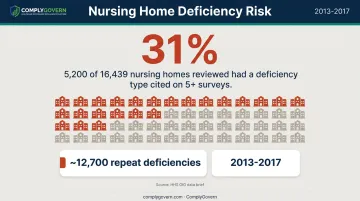
That statistic measures recurrence, not a specific CAPA failure rate. But it points to a pattern compliance teams recognize: fixes go in, and the same problem shows up again next cycle. The gap between closing a corrective action and actually eliminating its cause is exactly where 8D's structure earns its keep.
What 8D helps address
- Cross-departmental investigation for adverse events that touch nursing, pharmacy, and risk management simultaneously
- Standardized documentation surveyors can follow without translation
- Consistency across multi-site health systems where facilities otherwise run corrective action differently
Without that structure, teams under pressure apply a quick fix, close the file, and move on without ever confirming they found the actual root cause. The result is a repeat deficiency at the next survey, because the underlying failure mode was never touched.
Is 8D mandated? No. CMS and accreditors don't name it as a required methodology. But its discipline maps closely to CMS outcome requirements: hospitals, ASCs, SNFs, and home health agencies are all required to measure success after implementing improvement actions and track whether that improvement is sustained.
How the 8D CAPA Process Works (Conceptual Flow)
8D functions as a sequential, gated process. Each discipline needs sign-off before the next one starts. That gating is what stops teams from skipping steps when they're short-staffed and under deadline pressure.
Inputs into the process:
- A documented problem, incident, or complaint
- A cross-functional team with relevant expertise
- Data on when, where, and how the issue occurred
Core action: Root cause tools (5 Whys, fishbone diagrams, Is/Is Not analysis) separate symptoms from true causes, while interim containment protects patients in the meantime.
Control mechanism: Gated sign-offs from a team leader and an executive champion, with documented verification built into each stage.
Here's how that plays out across the nine disciplines:
D0: Plan and Prepare
Gather initial symptom data and decide whether emergency action is needed right now, before the formal investigation even begins. If patients are at risk, this happens in hours, not days.
D1: Form a Cross-Functional Team
Assemble clinical, quality, and risk expertise under a designated leader, plus an executive champion who can actually approve changes once they're identified.
D2: Describe the Problem
Use 5W2H (who, what, where, when, why, how, how many) or Is/Is Not analysis to define the problem in specific, measurable terms: not "medication errors increased," but exactly which unit, which drug class, over what timeframe.
D3: Interim Containment Action
Put temporary measures in place that isolate the problem and protect patients while the permanent fix gets developed. This is a bridge, not a solution.
D4: Root Cause Analysis and Escape Point
Identify the verified root cause and the escape point — the closest process step where the issue could have been caught but wasn't. This second piece gets skipped constantly, and it shouldn't.
D5: Permanent Corrective Action
Select and verify a permanent fix using risk assessment (FMEA fits well here) and defined acceptance criteria, before it gets rolled out organization-wide.
D6: Implement and Validate
Roll out the fix, communicate it to everyone affected, and start measuring outcomes against the original problem statement.
D7: Prevent Recurrence
Update policies, SOPs, and training across similar processes or departments, so the same failure mode can't quietly reappear somewhere else in the building.
D8: Closure and Team Recognition
Document lessons learned, archive the record for audit and survey readiness, and recognize the team. Skipping this step is common and it costs you institutional memory later.
Where and When 8D CAPA Is Applied in Healthcare
8D shows up most often in these workflows:
- Incident and adverse event reporting
- Nonconformances in lab or pharmacy processes
- Supplier and vendor quality issues
- Survey deficiency responses
Common trigger points:
- Post-incident investigation, immediately following an adverse event
- Post-audit or post-survey corrective action planning
- Complaint handling, especially with elevated volume on a single issue
- Sentinel event root cause analysis
- Repeat nonconformances flagged during internal risk assessment
An adverse event report, a survey citation, or a spike in complaints can each be the signal that triggers a full 8D cycle rather than a quick, informal fix.
Key Factors That Affect 8D CAPA Effectiveness in Healthcare
Several conditions determine whether 8D actually delivers, or just generates paperwork:
- Data quality: Incomplete incident documentation weakens root cause analysis and delays closure. Garbage in, garbage out applies directly here.
- Team composition: Cross-functional participation is hard to sustain when clinical units are already short-staffed.
- Scale: Multi-site health systems need standardized templates, or 8D execution drifts between facilities and departments. Standardized CAPA workflows, like those built into ComplyGovern's platform, help maintain consistency across sites.
- Regulatory timelines: CMS and accreditor deadlines for corrective action plans often conflict with the thoroughness 8D demands. A 10-day plan-of-correction window leaves little room for a full root cause investigation.
Common Misconceptions and Limitations of 8D for Regulated CAPA
Three misconceptions cause the most trouble in practice:
- "Completing all eight disciplines means we're compliant." This isn't automatic — documentation quality and effectiveness verification matter more than mechanically checking boxes through D0-D8.
- "Containment counts as resolution." It doesn't: teams sometimes close CAPAs right after D3 containment, without ever finishing root cause analysis or permanent correction.
- Process versus outcome confusion. Teams treat "we did 8D" as proof of compliance, rather than evidence that the underlying problem was actually fixed. Those are two entirely different claims.
The Verification Gap Healthcare Compliance Teams Should Know
Here's the structural issue nobody talks about enough: 8D's D5-D6 sequence verifies that a corrective action was selected and implemented. It doesn't prove real-world effectiveness after the fact.
That expectation shows up across multiple frameworks:
- FDA (21 CFR 820.100): requires verifying an action was effective after implementation
- ISO 13485: imposes the same after-the-fact verification requirement, using data gathered over time
- CMS surveyors and accreditors: hold organizations to the same standard, even without citing 8D by name
What that means practically: a corrective action plan submitted to a surveyor or accreditor should include a post-implementation effectiveness check with a defined data collection timeframe — not just proof that the fix went live.
This is exactly where CAPA processes tend to break down. The fix gets implemented, the file gets closed, and nobody circles back three months later to confirm the deficiency actually stopped recurring.
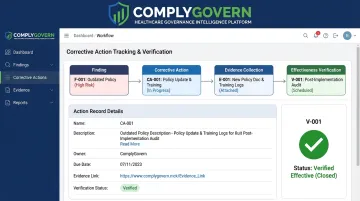
A connected governance platform like ComplyGovern helps close that gap by keeping corrective action tracking, evidence collection, and effectiveness verification linked to the original finding. Effectiveness data becomes a built-in step in the workflow, rather than a manual follow-up someone has to remember to schedule.
This same verification gap also shapes when 8D belongs in the toolkit at all. A minor, isolated administrative error rarely justifies pulling together a full cross-functional team investigation. If your organization defaults to 8D for every small deviation, that's a sign the framework is being applied by habit rather than by actual need.
Conclusion
8D CAPA gives healthcare organizations a disciplined, team-based path from containment through permanent correction and prevention. It's a strong framework — when it's applied to problems that actually warrant it, and when teams don't mistake "we followed the steps" for "we fixed the problem."
Understanding both its strengths and its verification-timing limitation helps compliance and quality teams use 8D correctly, instead of treating it as an automatic compliance guarantee.
A unified platform like ComplyGovern connects corrective actions to evidence, risk registers, and executive dashboards. This gives healthcare organizations real audit and survey readiness, not a folder of disconnected documents assembled the week before a visit.
Frequently Asked Questions
What is the difference between 8D and CAPA?
CAPA is the regulatory or quality obligation to correct a problem and prevent recurrence. 8D is one specific nine-step methodology organizations can use to fulfill that obligation, not the only one available.
What are the 8D quality tools?
Common tools include 5 Whys, Ishikawa/fishbone diagrams, Is/Is Not analysis, 5W2H for problem definition, and FMEA for risk assessment during D5. Each maps to a specific discipline in the process.
Is 8D required by CMS or accrediting bodies for healthcare corrective actions?
No. CMS, Joint Commission, DNV, and other accreditors don't name 8D as a required methodology. Its emphasis on root cause analysis and verification does align with what surveyors expect to see documented.
How long does an 8D CAPA investigation typically take?
Timelines vary by complexity and data needs. Simple issues can close in days, while investigations requiring accumulated performance data for effectiveness checks can take months.
Can small healthcare facilities or single departments use 8D, or is it only for large health systems?
8D scales down well to smaller teams and simpler problems. The full nine-discipline rigor is best reserved for higher-risk or recurring issues, not every minor deviation.
How is 8D different from simpler root cause tools like 5 Whys or Fishbone diagrams?
5 Whys and fishbone diagrams are individual analysis tools used within 8D's root cause discipline (D4). 8D itself is the full end-to-end framework, spanning team formation through prevention and closure.