Introduction
Healthcare compliance teams walk into 2026 carrying a heavier load than ever: CMS surveys, state inspections, and accreditation cycles for a half-dozen agencies, often overlapping.
Many compliance officers still manage this with spreadsheets, shared drives, and a patchwork of departmental tools that were never built to talk to each other.
That approach breaks down fast when a surveyor shows up unannounced.
GRC software has moved past the standalone risk register and disconnected audit log. Today's platforms connect governance, risk, compliance, audit, and even AI oversight into one system that stays current instead of scrambling before a visit.
This guide compares the top GRC software platforms for 2026, including a dedicated look at healthcare-specific solutions built for CMS-recognized facilities.
Whether you run a 40-bed critical access hospital or a multi-state health system, you'll find what to weigh based on your size, industry, and regulatory footprint.
Key Takeaways
- GRC software replaces spreadsheets and disconnected tools with one unified compliance system
- Healthcare platforms must map to CMS, Joint Commission, CIHQ, ACHC, and HIPAA, not generic risk tools
- Top 2026 platforms combine automation, AI insights, EHR integrations, and real-time dashboards
- The right tool depends on framework coverage, integration depth, and total cost, not brand name
Overview of GRC Software in the Healthcare and Enterprise Market
GRC stands for governance, risk, and compliance: three functions unified into a single operational discipline rather than three departments working from three separate spreadsheets. In healthcare, that discipline stretches further, covering accreditation readiness, quality performance, and patient safety alongside the usual regulatory checklist.
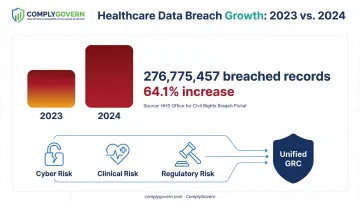
The pressure to unify these functions keeps climbing. In 2024 alone, healthcare organizations reported 276,775,457 breached records, a 64.1% jump from 2023, according to HIPAA Journal's analysis of OCR breach data. Combined with tightening CMS Conditions of Participation and shifting accreditation standards, that volume of exposure has pushed cyber risk, clinical risk, and regulatory risk into the same conversation. That convergence makes vendor selection harder, since a platform built to manage general enterprise risk doesn't automatically understand healthcare's accreditation and clinical compliance demands.
General enterprise GRC platforms and healthcare-specific solutions solve overlapping problems, but they aren't interchangeable:
- An enterprise tool built for SOX controls or ISO certification wasn't designed with Joint Commission tracer methodology in mind
- A hospital running a generic platform often ends up bolting on manual workarounds for accreditation-specific workflows
- Neither category is "better" universally, only better suited to a particular regulatory footprint
The list below covers both categories, so you can match the right tool to your compliance environment instead of forcing a generic platform to do a healthcare-specific job.
Top GRC Software Platforms for 2026
We evaluated these platforms on five criteria: regulatory framework alignment, automation depth, integration ecosystem, usability, and industry specialization. A tool built for general enterprise risk won't necessarily fit a hospital's accreditation cycle, and the reverse is just as true.
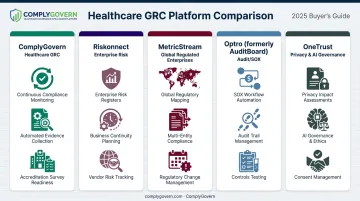
ComplyGovern — Best for Healthcare-Specific Governance, Risk, and Compliance
ComplyGovern was built for healthcare, not adapted from a generic enterprise risk tool. The platform unifies nine interconnected disciplines into one system of record:
- Governance, regulatory compliance, and accreditation readiness
- Policy management and enterprise risk
- Quality, incident/CAPA, and medical staff governance
- AI governance
Its Governance Intelligence Engine automatically links regulations to accreditation standards, policies, controls, evidence, risks, and corrective actions. When a regulation changes, the impact surfaces across every connected document instead of requiring six manual updates.
What sets it apart from standalone GRC tools:
- Native Microsoft 365 and SharePoint integration — policies and evidence live in systems staff already use daily
- HIPAA-aligned security built into the architecture from the ground up
- Clinical system integrations with Epic, Oracle Health (Cerner), MEDITECH, and athenahealth
- Continuous survey readiness through a live Readiness Index, replacing last-minute scrambling
| Best For | Hospitals, health systems, ASCs, SNFs, home health/hospice, FQHCs, and other CMS-recognized facility types needing unified accreditation and compliance management |
| Key Differentiator | Governance Intelligence Engine linking regulations, policies, controls, evidence, risks, and corrective actions with role-specific executive dashboards |
| Regulatory Coverage | U.S. federal healthcare laws, CMS-approved accrediting organizations, and international standards across the UK, Australia, and New Zealand |
Riskonnect — Best Overall Enterprise GRC Platform
Riskonnect brings enterprise risk management, compliance, audit, IT risk, and business resilience together on one data model. Everything runs from the same underlying architecture, which cuts down on the data silos that plague less integrated suites.
The platform covers a wide regulatory footprint, including ISO standards, GDPR, SOX, HIPAA, and DORA, and adds AI-powered risk intelligence with visual reporting comparable to Power BI dashboards. That breadth suits mid-market and global enterprises juggling multiple compliance obligations at once.
The tradeoff: getting full value out of Riskonnect takes meaningful upfront configuration. Teams that skip this step often end up using a fraction of what the platform can actually do.
| Best For | Mid-market and global enterprises needing integrated risk, compliance, and resilience management |
| Key Differentiator | Single source-code architecture eliminating data silos across modules |
| Notable Limitation | Requires meaningful initial configuration to unlock full platform value |
MetricStream — Best for Large, Regulated Global Enterprises
MetricStream's Connected GRC architecture splits into three pillars: BusinessGRC, CyberGRC, and ESGRC. This design works well for organizations running cross-functional programs across multiple business units and geographies, where a shared source of truth outweighs the need for a lightweight interface.
Framework alignment is a strength here, with ISO 31000, NIST CSF, and ISO 27001 support built into the cyber risk modules. Large, multi-entity organizations with dedicated GRC teams tend to get the most value from this depth.
The catch: implementation is resource-intensive, and several reviewers describe the interface as dated compared to newer entrants. Organizations without a dedicated team to manage the rollout may find the learning curve steep.
| Best For | Large, globally distributed, highly regulated organizations with dedicated GRC teams |
| Key Differentiator | Connected GRC model providing a shared, cross-domain source of truth |
| Notable Limitation | Resource-intensive implementation and a less modern user interface |
AuditBoard (now Optro) — Best for Audit and SOX-Heavy Programs
AuditBoard rebranded to Optro on March 9, 2026, according to Optro's official rebrand announcement, framing the move around AI's growing role in GRC. The name changed. The audit-first DNA didn't. Optro remains built by practitioners for internal audit, SOX compliance, and controls-heavy teams.
Its strength is automated evidence collection and control testing wrapped into unified audit, compliance, and risk workflows. Teams running heavy SOX programs get purpose-built tools instead of generic risk modules retrofitted for audit use.
Implementation timelines run longer than some competitors, and Gartner Peer Insights reviewers report inconsistent experience among support and implementation staff.
| Best For | Audit-heavy enterprises needing SOX compliance and cross-team controls visibility |
| Key Differentiator | Purpose-built audit workflows with strong collaboration between audit and business stakeholders |
| Notable Limitation | Longer implementation timelines and inconsistent post-implementation support experiences |
OneTrust — Best for Privacy, Third-Party Risk, and AI Governance
OneTrust covers a wider trust surface than most GRC platforms: privacy automation, security risk, third-party risk, and AI governance all live under one roof. The company advertises 50+ prebuilt frameworks on its compliance automation product page, plus one of the larger vendor risk databases in the category.
Dedicated AI governance workflows set OneTrust apart for organizations bracing for new AI regulations, and its third-party risk tools handle complex vendor ecosystems well.
Setup is the sticking point. Reviewers on G2 and Gartner cite steep learning curves and heavy reliance on professional services to configure the data model correctly, and pricing sits at the premium end of the market.
| Best For | Organizations managing complex vendor ecosystems and privacy-driven compliance programs |
| Key Differentiator | Unified platform covering privacy, security, risk, and ethics in one place |
| Notable Limitation | Complex setup with heavy reliance on professional services and premium pricing |
How We Chose the Best GRC Software
We evaluated each platform against five criteria:
- Regulatory and framework coverage
- Automation and AI maturity
- Integration ecosystem
- Ease of adoption
- Industry specialization
That last criterion trips up a lot of buyers. Choosing a platform for its brand recognition, without checking whether it maps to your specific facility type and regulatory obligations, is one of the most common and costly mistakes in this category.
A generic enterprise risk tool might handle SOX beautifully and still leave a hospital compliance officer building CMS (Centers for Medicare & Medicaid Services) survey binders by hand. Cost is the next place buyers get tripped up.
Pricing varies too much to publish a single number. It shifts based on modules selected, user counts, facility count, and required integrations.
Gartner reports that GRC vendor evaluation alone typically takes more than six months, followed by another nine months before organizations reach full functionality. Treat published price lists as a starting point, not a quote, and request a demo tailored to your organization instead.
How to Choose the Right GRC Software for Your Organization
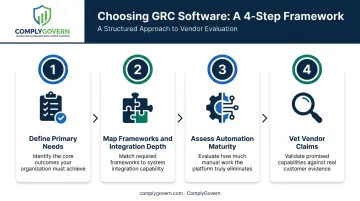
Define Your Primary GRC Needs First
Start by separating two different problems. General enterprise risk management (SOX controls, ISO certification, vendor risk) is not the same challenge as healthcare accreditation and survey readiness. Ask yourself:
- Do you need broad enterprise risk coverage across multiple business units?
- Do you need CMS survey and accreditation readiness for a specific facility type?
- Do you need both, and if so, which is more urgent right now?
Map Frameworks and Verify Integration Depth
List every framework and accrediting body you're actually accountable to, whether that's CMS Conditions of Participation, Joint Commission, HIPAA, ISO, SOX, or international standards like the UK's CQC or Australia's NSQHS. Confirm the platform natively supports each one. A vendor claiming "broad compliance coverage" without naming your specific accrediting body is worth pressing on during the demo.
Framework coverage means little without deep system integration. Check how deeply the platform connects with what you already run. For healthcare buyers, that means confirmed integrations with Epic, Cerner, or MEDITECH, not a vague promise of "EHR compatibility." A platform that can't pull clinical data into compliance workflows leaves your team doing manual entry no matter how polished the dashboards look.
Assess Automation Maturity and Vet Vendor Claims
Ask specifically:
- How much of evidence collection is automated versus manually uploaded?
- Does policy review happen on a fixed schedule, or does someone need to remember to trigger it?
- Is regulatory monitoring continuous, or does it depend on someone checking a website?
Vendor answers matter only as much as the proof behind them. Before signing anything, ask for a live demo scenario using your facility type, case studies from organizations similar in size and structure to yours, and references you can actually call. Vendors who hesitate on any of these are telling you something.
Conclusion
The right GRC platform matches your organization's actual regulatory reality, not a feature checklist or a familiar brand name. A tool built for SOX-heavy audit programs will underserve a skilled nursing facility bracing for a state survey, and vice versa.
Once that fit is confirmed, weigh scalability, integration depth, and total cost of ownership before signing a contract. The platform that looks best in a sales demo isn't always the one your staff will actually use six months in.
For healthcare organizations specifically, that means:
- Continuous survey readiness instead of reactive scrambling before inspections
- Native integrations with the clinical systems you already run
- Governance that connects the boardroom to the bedside
That's the gap ComplyGovern was built to close for CMS-recognized facilities of every size, from single-site suppliers to multi-hospital systems.
Frequently Asked Questions
What are GRC software solutions?
GRC software unifies governance, risk management, and compliance activities into a single platform, replacing scattered spreadsheets and departmental tools with centralized visibility and automation.
What features should healthcare organizations look for in GRC software?
Look for accreditation framework coverage (Joint Commission, CIHQ, ACHC), EHR integrations, HIPAA-aligned security, and automated survey readiness. Generic enterprise risk features alone aren't enough.
How much does GRC software typically cost?
Pricing varies by modules, user count, and facility count, so there is no universal price list. Request a tailored quote based on your specific setup rather than relying on published estimates.
What is the difference between GRC software and compliance management software?
Compliance software addresses a narrower scope, tracking regulatory adherence within one domain. GRC software unifies governance, risk, and compliance functions together across the entire organization.
Can GRC platforms integrate with EHR systems like Epic or Cerner?
Yes. Leading healthcare GRC platforms, including ComplyGovern, offer integrations with major clinical systems such as Epic, Oracle Health (Cerner), MEDITECH, and athenahealth.
How long does it take to implement a GRC platform?
Implementation timelines range from a few weeks to several months, depending on platform complexity, the number of modules deployed, and your organization's size.