Many compliance and risk teams are still running this environment on spreadsheets, shared drives, and disconnected departmental tools. That patchwork creates blind spots: no one has a full picture of organizational risk, and boards often find out about problems after they've already become findings.
This guide compares the top compliance enterprise risk management (ERM) platforms for 2026 — healthcare-specialized and general-purpose — so you can match a solution to your organization's actual regulatory profile, not just its brand recognition.
Key Takeaways
- ERM software unifies risk, regulatory, and governance data in one system of record.
- The GRC software market hits $23.32 billion in 2026, reaching $39.01 billion by 2031.
- Healthcare needs platforms pre-mapped to CMS facility types and accreditors, not generic GRC tools.
- Top picks: ComplyGovern for healthcare, plus MetricStream, RiskWatch, Archer, and LogicGate.
- Prioritize fit, integration depth, and total cost over analyst-quadrant placement.
Overview of Compliance Enterprise Risk Management Software
Compliance ERM software merges two functions that used to live in separate tools: risk identification and scoring (the "ERM" side) with regulatory tracking, policy management, and audit readiness (the "compliance" side).
Instead of a risk register in one spreadsheet and a policy library in a shared drive, everything connects: a regulatory change can automatically flag the policies, controls, and risks it touches.
This category is growing fast. Mordor Intelligence estimates the global GRC software market at $23.32 billion in 2026, expanding to $39.01 billion by 2031 — a 10.84% CAGR. That growth reflects real pressure: regulatory volume keeps climbing across every regulated industry, and manual tracking can't keep pace anymore.
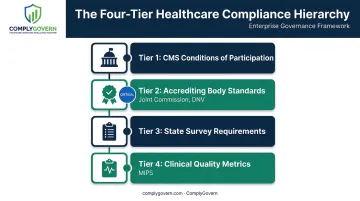
Healthcare carries a uniquely layered burden. Organizations must satisfy:
- CMS Conditions of Participation specific to their facility type
- Accrediting body standards (Joint Commission, DNV, AAAHC, and others) tied to deemed status
- State survey requirements for facilities not under federal deeming authority
- Clinical quality metrics like CMS quality measures and MIPS
Generic GRC platforms weren't built to map to all of this out of the box. That's why the comparison below includes both healthcare-specialized and general enterprise platforms, and the right fit depends heavily on which layers apply to your organization.
Top Compliance Enterprise Risk Management Software for 2026
We evaluated each platform against five criteria: regulatory framework coverage, AI capability, integration depth, industry fit, and analyst or customer validation. Here's how the field breaks down.
ComplyGovern
ComplyGovern is an intelligent healthcare compliance and governance platform that unifies nine interconnected disciplines into a single system of record. These include governance, regulatory compliance, accreditation readiness, policy management, enterprise risk, quality and performance, incident and corrective action, medical staff governance, and AI governance.
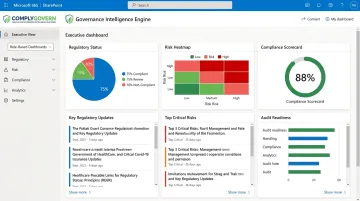
What sets it apart is the Governance Intelligence Engine. It automatically links regulations, accreditation standards, policies, controls, evidence, risks, audits, findings, and corrective actions straight to executive dashboards.
When a regulation changes, that update flows through the entire chain: no manual cross-referencing, no duplicate data entry across departments. The result is continuous survey readiness instead of the weeks-long scramble that typically precedes a Joint Commission or CMS visit.
The platform is HIPAA-aligned by design, with role-based access control, MFA/SSO through Microsoft Entra ID, encryption at rest and in transit, and comprehensive audit logging. It's also built natively on Microsoft 365 and SharePoint, so it fits inside the collaboration tools most health systems already use.
| Best For | All CMS-recognized healthcare facility types — hospitals, ASCs, SNFs, HHAs, FQHCs, DMEPOS suppliers, and more — plus executive leadership and compliance, quality, and risk teams needing one source of truth |
| Key Differentiator | Nine connected governance disciplines in one system of record, with role-specific executive and board dashboards |
| Integrations | Epic, Oracle Health (Cerner), MEDITECH, athenahealth, HL7/FHIR, and native Microsoft 365/SharePoint |
MetricStream
MetricStream has served GRC organizations for more than 20 years and now positions itself as an "AI-First Connected GRC" platform built for large enterprises in banking, insurance, and healthcare.
Its differentiator is Connected GRC architecture, a unified data model where risk, compliance, audit, and policy information share context instead of living in isolated modules. AI shows up throughout the workflow, including a policy assistant, survey autofill, and regulatory alert summarization. MetricStream was named a Leader in IDC's MarketScape for GRC Software in 2025 and has multiple prior Gartner Leader recognitions in IT vendor risk management.
| Best For | Large enterprises and regulated industries needing customized, multi-framework GRC programs |
| AI Capabilities | Advanced, embedded directly into daily risk, compliance, and audit workflows |
| Ideal Org Size | Large and global enterprises, including Fortune 500 companies |
RiskWatch
Founded in 1993, RiskWatch built its reputation around the Global Risk Register, a consolidated view of enterprise, IT, vendor, and physical risk that rolls up from business unit to board level.
Two features stand out. First, KRI-driven threshold escalation automatically flags risks when key risk indicators cross a defined threshold, rather than relying on someone noticing a spreadsheet cell turn red. Second, bi-directional risk-to-compliance mapping connects identified risks directly to the controls and frameworks meant to mitigate them. RiskWatch supports 40+ pre-built framework libraries, including HIPAA and ISO 27001.
| Best For | Mid-market and regulated-industry risk teams wanting one register for enterprise, IT, vendor, and physical risk |
| Key Feature | KRI-driven threshold escalation paired with bi-directional compliance mapping |
| Deployment | Single-tenant option available for customer-owned data residency (standard hosting is multi-tenant SaaS) |
RSA Archer
Archer has operated for roughly 25 years and remains a go-to platform for large, highly regulated enterprises. Archer reports more than 1,200 clients across 48 countries, including 38 of the top 50 banks.
Its strength is depth: extensive configurability and a large pre-built use-case library covering operational risk, business continuity, and policy management. That flexibility comes at a cost. Archer's interface is dated compared to newer entrants, and implementation typically requires a longer runway and more internal resources to configure correctly.
| Best For | Large, highly regulated enterprises needing on-prem deployment or deep legacy customization |
| Deployment | Cloud and on-premise options |
| Consider Alternative If | You need a modern UI, fast implementation, or industry-specific out-of-the-box frameworks |
LogicGate Risk Cloud
LogicGate, founded in 2015, took a different approach: a no-code/low-code platform where risk teams build their own workflows without waiting on IT.
The drag-and-drop process builder is the headline feature, but the licensing model matters too. LogicGate charges based on Applications and Power User seats rather than a flat enterprise fee, which can lower costs for teams with a small core group of power users and many casual viewers.
LogicGate has earned G2 Leader recognition for 28 consecutive quarters, a genuinely long streak in a category where vendor claims often outpace independent validation.
| Best For | Mid-market teams (roughly 200–2,000 employees) wanting to build custom risk/compliance workflows in-house |
| Key Feature | No-code workflow and process designer |
| Limitation | Steep initial learning curve and lighter pre-built framework libraries than larger competitors |
How to Choose the Right Compliance ERM Software
The most common mistake buyers make is picking a platform because it topped an analyst quadrant, not because it fits their actual regulatory environment. A Fortune 500 bank and a 40-bed critical access hospital have almost nothing in common when it comes to compliance requirements, and the software shouldn't be either.
Match Industry Specialization to Your Regulatory Reality
For healthcare organizations, check whether a platform maps directly to CMS Conditions of Participation, accrediting body standards, and clinical quality workflows out of the box. If it doesn't, you're signing up for months of custom configuration before you get any value.
Separate Real AI From Roadmap Promises
AI is now table stakes in vendor marketing, but production quality varies widely. A Drata and Wakefield Research survey of 300 IT and security professionals found that 90% said at least some of their GRC AI investments fell short of expectations. Worse, 43% said the tools actually made their jobs harder. Ask vendors for evidence of AI in production (automated evidence collection, regulatory change monitoring, corrective action tracking), not just a feature on a slide.
Weigh Integration, Scalability, and Total Cost of Ownership
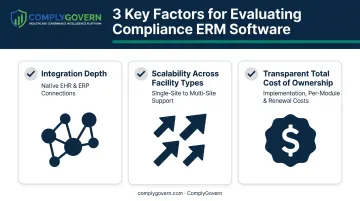
Beyond specialization and AI, three more factors determine whether a platform holds up long-term:
- Integration depth: Look for native connections to Epic, Oracle Health (Cerner), MEDITECH, or athenahealth if you're in healthcare, or ERP and ITSM connectivity for general enterprise use. Push past the word "interoperable" for specifics.
- Scalability across facility types: Confirm the platform handles both a single-site supplier and a multi-hospital system without separate implementations or a future migration.
- Transparent total cost of ownership: Most platforms in this category, including RiskWatch, Archer, and MetricStream, use quote-only pricing. Press vendors for implementation, per-module, and renewal-escalator costs upfront, since these quietly inflate year-two pricing.
Conclusion
No single platform qualifies as the "best" compliance ERM software. The right fit depends on your regulatory complexity and operational scale.
A hospital system juggling CMS CoPs, Joint Commission surveys, and state licensing needs something different from a multinational bank managing operational risk across 40 countries.
Before signing a multi-year contract, validate three things:
- Run a pilot using real data from your organization
- Confirm integration depth against your actual clinical or business systems
- Get clear on total cost of ownership, not just year-one pricing
For healthcare organizations specifically, ComplyGovern was built for exactly this problem: continuous compliance, unified governance across nine disciplines, and one source of truth from boardroom to bedside. If fragmented spreadsheets and last-minute survey scrambles sound familiar, request a demo to see how the Governance Intelligence Engine handles it differently.
Frequently Asked Questions
What is the best risk management and compliance software?
It depends on your industry, regulatory complexity, and organization size. Healthcare organizations typically get the most value from purpose-built platforms like ComplyGovern, while large multi-industry enterprises may prefer generalist GRC platforms like MetricStream or Archer.
What are the 5 risk management tools?
This guide covers ComplyGovern, MetricStream, RiskWatch, Archer, and LogicGate as representative leaders across healthcare-specialized and general enterprise GRC categories. Which one is "best" depends entirely on your use case and industry.
What is compliance enterprise risk management (ERM) software?
It's software that unifies risk identification, scoring, and treatment with regulatory compliance tracking, policy management, and audit readiness in one platform — replacing the fragmented spreadsheets and siloed tools many organizations still rely on.
What features should healthcare organizations prioritize in compliance ERM software?
Prioritize CMS and accreditation framework mapping, native EHR integrations (Epic, Oracle Health (Cerner), MEDITECH), HIPAA-aligned security architecture, and continuous survey readiness rather than periodic, manual prep cycles.
How is healthcare-specific compliance software different from general GRC platforms?
Healthcare-specific platforms map directly to CMS facility types, accrediting bodies, and clinical quality metrics out of the box. General GRC tools require heavy custom configuration to achieve the same fit.
How much does compliance ERM software typically cost?
Pricing varies widely and is often quote-only, scaling with organization size, number of frameworks, and modules selected. Always request a transparent quote and clarify renewal terms before signing.