Yet many compliance, quality, and risk teams still rely on spreadsheets and shared drives to manage it all. The result: missed deadlines, zero executive visibility, and duplicated work across departments that should be pulling in the same direction.
This guide reviews the top corrective action tracking software of 2026 for healthcare organizations, breaks down the selection criteria that actually matter, and helps you figure out which platform fits your facility type.
Key Takeaways
- Regulatory mapping beats generic task lists, automatically linking findings to CMS tags, accreditation standards, and HIPAA requirements
- ComplyGovern unifies compliance, quality, risk, and corrective action governance in one system
- Ideagen, AssurX, Qualio, and Compliancy Group serve narrower CAPA or HIPAA-specific use cases
- Clinical system integration and HIPAA-aligned security matter more than generic quality-management features
Overview of Corrective Action Tracking Software in Healthcare Compliance
Corrective action tracking software is a digital system for identifying, documenting, assigning, and verifying the resolution of nonconformities, whether those come from a survey finding, an internal audit, a patient safety incident, or a complaint. At its most basic, it replaces the manual chase of "who owns this, and did it get fixed?"
In healthcare, the stakes are higher than in most other industries. CMS applies different Conditions of Participation and Conditions for Coverage depending on facility type.
Hospitals, ASCs, home health agencies, hospices, and long-term care facilities all answer to different rulebooks, as CMS outlines in its Conditions for Coverage and Participation resources. On top of that, accreditation surveyors from the Joint Commission, DNV, CIHQ, and HFAP add another layer of standards to track.
The scale of the exposure is real. The Office of Inspector General found that State Survey Agencies cited more than 6,600 nursing homes, nearly 43%, for infection prevention and control deficiencies alone. That's one category of finding, in one facility type.
Why generic CAPA tools fall short
Most CAPA software was built for manufacturing floors and ISO 9001 audits, not hospital corridors. That creates gaps:
- Lacks mapping to CMS facility types or citation tags
- Missing native HIPAA safeguards for ePHI stored in evidence files
- No interoperability with EHR systems like Epic or MEDITECH
- Uses generic nonconformity workflows that don't reflect CMS-2567 correction plan requirements
The platforms below were evaluated specifically through a healthcare governance, compliance, and quality lens, using CMS facility-type mapping, HIPAA safeguards, and EHR interoperability as core criteria.
Best Corrective Action Tracking Software for Healthcare Organizations in 2026
Each platform below was assessed against five factors: regulatory alignment with healthcare frameworks, integration with clinical systems, automation depth, executive visibility, and data security.
ComplyGovern
ComplyGovern is a healthcare compliance and governance platform built to replace spreadsheets, shared drives, and siloed departmental apps with one connected system. It spans nine governance disciplines, including corrective action tracking, rather than treating CAPA as an isolated function.
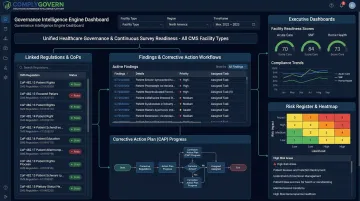
What sets it apart is the Governance Intelligence Engine, which automatically links regulations, standards, policies, audits, findings, and corrective actions together. When a finding is logged from a survey or incident, it flows directly into linked corrective action workflows, risk registers, and executive dashboards without manual re-entry. That means continuous survey readiness instead of a last-minute scramble every time a surveyor's visit is announced.
The platform is HIPAA-aligned by design, with role-based access control, encryption at rest and in transit, and comprehensive audit logging. It integrates natively with Epic, Oracle Health (Cerner), MEDITECH, and athenahealth through HL7 and FHIR standards. It's also built on Microsoft 365 and SharePoint, so evidence collection and workflow routing happen inside tools staff already use daily.
| Best For | Health systems, hospitals, ASCs, SNFs, home health, hospice, and other CMS-regulated facility types needing unified governance |
| Key Features | Governance Intelligence Engine, automated evidence collection, role-specific executive dashboards, Microsoft 365/SharePoint native integration |
| Security & Integrations | HIPAA-aligned security; interoperable with Epic, Oracle Health (Cerner), MEDITECH, athenahealth, HL7, and FHIR |
Ideagen
Ideagen provides quality and compliance software for regulated industries, with CAPA tools covering issue identification, planning, and reporting. It publicly positions itself within the healthcare industry and reports serving over 900 hospitals and healthcare centers.
Automated workflows and training-tracking features help teams close out CAPAs efficiently. That said, it's built as a general regulated-industry tool first, with healthcare as one vertical among several, not a purpose-built healthcare governance system.
| Best For | Mid-to-large regulated organizations needing standalone CAPA workflow automation |
| Key Features | Automated workflows, training tracking, CAPA document management |
| Limitation for Healthcare | Lacks native healthcare accreditation/CMS framework mapping and clinical system integrations |
AssurX
AssurX serves compliance and quality management needs across food manufacturing, life sciences, and healthcare-adjacent industries. Its strengths lie in document management and integrations with MES, LIMS, ERP, and CRM systems, plus complaint management for regulated environments.
The complaint-handling capability is genuinely useful for organizations that need to track adverse events alongside corrective actions. But AssurX's core positioning centers on manufacturing and life sciences workflows, not CMS survey readiness.
| Best For | Life sciences and manufacturing-adjacent organizations with complex system integration needs |
| Key Features | Document management, complaint management, third-party system integrations |
| Limitation for Healthcare | Not purpose-built for CMS survey readiness or multi-facility-type healthcare governance |
Qualio
Qualio is a CAPA management platform aimed primarily at healthcare and life sciences companies building regulated products, such as medical devices and SaMD. Its root cause analysis tools and event/task dashboard give quality teams a structured path from detection to closeout, and Salesforce integration helps sync CAPA data with broader business systems.
The catch: Qualio's orientation leans toward product and manufacturing quality, not provider-side accreditation. A hospital compliance team looking for CMS-2567 tracking won't find that here.
| Best For | Life sciences and medical device companies managing product-quality CAPAs |
| Key Features | Root cause analysis, event and task dashboard, Salesforce integration |
| Limitation for Healthcare | Oriented toward product/manufacturing quality rather than provider-side accreditation and governance |
Compliancy Group
Compliancy Group focuses specifically on HIPAA compliance software for healthcare practices, helping them manage risk assessments and the corrective actions that follow. Guided compliance coaching and remediation checklists make it accessible for smaller practices without dedicated compliance staff.
This narrower scope is both its strength and its limit. It's a solid fit for a small practice managing HIPAA risk remediation, but it doesn't reach into broader CMS Conditions of Participation, accreditation survey management, or enterprise-level governance.
| Best For | Smaller healthcare practices focused primarily on HIPAA risk remediation |
| Key Features | Guided compliance coaching, risk assessment tracking, remediation checklists |
| Limitation for Healthcare | Limited coverage of broader CMS, accreditation, and enterprise governance requirements |
How We Chose the Best Corrective Action Tracking Software
The most common mistake healthcare buyers make is picking a generic manufacturing-oriented QMS or CAPA tool because it looks feature-rich on a comparison chart.
These tools rarely map to CMS Conditions of Participation or accreditation standards out of the box. That gap means someone on your team ends up building the mapping manually anyway.
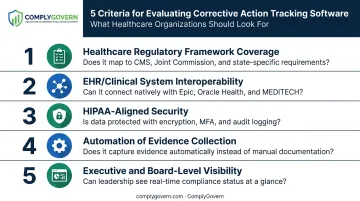
To help you avoid that outcome, we weighed five factors, each tied to a measurable operational outcome:
- Healthcare regulatory framework coverage — does the platform map to CMS facility types, Joint Commission standards, and state licensure requirements?
- EHR/clinical system interoperability — can it connect to Epic, Oracle Health (Cerner), MEDITECH, or athenahealth without custom middleware?
- HIPAA-aligned security — are role-based access, encryption, and audit logging built in from the start?
- Automation of evidence collection — does it reduce manual document-gathering before a survey?
- Executive and board-level visibility — can leadership see corrective action status in real time, not through quarterly reports?
Findings from the Joint Commission illustrate why the fourth factor matters so much. More than 77% of surveyed hospitals received at least one infection prevention and control finding in 2023, often averaging more than two per survey.
A platform that can't handle multiple concurrent findings, each with its own evidence deadline, isn't built for the reality most hospitals face.
Conclusion
Choosing a corrective action tracking partner should come down to fit with your regulatory and operational reality, not brand recognition or a slick sales deck. A tool built for automotive suppliers or pharmaceutical labs will always require workarounds in a hospital or SNF setting.
Before you commit, evaluate three things:
- Scalability across every facility type you operate, not just your current site
- Ongoing visibility through live dashboards, not static reports after the fact
- Total cost of ownership, including implementation and training, not just license fees
If you're ready to see what unified governance looks like (corrective action tracking, accreditation readiness, and executive dashboards in one system of record), ComplyGovern's team can walk you through it.
Frequently Asked Questions
What are the 5 steps of a corrective action?
The typical sequence is: identify the problem, contain it, conduct root cause analysis, implement the corrective action, then verify and monitor its effectiveness. No single formal regulatory standard mandates these exact steps, but they reflect how most healthcare CAPA processes operate in practice.
How do I monitor and track a corrective action plan?
Use centralized tracking software rather than spreadsheets, assign clear ownership for each action, set firm deadlines, and schedule regular status reviews. Effectiveness verification should happen after implementation, not just at closeout.
What are examples of corrective actions?
Common healthcare examples include revised infection-control procedures after an outbreak, staff retraining following a medication error, and updated documentation workflows after a CMS survey finding. Each ties back to a specific citation or incident.
What is a CAPA tracker?
A CAPA tracker is a tool — spreadsheet or software — that logs nonconformities, assigns responsibility, and monitors status from detection through closure. In healthcare, it also needs to link each item to the specific facility-type regulation it addresses.
Why do healthcare organizations need specialized corrective action tracking software instead of generic QMS tools?
Healthcare requires mapping to CMS facility types, accreditation standards, HIPAA security safeguards, and clinical system integration, none of which generic manufacturing-oriented QMS tools were built to handle. Retrofitting a manufacturing tool for hospital use typically adds manual work instead of reducing it.
How does corrective action tracking support accreditation and CMS survey readiness?
Continuous tracking and evidence documentation replace reactive, last-minute survey prep with an always-ready posture. Instead of scrambling to compile evidence weeks before a survey, findings and their corrective actions stay linked and current year-round.