Introduction
A hospital never knows when the surveyors will walk through the door. CMS confirms that all hospital surveys are unannounced.
Skilled nursing facilities face a standard survey cycle of roughly 9 to 15 months. That unpredictability is exactly why regulatory document management software has become essential infrastructure for compliance and quality teams.
Many organizations still rely on spreadsheets, shared drives, and department-specific folders to track policies. The result: duplicate work, missed review cycles, and a frantic scramble the night before an inspection.
This guide breaks down the real mechanics behind regulatory document management software, showing exactly how continuous survey readiness works in practice.
Key Takeaways
- Regulatory document management software maps every document directly to CMS, state, and accreditation requirements.
- Compliance follows a lifecycle: policy creation, version control, monitoring, and audit-ready output.
- Automated approval workflows and tamper-proof audit trails replace manual tracking.
- Every CMS-recognized facility type uses it, from acute care hospitals to single-site suppliers.
- Leading platforms unify document control, quality, risk, and governance in one system.
What Is Regulatory Document Management Software?
Regulatory document management software is a specialized digital system built to create, control, map, and retrieve policies, procedures, and compliance evidence tied to specific requirements, such as CMS Conditions of Participation, state licensure rules, and accrediting body standards.
Generic file storage can't do this. A folder full of PDFs doesn't know which policies are affected when a CMS rule changes. It can't tell a compliance officer which reviews are overdue, and it certainly can't produce audit-ready evidence on demand during a survey.
What It Is Not
This category specifically excludes:
- Not cloud storage: Google Drive and SharePoint on their own store files but don't map them to regulations.
- Not HR software: employee record systems track personnel data, not policy compliance.
- Not a basic EDMS: standard document management systems handle versioning but lack regulatory intelligence.
Why Dedicated Systems Persist
Generic AI and cloud tools have improved, yet purpose-built compliance systems remain necessary because the stakes are real. HHS's Office for Civil Rights has settled or imposed civil money penalties in 152 HIPAA cases totaling $144,878,972 as of late 2024.
Documentation failures such as outdated policies, missing evidence, and unreviewed procedures routinely factor into those enforcement actions. That gap between generic tools and dedicated systems becomes clear once you look at how compliance software is actually structured.
Compliance software generally falls into two structural approaches: standalone modules that manage files in isolation, or document management embedded within broader governance platforms.
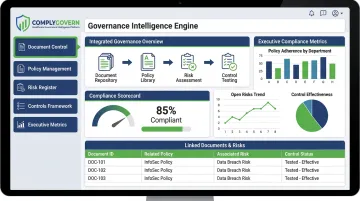
ComplyGovern takes the second approach. It connects document control to policies, risks, controls, and executive dashboards through its Governance Intelligence Engine, rather than treating documentation as a disconnected task.
How Does Regulatory Document Management Software Ensure Compliance?
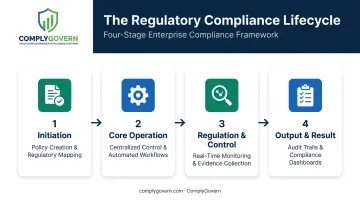
Compliance emerges from a defined lifecycle, not a single feature or checklist. Each stage in that lifecycle reduces risk and strengthens audit readiness long before a surveyor arrives.
Initiation: Policy Creation and Regulatory Mapping
The cycle begins when something changes: a new regulation, an updated accreditation standard, or simply a scheduled periodic review. That trigger initiates creation or revision of a policy, which gets mapped directly to the relevant CMS requirement or accreditation standard it satisfies.
This initiation can be manual, where a compliance officer starts a review, or automated, where a regulatory monitoring feed flags affected policies. The common bottleneck without automatic mapping is simple: teams often don't realize which internal policies a regulatory change touches until it's already a problem.
Core Operation: Centralized Control and Automated Workflows
At the center of the system sits a single source of truth. Every controlled document lives in one repository with version control, so only the current, approved version is visible to staff. Outdated drafts get archived automatically, not left circulating in someone's inbox.
Automated approval workflows route drafts through designated reviewers and signers, logging status and timestamps at each step. This structure:
- Cuts review cycle time by removing manual chasing and email back-and-forth
- Prevents conflicting versions from spreading across departments or facility locations
- Creates a documented approval chain reviewers can point to during an audit
ComplyGovern's Governance Intelligence Engine drives this automation natively, linking every workflow step to the regulation or accreditation standard it satisfies.
Regulation and Control: Real-Time Monitoring and Evidence Collection
Regulations shift constantly, and documentation has to keep pace or gaps start forming. Continuous monitoring feeds flag affected policies automatically when rules shift, rather than waiting for someone to notice months later.
When documentation gaps surface, corrective action tracking kicks in. Evidence gets tied to specific controls, and any gap triggers a structured CAPA (corrective and preventive action) process: root cause analysis, a fix, and verification that the fix actually worked. This is the stage that stops repeat findings from becoming a pattern.
Output and Result: Audit Trails and Compliance Dashboards
Every document action (creation, review, approval, revision, staff attestation) gets logged in a tamper-proof audit trail. When a survey arrives, that trail compiles into an audit-ready evidence package on demand, instead of someone digging through file cabinets.
That output feeds directly into compliance dashboards for compliance officers, quality teams, executives, and boards. The measurable payoff: less survey prep time, fewer deficiencies, and a compliance posture that's continuous instead of reactive.
Where Is Regulatory Document Management Software Used?
This software fits into several points across the healthcare compliance workflow:
- Policy governance — maintaining the master library of approved, current procedures
- Accreditation survey preparation — building the evidence trail before Joint Commission, DNV, or AAAHC arrives
- State licensing renewals — tracking documentation against state-specific requirements
- Quality and risk incident documentation — connecting corrective actions back to the policies that triggered them
It performs equally well at large multi-site health systems and single-site facilities, though the value grows with complexity: organizations tracking multiple overlapping frameworks, such as CMS, state agencies, and accrediting bodies across hospitals, SNFs, HHAs, ASCs, hospices, and FQHCs, feel the difference most.
ComplyGovern's Governance Intelligence Engine maps each facility's requirements automatically, which matters given the scale involved. CMS-approved accreditation programs alone cover more than 9,000 Medicare and Medicaid providers and suppliers, each needing its own mapped documentation.
Other industries use similar concepts differently. Pharma works under GxP and 21 CFR Part 11 controls for electronic records. Finance answers to SOX and PCI DSS. Healthcare's distinguishing feature is the sheer frequency of unannounced surveys combined with facility-specific requirements that shift depending on provider type.
Key Benefits and Choosing the Right Solution
Key Benefits
The operational payoff shows up in a few consistent ways:
- Lower administrative burden: automated evidence collection and policy reviews replace manual spreadsheet updates
- Reduced organizational risk: continuous readiness produces fewer citations and stronger patient safety outcomes than the last-minute scrambling many organizations rely on before surveys
- Scalability: adding facilities means adding regulatory mapping and review cycles without multiplying administrative headcount
Choosing the Right Solution
Not every platform fits every organization. A few things worth checking before committing:
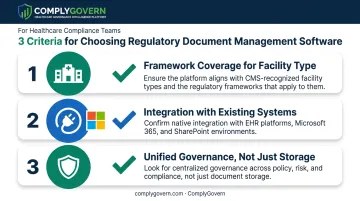
- Framework coverage for your facility type. A rural health clinic and an academic medical center face different accrediting bodies, so the software should reflect that instead of forcing a one-size-fits-all template.
- Integration with existing systems. Look for native connections to EHR platforms and Microsoft 365/SharePoint, so the software doesn't become another isolated data silo.
- Unified governance, not just storage. Platforms that connect document control to quality, risk, and policy management deliver more value than a standalone repository.
ComplyGovern, for example, combines document control with a Governance Intelligence Engine, HIPAA-aligned security, and role-specific executive dashboards, giving organizations one source of truth that runs from the boardroom to the bedside.
Conclusion
Compliance in healthcare depends on continuous document lifecycle control, not an annual cleanup sprint. That means mapping policies to the right regulations, enforcing version discipline, monitoring changes as they happen, and producing evidence the moment it's requested.
Organizations that adopt a unified platform like ComplyGovern make a real operational shift, trading reactive scrambling for continuous, board-visible survey readiness.
Frequently Asked Questions
What is the difference between regulatory document management software and a regular document management system?
Regular DMS tools store and organize files generically. Regulatory document management software maps documents to specific regulations, enforces version control against compliance timelines, and produces audit-ready evidence automatically.
How does regulatory document management software help during a CMS survey or accreditation audit?
It compiles current, approved policies and supporting evidence instantly into an audit-ready package. That eliminates the manual scramble to locate and verify documents on inspection day.
Can regulatory document management software integrate with EHR systems like Epic or Cerner?
Leading platforms offer interoperability with major clinical systems, including Epic, Oracle Health (Cerner), MEDITECH, and athenahealth, typically through HL7 and FHIR standards, connecting compliance data with clinical workflows.
Is regulatory document management software only for hospitals, or does it apply to smaller facilities too?
It applies across all CMS-recognized facility types, including large health systems, single-site suppliers, ASCs, home health agencies, and rural health clinics, each with regulatory mapping tailored to their specific requirements.
How does document version control prevent compliance violations?
Version control ensures only the current, approved policy is visible to staff, automatically archiving outdated versions. Audits never rely on incorrect or superseded documentation as a result.
What security standards should regulatory document management software meet in healthcare?
Healthcare-grade platforms should offer HIPAA-aligned security, role-based access controls, encryption at rest and in transit, and full audit trails to protect sensitive compliance and patient safety data.