Introduction
Regulatory complexity isn't slowing down as organizations head into 2026. AI oversight requirements, cross-border data rules, and shifting accreditation standards are piling onto already-stretched legal, compliance, and risk teams.
Manual tracking can't keep pace. In NAVEX's 2025 survey of nearly 1,000 risk and compliance professionals, purpose-built technology was already used by 78% for training, 73% for policy management, and 71% for incident management. Spreadsheets alone no longer cut it.
The right compliance software reduces manual risk, prevents costly penalties, and keeps teams audit-ready year-round. This guide compares the top legal compliance software tools for 2026 across GRC, policy management, and healthcare-specific governance categories, so you can match the platform to your actual regulatory footprint.
Key Takeaways
- Compliance automation now spans training, policy management, audits, and risk tracking industry-wide
- Healthcare, financial services, and SaaS each face distinct compliance framework requirements
- ComplyGovern stands out for unifying healthcare governance with continuous accreditation readiness
- Prioritize framework coverage, automation depth, integrations, and audit-readiness over brand name alone
Overview of Legal Compliance Software in 2026
Legal compliance software automates regulatory monitoring, policy enforcement, audit preparation, and risk management across whatever frameworks apply to your organization. It replaces manual spreadsheet tracking with centralized systems that flag gaps before they become violations.
The scope of "compliance" has widened considerably, and AI oversight is now a core requirement.
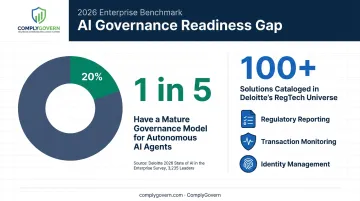
Deloitte's 2026 enterprise AI report, surveying 3,235 leaders in August and September 2025, found that only 1 in 5 companies had a mature governance model for autonomous AI agents. That gap is pushing organizations toward platforms that build AI governance in from day one.
At the same time, RegTech adoption keeps expanding. Deloitte's RegTech Universe now catalogs more than 100 solutions spanning regulatory reporting, transaction monitoring, and identity management — a sign that fragmented point solutions are giving way to broader, connected platforms.
The 10 tools below were chosen based on:
- Reliability and proven platform stability
- Depth of workflow automation
- Industry-specific specialization
- Established customer trust and adoption
They range from general-purpose GRC platforms to industry-specific systems like healthcare governance software, because "best" depends entirely on what your organization actually regulates.
Top Legal Compliance Software Tools for 2026
This list blends general-purpose GRC and legal compliance platforms with industry-specialized tools. There's no single winner — the right pick depends on your sector, team size, and regulatory scope.
ComplyGovern
ComplyGovern is an intelligent healthcare compliance and governance platform that unifies governance, compliance, accreditation, quality, risk, and policy management into one system of record for CMS-recognized healthcare facilities. It's built for hospitals, ASCs, SNFs, home health agencies, and other regulated providers navigating fragmented oversight.
What sets it apart is its Governance Intelligence Engine, which automatically links regulations, standards, policies, controls, evidence, and corrective actions so a single update flows through the entire governance chain. Instead of scrambling before a survey, organizations maintain continuous readiness.
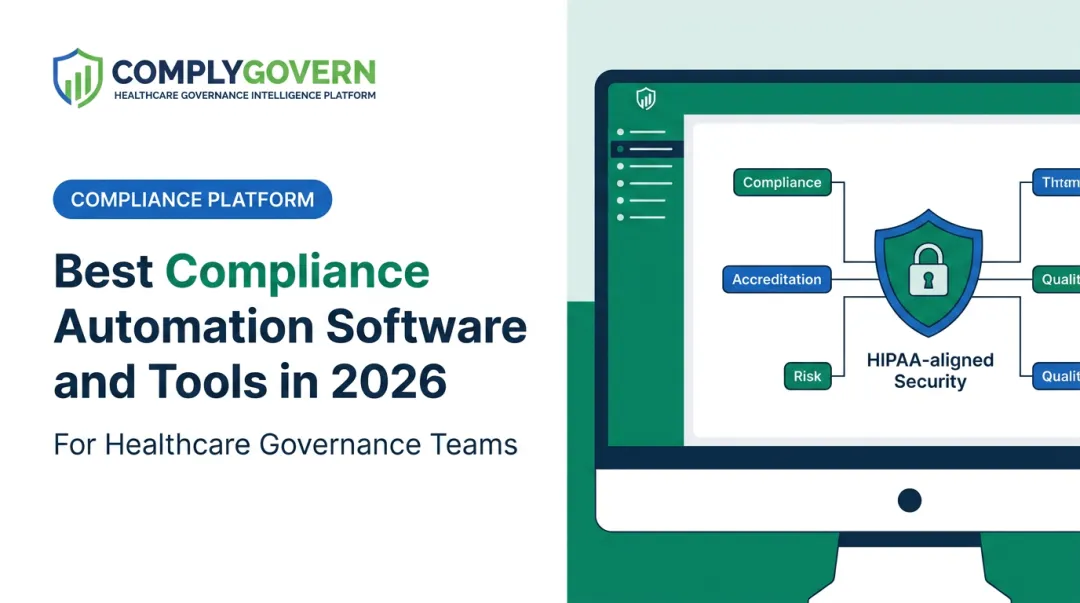
The platform replaces spreadsheets and shared drives with HIPAA-aligned security, native Microsoft 365/SharePoint integration, and interoperability with Epic, Oracle Health, MEDITECH, and athenahealth.
| Category | Details |
|---|---|
| Best For | Hospitals, health systems, ASCs, SNFs, and other CMS-recognized facilities needing unified governance and continuous accreditation readiness |
| Key Features | Nine connected governance disciplines, AI governance module, role-specific executive dashboards, EHR integrations (Epic, Oracle Health, MEDITECH, athenahealth) |
| Limitations | Purpose-built for healthcare; not designed for general corporate legal or non-healthcare regulatory use cases |
OneTrust
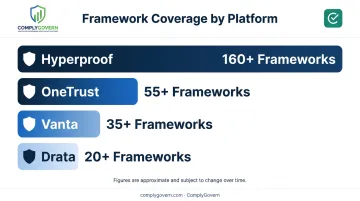
OneTrust is a GRC and privacy management platform supporting 55+ regulatory frameworks, including CMMC 2.0, SOC 2, NIST, and GDPR. It stands out for centralizing risk and compliance workflows with real-time monitoring and more than 200 integrations, serving over 14,000 customers ranging from small businesses to large enterprises.
| Category | Details |
|---|---|
| Best For | Organizations managing privacy, data governance, and multi-framework compliance at any scale |
| Key Features | Automated workflows, AI governance tools, integrated risk assessments, tiered usage-based pricing |
| Limitations | Usage-metered packaging can grow complex and costly as programs scale |
Vanta
Vanta is a continuous compliance automation platform covering 35+ frameworks, including SOC 2, ISO 27001, HIPAA, and ISO 42001. It automatically gathers evidence and monitors connected systems around the clock, and its Trust Center lets companies publish security posture directly to prospects and auditors. More than 16,000 customers use it, from early-stage startups to enterprise teams.
| Category | Details |
|---|---|
| Best For | Companies of any size pursuing rapid certification and customer trust-building |
| Key Features | Continuous monitoring, Trust Center, automated questionnaire responses |
| Limitations | Pricing varies significantly by plan and scale |
Drata
Drata is a continuous compliance monitoring platform covering 20+ frameworks with automated evidence collection. Its Audit Hub centralizes auditor messages, tasks, and evidence requests in one secure portal, while an open REST API lets teams connect compliance data to other systems. Drata now serves 8,500+ customers spanning startups through large enterprises.
| Category | Details |
|---|---|
| Best For | Growing organizations needing scalable, continuous monitoring without manual audit chasing |
| Key Features | Policy Center templates, Audit Hub, open API, automated evidence collection |
| Limitations | Costs increase as you add frameworks and modules |
LogicGate (Risk Cloud)
LogicGate offers a no-code GRC platform with 30+ customizable applications for compliance, risk, and audit workflows. Its Automated Control Gap Analysis tool compares frameworks to surface overlapping coverage and gaps, and its SOX Compliance Application automates internal-control testing for Section 404 reporting.
| Category | Details |
|---|---|
| Best For | Organizations wanting a fully customizable, no-code GRC platform |
| Key Features | Automated control gap analysis, regulatory change management, SOX workflows |
| Limitations | Requires setup investment; steeper learning curve for smaller teams |
Hyperproof
Hyperproof is an AI-powered GRC solution with 160+ pre-built frameworks, including GDPR, HIPAA, NIST, SOC 2, and ISO 27001. Its evidence reuse capability lets controls map across frameworks, so teams document once and apply everywhere, and it added AI-native vendor risk management in 2026.
| Category | Details |
|---|---|
| Best For | Organizations with complex, multi-framework GRC needs, including global enterprises |
| Key Features | Evidence reuse automation, vendor risk management, SSO support, executive dashboards |
| Limitations | Higher learning curve and cost relative to simpler compliance tools |
VComply
VComply is a governance, risk, and compliance platform built around real-time dashboards and policy version control. It centralizes audit documentation, tracks approval history, and maintains a full audit trail of every policy change.
| Category | Details |
|---|---|
| Best For | Organizations needing centralized policy enforcement and audit-ready documentation |
| Key Features | Automated compliance workflows, risk tracking, version-controlled policy lifecycle |
| Limitations | Less depth in industry-specific regulatory frameworks than specialized platforms |
NetDocuments
NetDocuments is a secure, cloud-based document management platform built for regulated legal environments. It offers detailed version control, comprehensive audit trails, and AES-256 object-level encryption on every document, with native Microsoft integration for legal workflows.
| Category | Details |
|---|---|
| Best For | Law firms and corporate legal departments needing advanced document security |
| Key Features | Enterprise encryption, audit trails, version control, Microsoft integration |
| Limitations | Focused on document governance, not broader GRC or risk management |
Fenergo
Fenergo is a client lifecycle management platform automating KYC, AML, and due diligence for financial institutions. It covers onboarding, ongoing KYC reviews, and offboarding through centralized, automated workflows built specifically for banking regulatory obligations.
| Category | Details |
|---|---|
| Best For | Banks and fintechs managing KYC/AML and cross-border regulatory obligations |
| Key Features | Automated onboarding, risk scoring, regulatory document management |
| Limitations | Primarily designed for financial services, not general legal compliance |
PowerDMS
PowerDMS is a policy and accreditation management platform built primarily for public safety agencies. It offers a secure cloud repository for policies, electronic signatures for acknowledgment tracking, and detailed event logs that record nearly every system action.
| Category | Details |
|---|---|
| Best For | Public safety agencies focused on policy management and accreditation tracking |
| Key Features | Centralized policy management, e-signatures, event logs, accreditation mapping |
| Limitations | Not built for case or legal document management; limited legal tech integrations |
How We Chose the Best Legal Compliance Software
A common mistake is picking a tool based on brand recognition alone, without checking whether it actually covers your regulatory frameworks or industry. A platform that's excellent for SOC 2 automation may be entirely wrong for HIPAA-driven healthcare governance.
We evaluated each platform against factors tied directly to real business outcomes:
- Framework coverage: Does it map to the specific regulations you're on the hook for, reducing gaps that lead to penalties?
- Automation and AI capabilities: Can it cut manual evidence-gathering time, or does it just digitize the same manual process?
- Integration ecosystem: Will it connect with your existing systems (EHRs, Microsoft 365, ERPs) without forcing duplicate data entry?
- Industry specialization: Is it built for your sector's actual audit and survey cycles, not a generic checklist?
- Audit-readiness: Does it maintain continuous readiness, or only prep you reactively before a scheduled review?
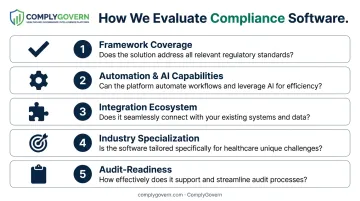
These criteria consistently separated platforms that reduce organizational risk and speed up audits from those that just add another dashboard to check.
Conclusion
There's no universal "best" legal compliance software. The right answer depends on your organizational type, regulatory complexity, and whether you need general-purpose GRC or industry-specific governance.
Before committing to any platform, evaluate scalability, integration depth, and total cost of ownership — not just the feature list on the sales page. A tool that fits a 50-person SaaS startup rarely fits a 500-bed hospital system, and vice versa.
Healthcare organizations seeking continuous, unified governance across compliance, accreditation, quality, and risk can request a ComplyGovern demo as a purpose-built alternative to fragmented point solutions.
Frequently Asked Questions
What are the 3 C's of compliance?
Definitions vary, but the most common framework cites Compliance, Conduct, and Culture: adherence to regulations, individual behavior, and organizational values. Other frameworks swap in Controls or Communication, so confirm which version your auditor or industry uses.
What are examples of legal compliance software?
Examples include GRC platforms, policy management systems, eDiscovery tools, document redaction software, and healthcare-specific governance platforms like ComplyGovern. Each category addresses a different slice of regulatory obligation.
How much does legal compliance software typically cost?
Pricing varies widely. Capterra's entry-level GRC pricing data ranged from roughly $1.25 to $276+ per month, while enterprise platforms typically use custom quotes based on frameworks, users, and modules selected.
Is legal compliance software different for healthcare organizations?
Yes. Healthcare compliance requires alignment with CMS Conditions of Participation, accreditation standards, and HIPAA — requirements that general-purpose compliance tools often don't fully address out of the box.
What features should I prioritize when choosing compliance software in 2026?
Prioritize real-time regulatory monitoring, automated evidence collection and reporting, deep integration with your existing systems, and the ability to scale as your framework list grows.
Can one platform handle both governance and compliance for healthcare organizations?
Yes. Unified platforms like ComplyGovern connect governance, compliance, accreditation, quality, and risk into a single system rather than requiring multiple disconnected tools.