Introduction
Walk into most Medical Staff Offices and you'll find the same problem: peer review forms that look nothing alike from one department to the next. Surgery uses a spreadsheet. Cardiology uses a Word document someone created in 2015. Emergency Medicine has a PDF that nobody remembers approving.
This inconsistency isn't just messy — it's a liability. When surveyors or plaintiff's attorneys ask for documentation, gaps in process become gaps in defense.
Physician peer review is a structured, confidential process where clinical colleagues evaluate a provider's care against established standards. It's required for accreditation, tied directly to reappointment decisions, and central to patient safety oversight.
This guide gives you two things: a practical peer review form structure you can adapt today, and the broader toolkit — policies, workflows, scoring methods, and legal safeguards — needed to run a defensible program.
Key Takeaways
- Defensible peer review forms need case identification, clear criteria, documented findings, scoring, and a SMART action plan
- Peer review, FPPE, and OPPE are distinct processes that feed one credentialing cycle, not interchangeable terms
- A true toolkit includes policies, trigger criteria, workflow steps, trend dashboards, and an appeal process
- HCQIA and state statutes protect peer review only when procedures are fair and well-documented
What Is Physician Medical Staff Peer Review?
Clinical peer review is the process where practitioners in the same professional field assess a colleague's care against established standards. The Centers for Medicare & Medicaid Services (CMS) defines it plainly: a review by health care practitioners of services furnished by other practitioners in the same field.
The goal isn't punishment. It's professional self-monitoring that keeps patient safety and care quality on track.
Peer Review vs. FPPE vs. OPPE
Many use these three terms interchangeably, and that's a mistake. Each serves a different function in the credentialing lifecycle.
| Process | Purpose | Trigger | Duration |
|---|---|---|---|
| Peer review | Case-specific evaluation of a clinical decision or outcome | Routine sample, complaint, sentinel event | Single case cycle |
| FPPE | Evaluates competence for privileges without prior documented performance | New privilege request or a safety concern | Time- or volume-limited |
| OPPE | Ongoing monitoring of existing privileges | Continuous | Periodic, organization-defined |
The Joint Commission's FPPE guidance confirms FPPE applies to all newly requested privileges, plus any situation where a question arises about a practitioner's ability to deliver safe, high-quality care. OPPE, by contrast, runs on a cycle the organization itself defines — there's no universal six-month rule, despite what many toolkits assume.
Why Structured Review Matters
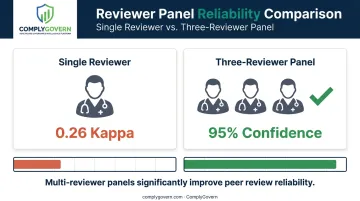
Here's the uncomfortable truth: individual clinical judgment about "what went wrong" varies more than most people expect. A 2012 study asked 30 physicians to rate the same 319 poor-outcome cases on an adverse-event scale.
The median agreement between reviewer pairs was just 0.26, a weak correlation by any standard. Researchers needed at least three reviewers scoring the same case to reach 95% confidence in the finding.
That single data point explains why standardized forms, defined criteria, and multi-reviewer panels matter. They function as the mechanism that makes peer review findings reliable enough to survive scrutiny.
Key Elements of an Effective Physician Peer Review Form
A well-built form balances three things: objectivity, legal protection, and constructive feedback. Miss any one of these, and the form either invites bias or fails to hold up under review. Most effective forms organize into five core sections.
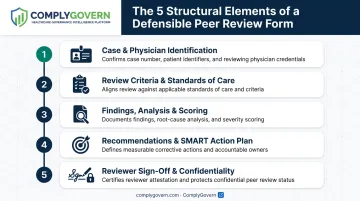
Case & Physician Identification
Every form starts with the basics, captured consistently:
- Physician name and specialty
- De-identified patient/case ID
- Date of service
- Reviewer name(s) and credentials
- Reason for review (routine cycle, sentinel event, complaint-triggered, statistical outlier)
Skipping any of these creates ambiguity later — especially the "reason for review" field, which auditors often check first.
Review Criteria & Standards of Care
This is where vague forms fail. Instead of asking reviewers to judge "quality of care" in the abstract, the form should reference the specific guideline, protocol, or benchmark used for that case type. Common examples include a sepsis bundle, a surgical checklist, or a specialty society's clinical guideline. Subjective criteria invite inconsistent scoring and weaken legal defensibility if the case is ever challenged.
Findings, Analysis & Scoring Rubric
Most organizations use one of two approaches:
- Likert scales (1-5) rating specific performance domains like judgment, documentation, or communication
- Tiered ratings: a simplified three-tier model such as meets standard, minor deviation, and significant concern
The three-tier model tends to win out in practice. It's fast, it's consistent across reviewers, and it avoids the false precision of a five-point scale applied to genuinely subjective clinical judgment calls.
Recommendations & SMART Action Plan
Findings without follow-through go nowhere. Every recommendation should be:
- Specific: naming the exact behavior or process to change
- Measurable: tied to a metric or observable outcome
- Achievable: realistic given the provider's role and resources
- Relevant: directly connected to the finding
- Time-bound: with a named responsible party and a follow-up date
Reviewer Sign-Off & Confidentiality Statement
Every form closes with a reviewer signature, a date, and a confidentiality clause citing the applicable state peer review privilege statute. This detail anchors the document's legal protection under state peer review privilege law.
Manually tracking these five elements across dozens of reviewers and case files invites the exact inconsistency the form is meant to prevent. Medical staff governance platforms such as ComplyGovern help standardize the template, timestamp the sign-off, and centralize the evidence, closing that gap automatically.
Building a Complete Peer Review Toolkit (Beyond the Form)
A single form can't carry an entire program. Organizations need supporting infrastructure to standardize the full lifecycle of a review, from trigger to final action.
A complete toolkit includes:
- A peer review policy/bylaws template defining committee structure, quorum requirements, and reporting lines up to the Medical Executive Committee and board
- Case selection and trigger criteria tools covering routine cyclical review, sentinel events, patient complaints, and statistical outliers, so identification never depends on one person's memory
- Aggregate trend-analysis tools, such as the OPPE/FPPE dashboards built into platforms like ComplyGovern, that roll individual case findings into visible trends and surface systemic issues before they escalate
- A due process/appeal template guaranteeing the reviewed physician can respond to findings before anything is finalized in the credentialing file
The Standard Workflow
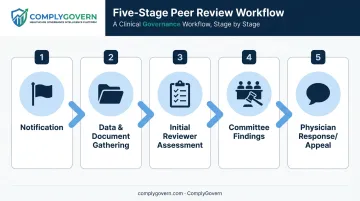
Most defensible programs follow a similar sequence:
- Notification: the case is flagged and the reviewer(s) assigned
- Data and document gathering: records, notes, and relevant clinical guidelines are compiled
- Initial reviewer assessment: the case is scored against defined criteria
- Committee findings: the review body evaluates the assessment and reaches a determination
- Physician response/appeal opportunity: the provider can respond before the file closes
Getting the trigger criteria right at the front end determines whether this workflow surfaces the right cases at all. NAMSS's 2025 roundtable on clinical peer review identified root-cause analysis results, patient complaints, quality and risk reports, and leadership referrals as the most common professional-review triggers. That list doubles as a useful checklist when building your own criteria.
Best Practices & Legal/Regulatory Considerations
Best Practices for a Fair, Effective Program
Two practices separate high-functioning peer review programs from ones that generate resentment and non-participation:
- Use multidisciplinary reviewer panels. Single-reviewer scoring is unreliable, as the 0.26 kappa finding above shows, so standardized training helps align how clinicians interpret the same case.
- Build a performance-improvement culture, not a disciplinary one. Physicians who see peer review as punitive stop engaging honestly, so frame findings around learning and system fixes instead of blame.
Legal & Regulatory Safeguards
The Health Care Quality Improvement Act (HCQIA) of 1986 provides the federal foundation for peer review immunity. But that immunity isn't automatic. Under 42 U.S.C. § 11112, a professional review action qualifies for immunity from damages only when it meets four conditions:
- Taken in the reasonable belief it furthers quality health care
- Made after reasonable fact-finding
- Preceded by adequate notice and a fair hearing process
- Warranted by the known facts
Miss any of these, and the immunity shield weakens. The 1988 Supreme Court case Patrick v. Burget underscored this reality: the Court found Oregon hadn't actively supervised a hospital's peer review process, so state antitrust immunity didn't apply. The lesson still holds: procedural rigor is what protects the process. Automated audit trails and version-controlled documentation, features built into medical staff governance platforms like ComplyGovern, make it easier to demonstrate that rigor if immunity is ever challenged.
State peer review privilege statutes add another layer, shielding documentation from discovery, but only when the process follows the organization's own bylaws and confidentiality protocols. California, Texas, and Florida each protect different scopes of records with different exceptions, so a one-size-fits-all confidentiality clause won't cut it. Legal review at the state level remains necessary.
Streamlining Peer Review Documentation with ComplyGovern
Unifying Peer Review Documentation with ComplyGovern
Fragmented peer review documentation (spreadsheets in one department, shared drives in another, PDFs nobody's updated in years) creates real audit exposure. When a surveyor asks for a complete case trail, "give us a few days to pull it together" isn't the answer anyone wants to give.
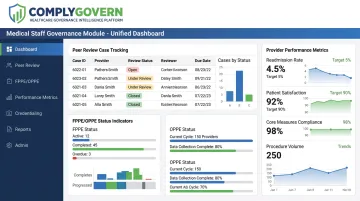
ComplyGovern's Medical Staff Governance module brings peer review management, FPPE, OPPE, and provider performance dashboards into one governed system rather than scattered files. Because it sits inside ComplyGovern's broader Governance Intelligence Engine, peer review documentation connects to the same evidence, policy, and reporting chain used across Quality, Risk, and Compliance. Each department works from that same record, rather than recreating its own version.
That matters for three groups:
- Medical Staff Offices get committee actions, bylaws references, and credentialing data in one place
- Executive leadership and boards gain real-time visibility into governance trends alongside broader compliance and quality data, without waiting for quarterly reports
- Compliance teams receive audit logging, role-based access, and encryption built into the platform's HIPAA-aligned architecture, keeping peer review records protected without separate security configuration
If your Medical Staff Office is still assembling case files from five different systems before every survey, it's worth seeing what a unified record looks like. You can request a demonstration to walk through the Medical Staff Governance module directly.
Frequently Asked Questions
What are the 5 key elements of peer review?
The five core structural elements are case and physician identification, review criteria and standards of care, findings and analysis, recommendations with an action plan, and reviewer sign-off with a confidentiality statement.
What is the 3-2-1 peer review?
"3-2-1" generally refers to a simplified tiered scoring rubric (for example: meets standard, minor deviation, significant concern) used to quickly and consistently categorize case outcomes during review.
What is the golden rule of peer review?
The golden rule is objective, evidence-based evaluation focused on performance improvement, not punitive judgment. Reviews that feel disciplinary tend to erode physician participation over time.
What's the difference between FPPE and OPPE?
FPPE is a time-limited evaluation triggered by new privilege requests or specific safety concerns. OPPE is ongoing, periodic monitoring of a provider's existing practice across their full privilege scope.
Is physician peer review documentation confidential?
Yes, in most cases. Peer review records are protected under state peer review privilege statutes and, for qualifying actions, HCQIA — but only when the process follows the organization's own bylaws and procedures.
How often should physician peer reviews be conducted?
Frequency depends on institutional policy and accreditation requirements. OPPE cycles are organization-defined, while FPPE is triggered by specific events like new privilege requests or identified concerns.