Introduction
Compliance audits in 2026 rarely stop at IT security. Healthcare organizations juggle HIPAA, GDPR, PCI DSS, SOC 2, and CMS Conditions of Participation, often all at once, often with the same three-person compliance team.
Manual, spreadsheet-based audit tracking can't keep up. Missed policy reviews, stale evidence folders, and last-minute survey scrambles create real risk, and real fatigue.
The market is responding fast. Grand View Research values the enterprise governance, risk, and compliance (GRC) software market at $82.9 billion in 2026, up from $72.4 billion the year before, and projects it will reach $203.7 billion by 2033.
Below, we break down the 10 platforms worth your attention this year, and how to pick the right one for your industry.
TL;DR
- Compliance audit software automates evidence collection, risk assessment, and audit-ready reporting
- Generic GRC platforms suit IT teams, but healthcare needs frameworks mapped to CMS and HIPAA
- Prioritize framework coverage, automation depth, and integrations over brand recognition
- This list ranks the top 10 tools for 2026, including ComplyGovern, built for healthcare governance
Overview of Compliance Audit Software in 2026
Compliance audit software centralizes the evidence, controls, and regulatory tracking that used to live across shared drives, email threads, and departmental binders. It gives teams one place to prove they're following the rules, instead of assembling proof under deadline pressure.
Complexity is the real driver here. More than 40% of organizations still lack a centralized system for risk and compliance data, according to Hyperproof's IT Risk and Compliance Benchmark research, leaving them stitching together multiple overlapping frameworks by hand.
The list below covers two categories: general enterprise platforms built for IT, security, and finance compliance teams, and industry-specific solutions, including healthcare governance software mapped to CMS and accreditation standards.
Top 10 Compliance Audit Software and Tools for 2026
We evaluated each platform on framework coverage, automation depth, industry fit, integration ecosystem, and verified customer trust.
ComplyGovern
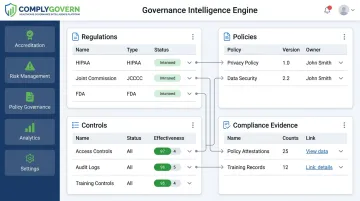
ComplyGovern is a healthcare compliance and governance platform that unifies nine disciplines, including regulatory compliance, accreditation readiness, quality management, risk, policy governance, and AI governance, into one system of record. Its Governance Intelligence Engine automatically links regulations and accreditation standards to internal policies, controls, and the evidence that proves compliance.
That linkage matters during a survey. If a regulation changes, the update flows through policies, controls, and corrective actions without anyone manually chasing down every affected document. The platform integrates natively with Epic, Oracle Health, MEDITECH, and athenahealth, and runs on Microsoft 365 and SharePoint with HIPAA-aligned security.
| Category | Details |
|---|---|
| Best For | Hospitals, health systems, ASCs, and all CMS-recognized facility types needing continuous accreditation and regulatory readiness |
| Key Features | Unified governance across nine disciplines, automated evidence collection, real-time executive/board dashboards, HIPAA-aligned security |
| Differentiator | Replaces fragmented spreadsheets and departmental apps with one connected system from boardroom to bedside |
AuditBoard
AuditBoard built its name as an enterprise risk and audit management platform used widely across finance and healthcare. Centralized dashboards, automated workflows, and real-time risk monitoring make it a strong fit for organizations managing complex, overlapping regulatory obligations.
| Category | Details |
|---|---|
| Best For | Large enterprises with complex, multi-framework regulatory obligations |
| Key Features | Automated audit trails, third-party integrations, real-time reporting |
| Reviews | 4.7/5 on Capterra, based on 414 reviews |
Vanta
Vanta automates SOC 2, ISO 27001, HIPAA, and GDPR audit prep through continuous control monitoring. Its pre-built compliance templates and automated evidence checks give fast-moving, tech-forward teams a shortcut through audit season.
| Category | Details |
|---|---|
| Best For | Startups and SaaS companies needing simplified multi-framework compliance |
| Key Features | Continuous monitoring, automated security checks, cloud integrations |
| Reviews | 4.2/5 on Capterra, based on 33 reviews |
Drata
Drata automates evidence collection and audit workflows, with pre-configured controls for SOC 2 and ISO 27001 baked in from day one. Built-in collaboration tools keep engineering, security, and compliance teams working from the same evidence pool instead of chasing each other over email.
| Category | Details |
|---|---|
| Best For | SaaS businesses handling sensitive customer data |
| Key Features | Automated evidence collection, real-time alerts, pre-configured controls |
| Reviews | 4.8/5 on Capterra, based on 6 reviews |
Hyperproof
Hyperproof is a cloud-based compliance and audit management platform designed to give teams real-time insight into their regulatory posture. It connects tasks, evidence, and teams so compliance work happens continuously instead of in scattered bursts before each audit.
| Category | Details |
|---|---|
| Best For | Mid-to-large enterprises needing continuous, cross-team compliance monitoring |
| Key Features | Automated evidence tracking, compliance dashboards, SIEM integrations |
| Reviews | No verified rating is available at publication; request current reviews directly from Hyperproof |
LogicGate Risk Cloud
LogicGate takes a low-code approach to risk and compliance automation, letting organizations build workflows around their own processes instead of forcing them into rigid templates. That flexibility appeals to regulated industries like finance, healthcare, and manufacturing, where compliance requirements rarely fit a one-size-fits-all mold.
| Category | Details |
|---|---|
| Best For | Regulated industries needing customizable compliance frameworks |
| Key Features | Automated risk assessments, third-party risk monitoring, enterprise integrations |
| Reviews | 4.7/5 on Capterra, based on 83 reviews |
Diligent (Diligent One Platform)
Diligent combines AI-powered analytics with governance and board reporting, aiming squarely at internal audit teams modernizing beyond spreadsheet-based sampling. Its roll-forward audit reuse and 100% transaction-coverage analytics give auditors a fuller picture without redoing prior work from scratch.
| Category | Details |
|---|---|
| Best For | Enterprises modernizing internal audit with AI-driven analytics and board-level reporting |
| Key Features | Automated workflows, roll-forward audit reuse, risk-based planning tools |
| Reviews | 4.4/5 on Capterra, based on 86 reviews |
Qualys Policy Audit
Qualys Policy Audit maps IT environments against 100+ frameworks with continuous, automated technical assessment. Its TruRisk scoring connects compliance gaps directly to exposure and business impact, so remediation gets prioritized by actual risk rather than a flat checklist.
| Category | Details |
|---|---|
| Best For | Large enterprises needing risk-prioritized, continuous compliance across IT infrastructure |
| Key Features | Continuous monitoring, automated ITSM remediation workflows, multi-framework reporting |
| Reviews | No product-specific score is publicly verified; the broader Qualys Cloud Platform holds 4.0/5 on Capterra, based on 33 reviews |
ZenGRC
ZenGRC replaces scattered spreadsheets with a centralized platform for structured compliance and audit tracking. Pre-built framework templates and unified risk dashboards help mid-size teams get organized quickly without a lengthy setup process.
| Category | Details |
|---|---|
| Best For | Mid-size organizations consolidating compliance from fragmented spreadsheets |
| Key Features | Centralized audit tracking, framework templates, risk dashboards |
| Reviews | 4.4/5 on Capterra, based on 27 reviews |
Scytale
Scytale pairs AI-powered automation with dedicated GRC expert support, a combination aimed at teams who want software plus a human backstop. Multi-framework cross-mapping and built-in audit management cut down on the duplicate work that comes from managing SOC 2, ISO 27001, GDPR, and SOX ITGC separately.
| Category | Details |
|---|---|
| Best For | Startups to enterprises managing SOC 2, ISO 27001, GDPR, and SOX ITGC simultaneously |
| Key Features | AI GRC agent, continuous monitoring, customizable Trust Center |
| Reviews | 5.0/5 on Capterra, based on 5 reviews |
How We Chose the Best Compliance Audit Software
The most common mistake buyers make is choosing software based on brand recognition alone, then discovering months later that it doesn't map to their industry's actual requirements. A platform built for SOC 2 startups won't help a skilled nursing facility survive a state survey.
We weighed each platform against:
- Regulatory framework coverage: Maps directly to the standards your organization answers to, not generic checklists.
- Automation and evidence-collection depth: Measures how much manual work each platform removes through automated workflows.
- Integration ecosystem: Checks whether it connects to the systems your team already uses daily.
- Industry specialization: Distinguishes purpose-built platforms from generic templates retrofitted for your sector.
- Verified customer reviews: Draws on user feedback about reduced audit prep time and usability.
Choosing Compliance Audit Software for Healthcare Organizations
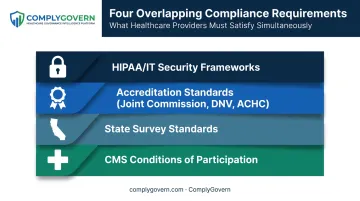
Healthcare compliance audits are a different animal entirely. Providers must satisfy a stack of overlapping requirements at once:
- CMS Conditions of Participation
- State survey standards
- Accreditation standards from bodies like The Joint Commission, DNV, and ACHC
- HIPAA and general IT security frameworks
Why generic GRC tools fall short
Most GRC platforms were built for IT and security teams tracking SOC 2 or ISO 27001. They aren't built to map internal policies to CMS facility-type requirements or accreditation-specific survey standards. That gap forces compliance teams back into spreadsheets to fill in what the software can't do.
CMS itself only grants deemed status to accreditors whose standards meet or exceed Medicare requirements and whose survey processes are comparable. That means any facility's compliance program has to satisfy both federal rules and accreditor-specific expectations simultaneously.
The shift to continuous readiness
Healthcare organizations are moving away from reactive, last-minute audit prep toward continuous survey readiness. Both The Joint Commission and DNV emphasize embedding quality and safety into daily operations, rather than treating survey prep as an annual scramble. This shift reduces organizational risk and directly supports better patient safety outcomes.
ComplyGovern's unified governance model addresses exactly this challenge, connecting compliance, accreditation, quality, risk, and policy management in one platform with native integrations to Epic, Oracle Health, MEDITECH, and athenahealth. Rather than pulling evidence from six disconnected systems before a survey, teams work from one continuously updated source.
Executive and board visibility matters too
Boards and C-suite leaders need a single source of truth rather than a summary hand-compiled the week before a board meeting. Real-time dashboards that surface accreditation readiness, open findings, and enterprise risk give leadership the same visibility compliance teams have, closing a gap that often leaves boards discovering problems too late.
Conclusion
The right compliance audit software matches your operational goals and industry complexity, not brand recognition or market share. A tool built for SaaS security compliance won't serve a hospital's survey needs, and vice versa.
Before committing to any platform, evaluate its scalability, its framework coverage, and its total cost against the audit prep hours it will realistically save you.
If you're a healthcare compliance or quality leader looking for continuous, unified audit and accreditation readiness, explore what ComplyGovern can do for your organization.
Frequently Asked Questions
What is the best audit software?
It depends on your industry. ComplyGovern is purpose-built for healthcare governance and accreditation readiness, while platforms like Vanta and Drata are strong choices for SOC 2 and IT security compliance.
What is the difference between compliance audit software and GRC software?
GRC software covers broader governance and risk management across an organization. Compliance audit software focuses more narrowly on evidence collection, control validation, and audit-ready reporting, and can operate as a module inside a larger GRC system.
How much does compliance audit software typically cost?
Pricing varies widely based on company size, number of frameworks tracked, and automation depth. Most vendors, including Vanta and Drata, require a consultation for a personalized quote rather than publishing fixed rates.
Can compliance audit software support healthcare-specific frameworks like CMS and HIPAA?
Yes, but not every platform does it well. Specialized tools like ComplyGovern map policies directly to CMS facility types, accreditation standards, and HIPAA, something generic GRC tools typically can't do out of the box.
How often should a compliance audit be performed?
Formal audit frequency depends on the specific framework and regulator involved. That said, continuous monitoring throughout the year, rather than periodic check-ins, is the best way to avoid last-minute compliance gaps.
What features should I look for in compliance audit software?
Prioritize framework mapping specific to your industry, automated evidence collection, risk prioritization, integrations with your existing systems, and continuous (not just point-in-time) monitoring capabilities.